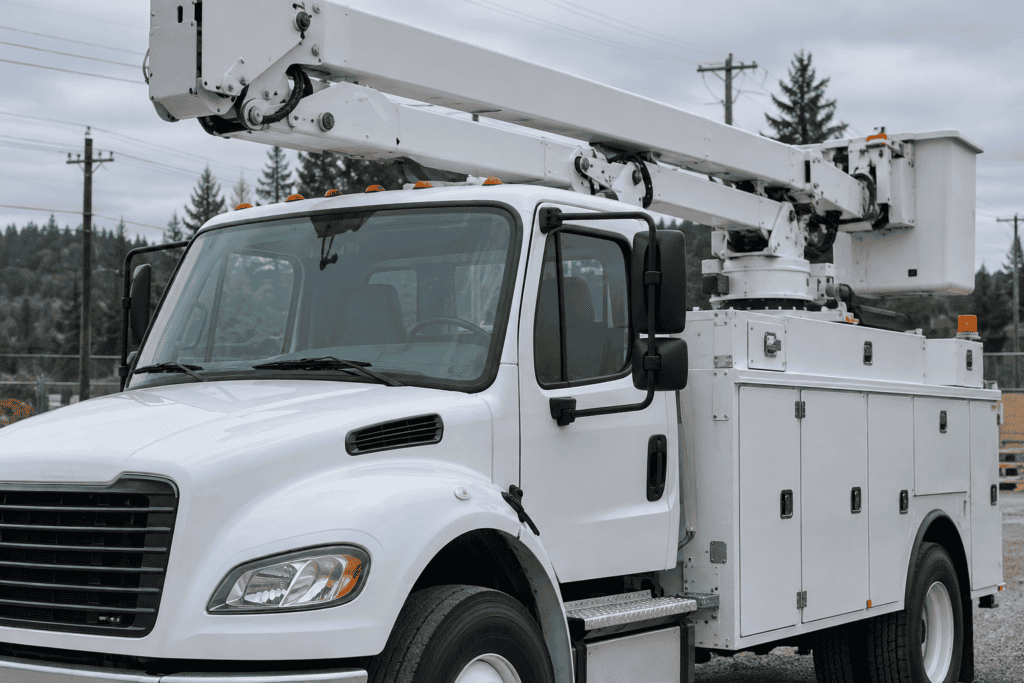
Quick Answer: Yes. Utility service vehicles are exempt from federal hours-of-service rules under 49 CFR §395.1(n) and from certain CDL requirements, but they are not exempt from the annual inspection. 49 CFR §396.1 lists only two exemptions from Part 396 — covered farm vehicles and pipeline welding trucks — and utility service vehicles appear on neither list. A bucket truck, line truck, digger derrick, or service rig with a gross vehicle weight rating of 10,001 pounds or more needs a periodic inspection every 12 months under §396.17, performed by an inspector qualified under §396.19. And the aerial device on top is governed by a different standard entirely, not by Part 396.
The utility service vehicle exemption is real and it is generous. It relieves drivers from federal and state hours-of-service limits, which is why line crews can respond to an outage without running out of hours. That exemption is well known in the industry, and it creates a reasonable but incorrect assumption: that utility vehicles sit outside the FMCSRs generally.
They do not. This guide covers exactly what the exemption reaches, what it leaves untouched, and what a utility or telecom fleet actually owes on the inspection side.
What Is a Utility Service Vehicle Under Federal Law?
49 CFR §395.2 defines it, and the definition is broader than most people expect. A utility service vehicle means any commercial motor vehicle:
“(1) Used in the furtherance of repairing, maintaining, or operating any structures or any other physical facilities necessary for the delivery of public utility services, including the furnishing of electric, gas, water, sanitary sewer, telephone, television cable or community antenna service, and broadband-internet and cellular telephone operations;
(2) While engaged in any activity necessarily related to the ultimate delivery of such public utility services to consumers, including travel or movement to, from, upon, or between activity sites (including occasional travel or movement outside the service area necessitated by any utility emergency as determined by the utility provider); and
(3) Except for any occasional emergency use, operated primarily within the service area of a utility’s subscribers or consumers…”
— 49 CFR §395.2
Note what the definition captures. Electric, gas, water, sanitary sewer, telephone, cable, broadband-internet, and cellular telephone operations are all named. That reaches investor-owned utilities, rural electric cooperatives, municipal water and sewer departments, telecom providers, cable companies, and the contractors performing that work.
Note also the first three words: “any commercial motor vehicle.” The definition starts by confirming these are commercial motor vehicles. It creates an exemption for certain rules, not a separate category outside the FMCSRs.
What the Utility Service Vehicle Exemption Actually Covers
The exemption comes from the National Highway System Designation Act of 1995, implemented by FHWA in a final rule published April 3, 1996. That rule is explicit about its scope: the exemptions it created for agricultural operations, ground water drilling rigs, construction materials and equipment, utility service vehicles, and snow and ice removal equipment relate to the hours-of-service and the commercial driver’s license requirements of the regulations.
Two things, and only two:
Hours of service — §395.1(n). Drivers of utility service vehicles are exempt from Part 395. FMCSA has confirmed this is broad, stating in published guidance that utility service vehicles as defined in §395.2 are exempt from both Federal and State hours-of-service regulations, and that drivers can respond to a downed power line without complying with either.
Commercial driver’s license — §383.3(d)(3). A related exemption applies on the licensing side.
That is the full extent of it. The 1996 rule did not touch Part 396, and no subsequent rulemaking has added utility service vehicles to the inspection exemptions.
What Part 396 Actually Exempts — The Complete List
This is the section to read if you take nothing else from this page. 49 CFR §396.1 is the scope provision for the entire inspection, repair, and maintenance part, and it names exactly two exemptions:
“(c) This part does not apply to ‘covered farm vehicles,’ as defined in 49 CFR 390.5, or to the drivers of such vehicles.
(d) The rules in this part do not apply to ‘pipeline welding trucks’ as defined in 49 CFR 390.38(b).”
— 49 CFR §396.1
Covered farm vehicles and pipeline welding trucks. That is the list.
Utility service vehicles are not on it. Neither are construction vehicles, snow removal equipment, ground water drilling rigs, or any of the other categories that received hours-of-service relief under the 1995 Act.
The contrast with farm vehicles is instructive. §390.39 gives covered farm vehicles a genuinely comprehensive exemption — from CDL requirements in Part 383, controlled substances and alcohol testing in Part 382, physical qualifications in Part 391 Subpart E, hours of service in Part 395, and inspection, repair, and maintenance in Part 396. That is what a broad exemption looks like when Congress writes one.
Utility service vehicles got hours of service and CDL. They did not get Part 396.
If that is the answer you came for: your utility vehicles over 10,001 pounds need an annual inspection every 12 months, performed by someone qualified under §396.19. Our course covers that qualification, and group registration covers a whole shop. The rest of this page is the detail.
So Does My Bucket Truck Need an Annual Inspection?
If it meets the commercial motor vehicle definition in 49 CFR §390.5, yes — every 12 months under §396.17, against the criteria in Appendix A to Part 396.
The threshold that matters is 10,001 pounds gross vehicle weight rating or gross combination weight rating, whichever is greater. Most utility equipment clears it comfortably:
| Vehicle | Annual inspection? | Why |
|---|---|---|
| Bucket truck / aerial lift | Yes if 10,001+ | Most medium-duty aerial units run 19,000–33,000 lbs GVWR |
| Line truck / digger derrick | Yes | Well above the threshold |
| Cable / telecom splicing van | Check the GVWR | Often 9,000–14,000 lbs — the band where it goes either way |
| Service truck towing a trailer | Often yes | Judged on gross combination rating — a 9,900 lb truck plus a 6,000 lb reel trailer is 15,900 lbs |
| Any trailer over 10,001 lbs | Yes, separately | §396.17(a) treats each unit of a combination as its own vehicle |
| Vac truck / hydro excavator | Yes | Typically 33,000–66,000 lbs |
Two rows deserve emphasis. The telecom splicing van sits in the 10,001–26,000 pound band where the annual inspection applies but no CDL is required — the gap where fleets most often assume they are outside the rules. And the service-truck-plus-trailer row catches operations that never think of themselves as running commercial vehicles at all.
For the full scope question, see what vehicles require a DOT annual inspection.
The Aerial Device Is a Separate Inspection Entirely
This one causes genuine confusion in utility fleets, and the two requirements are frequently conflated.
Part 396 governs the vehicle. Brakes, steering, suspension, tires, lighting, frame, coupling devices, fuel and exhaust systems — the components in Appendix A to Part 396. That is the DOT annual inspection.
The aerial device is governed separately. Vehicle-mounted elevating and rotating aerial devices fall under the ANSI/SIA A92.2 standard and the applicable OSHA requirements, which carry their own inspection and maintenance obligations. Boom condition, insulation testing on insulated units, load capacity, hydraulics, and outriggers are not Appendix A items.
Neither substitutes for the other. A current aerial device inspection does not satisfy §396.17, and a DOT annual inspection does not cover the boom. A utility fleet needs both, on separate schedules, documented separately.
This matters practically because it is easy to have one and assume you have the other. A shop that meticulously maintains its aerial devices may have no §396.17 documentation at all, because the crew associates “the inspection” with the lift rather than the truck.
Who Can Perform the Inspection?
A person qualified under 49 CFR §396.19. There is no federal DOT inspector certification and no agency issues one — the motor carrier qualifies its own inspectors and retains the evidence on file under §396.19(b).
Under §396.17(d) a carrier may perform its own annual inspections in-house, or under §396.17(e) use a commercial garage or similar business as its agent. Either way the carrier holds the qualification record.
The §396.19(a)(3) standard has two routes: a Federal- or State-sponsored training program or a qualifying state certificate, or a combination of training and/or experience totaling at least one year.
For a utility fleet this usually points one direction. Most utility and telecom operations already run their own maintenance shop with experienced technicians — the experience half of §396.19(a)(3)(ii) is already there. What is typically missing is documented training in the federal inspection standards, which is the piece an auditor asks for.
See who can perform DOT annual inspections, our guide to FMCSA §396.19, and for the manager’s view, DOT inspection training for fleet mechanics.
Brakes Carry a Second, Separate Qualification
Every annual inspection includes the brake system, and brakes have their own requirement under 49 CFR §396.25. It is not part of §396.19. It applies to anyone who inspects, maintains, services, or repairs brakes on a commercial motor vehicle, with its own evidence and its own retention period.
A CDL air brake endorsement does not satisfy §396.25 — FMCSA has stated that directly. See does a CDL air brake endorsement make you a qualified brake inspector, 396.19 vs 396.25, and our DOT air brake certification requirements guide.
The enforcement record justifies the emphasis. In CVSA’s 2026 International Roadcheck, inspectors conducted 54,575 inspections and placed 10,350 vehicles out of service — 19% — with brake system violations accounting for 3,379 out-of-service findings, 24.3% of the vehicle total and the largest single category. See why trucks fail DOT inspections.
Public, Private, and the “Service Area” Trap
Three jurisdiction questions come up constantly in utility fleets. Here are all three in one place.
1. “We only work inside our service area, so we’re intrastate.” The §395.2 definition requires the vehicle be operated primarily within the service area of a utility’s subscribers or consumers, and that sounds like a description of a purely local operation. It is not a jurisdictional statement — it is a condition of the hours-of-service exemption. Interstate commerce also reaches transportation occurring entirely within one state when it is part of a larger movement. And most states have adopted the FMCSRs for intrastate carriers anyway, sometimes at lower thresholds: Washington at 10,001 pounds in interstate or intrastate commerce, North Carolina above 10,000 pounds GVWR, Georgia under O.C.G.A. § 40-1-8.
2. “We’re a city department.” Under §390.3(f)(2), the FMCSRs in Parts 390 through 399 do not apply to transportation performed by the Federal government, a State, or any political subdivision. A municipal water, sewer, or electric utility operating its own vehicles generally falls outside the federal requirements. Two cautions: the exemption covers transportation performed by the public body, not a private contractor working for it, and many states apply their own inspection rules to public fleets regardless. Plenty of municipal fleets qualify inspectors anyway as a risk-management matter.
3. “Our state has its own program.” Some do, and it changes the answer. Texas and Pennsylvania require state-registered commercial vehicles to use certified state stations. California runs a 90-day cycle. Minnesota covers self-propelled special mobile equipment on a commercial chassis over 26,000 pounds — language that reaches a lot of utility equipment. Illinois maintains a separate public utility exemption procedure under 92 Ill. Adm. Code Part 386, Subpart C, though it applies only to utilities not already subject to the FMCSRs.
Most states — including Georgia, North Carolina, Florida, Washington, and Ohio — run no approved program, leaving the federal self-inspection route fully open. See do state DOT inspection requirements replace the federal annual inspection.
What Records Does a Utility Fleet Need?
| Record | Regulation | Retention |
|---|---|---|
| Annual inspection report | §396.21(b)(1) | 14 months |
| Inspector qualification evidence | §396.19(b) | Service + 1 year |
| Brake inspector qualification | §396.25(e) | Employment in role + 1 year |
| Driver vehicle inspection report | §396.11(a)(4) | 3 months |
| Aerial device inspection | ANSI/SIA A92.2, OSHA | Separate — not a Part 396 record |
Documentation of the current inspection must also be on the vehicle, either the §396.21(a) report or a decal carrying the four items §396.17(c)(2) requires. See what goes on the truck and what stays in the file, our FMCSA inspector qualifications form guide, and DVIR requirements under §396.11.
How Many People Actually Need Qualifying?
More than most utility fleets assume, and the arithmetic is worth doing before you qualify anyone.
Every person who signs an annual inspection report needs §396.19 qualification. Not the shop, not the company — the individual whose name goes on the §396.21(a) report. If three technicians across two service centers sign inspections, all three need documented qualification on file.
And every person who touches brakes needs §396.25 qualification, which is a wider group. That reaches technicians who adjust brakes during routine service and never sign an annual inspection at all.
Utility fleets tend to be geographically distributed in a way that multiplies this. A regional electric cooperative or telecom operation with service centers in four towns cannot route every bucket truck to one qualified inspector — the equipment is where the crews are.
Three practical consequences:
- A single qualified inspector is a single point of failure. Storm season, illness, or a resignation and your inspections stop, while the 12-month clock under §396.17 keeps running on every unit.
- Records created piecemeal come out inconsistent. Different completion dates, different providers, different formats. During a compliance review, the auditor asks for qualification evidence on every inspector who signed in the review period, and a file assembled over eighteen months rarely produces cleanly.
- Each trailer counts as its own vehicle. Under §396.17(a), a service truck and a reel trailer are two inspections, two reports, two sets of documentation. Fleets consistently undercount their inspection obligation for exactly this reason.
Qualifying the team together solves all three. Everyone completes the same curriculum, the records are created at the same time in the same format, and no one location depends on a person who might not be there.
What Happens If You Don’t Have One
Operating without a current annual inspection is among the most commonly cited vehicle maintenance violations in the federal enforcement system.
Section §396.17(h) subjects the motor carrier or intermodal equipment provider to the penalty provisions of 49 U.S.C. 521(b). Beyond the civil penalty, a vehicle without documentation of a current inspection can be placed out of service at roadside — which for a utility fleet means a bucket truck stranded away from the yard, mid-job.
The violation also feeds the Vehicle Maintenance categories in CSA, which affect your safety profile and insurance renewals. FMCSA has announced an enhanced Safety Measurement System that reorganizes the existing 959 roadside violations into 116 violation groups — fewer, broader categories mean each violation carries more weight. FMCSA set out the enhancements in a November 20, 2024 Federal Register notice (89 FR 91874), and said the launch date of the enhanced SMS website would be announced in a follow-up notice. See DOT compliance enforcement in 2026.
And for a contractor with new operating authority, the stakes are sharper. Under 49 CFR §385.321(b), using a commercial motor vehicle that has not been periodically inspected is one of sixteen violations that cause automatic failure of the new entrant safety audit, triggered when 51% or more of examined records show it. Two other Part 396 violations on that list need only a single occurrence. See the FMCSA new entrant safety audit.
Why Utility Fleets Get Caught
Three things combine. The hours-of-service exemption is genuinely broad, so it is reasonable to assume it reaches further than it does. Most utility equipment sits below the 26,001-pound CDL threshold but above the 10,001-pound inspection threshold, so fleets reason from “we don’t need CDLs” to “the DOT rules don’t apply.” And maintenance attention goes to the aerial device, because that is where the acute safety risk is — the chassis underneath is easy to treat as just a truck.
The result is an operation with meticulous aerial device records and nothing in the file proving the annual inspection was performed by a qualified person. Under §396.19(b), that record is the carrier’s obligation — and a qualified technician with no documentation is, to an auditor, an unqualified technician.
Qualify the shop, not one technician.
Utility and telecom operations almost always run their own maintenance, which means the experience half of §396.19(a)(3)(ii) is already covered. What an auditor asks for is documented training in the federal standards — and they ask for it for every person who signed an inspection, not just your lead tech.
That is why qualifying one person is usually the wrong shape. If your designated inspector is on a storm call, out sick, or leaves, the inspections stop. And technicians qualified individually over months produce inconsistent records — different dates, different formats, some files complete and some missing the carrier certification. Uniform documentation across every service center is what makes a compliance review straightforward instead of painful.
Group registration covers your whole maintenance team in one enrollment, with volume discounts at 3, 6, and 11 users. Everyone trains on the same standards, and every file comes out identical. Each person receives:
- Certificate of completion — documented training under §396.19(a)(3)(ii)(A)
- Inspector qualification form — the §396.19(b) record your organization retains
- Inspection checklist — for performing and recording annual inspections
100% online and self-paced, so nobody loses a day of field time. The qualification does not expire.
Qualifying one person? Single enrollment is here.
For the step-by-step path, see how to get certified to do DOT inspections, and if you’re setting up a new operation, the FMCSA new entrant safety audit.
Frequently Asked Questions
Are utility service vehicles exempt from DOT annual inspections?
No. 49 CFR §396.1 lists only two exemptions from Part 396: covered farm vehicles as defined in §390.5, and pipeline welding trucks as defined in §390.38(b). Utility service vehicles are not exempt from the annual inspection requirement, even though they are exempt from hours of service under §395.1(n) and from certain CDL requirements under §383.3(d)(3).
What does the utility service vehicle exemption actually cover?
Hours of service and commercial driver’s licensing. The exemption originates in the National Highway System Designation Act of 1995, and the implementing rule published April 3, 1996 states that the exemptions relate to the hours-of-service and the commercial driver’s license requirements of the regulations. FMCSA guidance confirms the hours-of-service exemption reaches both federal and state rules. It does not extend to Part 396 inspection, repair, and maintenance.
Does a bucket truck need a DOT annual inspection?
Yes, if it meets the commercial motor vehicle definition in 49 CFR §390.5 — generally a gross vehicle weight rating or gross combination weight rating of 10,001 pounds or more. Most medium-duty bucket trucks run between 19,000 and 33,000 pounds GVWR, well above the threshold, and need a periodic inspection every 12 months under §396.17.
Does the aerial device inspection count as the DOT inspection?
No. They are separate requirements under separate authorities. Part 396 and Appendix A govern the vehicle — brakes, steering, suspension, tires, lighting, frame, and the other chassis components. The aerial device itself falls under the ANSI/SIA A92.2 standard and applicable OSHA requirements, which carry their own inspection obligations. A current aerial device inspection does not satisfy §396.17, and a DOT annual inspection does not cover the boom.
Do telecom and cable company vehicles fall under this?
Yes. The §395.2 definition of utility service vehicle expressly includes telephone, television cable or community antenna service, and broadband-internet and cellular telephone operations. Those vehicles receive the hours-of-service exemption and remain subject to the Part 396 annual inspection requirement if they meet the §390.5 commercial motor vehicle definition.
What about municipal water, sewer, or electric departments?
Under §390.3(f)(2), the FMCSRs in Parts 390 through 399 do not apply to transportation performed by the Federal government, a State, or any political subdivision of a State. A publicly owned utility operating its own vehicles generally falls outside the federal requirements. Two cautions: the exemption covers transportation performed by the public body, not a private contractor working for it, and many states apply their own inspection requirements to public fleets regardless.
We only operate inside our service area — are we intrastate and therefore exempt?
Probably not. The “operated primarily within the service area” language in §395.2 is a condition of the hours-of-service exemption, not a statement about jurisdiction. Interstate commerce also includes transportation occurring entirely within one state when it is part of a larger interstate movement. And most states have adopted the Federal Motor Carrier Safety Regulations for intrastate carriers, sometimes at different weight thresholds, so an intrastate-only utility fleet is usually still subject to the inspection requirement under state law.
My utility trucks don’t need a CDL — does that mean no inspection?
No. The CDL threshold is 26,001 pounds under 49 CFR §383.5. The commercial motor vehicle definition that triggers the annual inspection starts at 10,001 pounds under §390.5. A vehicle between those figures requires a DOT annual inspection while the person driving it needs no CDL, and a great deal of utility and telecom equipment sits in exactly that band.
Who can perform the annual inspection on a utility fleet?
Anyone qualified under 49 CFR §396.19, which can be your own shop technician under §396.17(d) or a commercial garage acting as your agent under §396.17(e). No federal agency issues a DOT inspector certification; the motor carrier determines qualification and retains the evidence under §396.19(b). Most utility shops already satisfy the experience component of §396.19(a)(3)(ii) and need documented training in the federal standards to complete it.
How many technicians in a utility fleet need to be qualified?
Every person who signs an annual inspection report needs §396.19 qualification, and every person who inspects, maintains, services, or repairs brakes needs separate §396.25 qualification. Qualification attaches to the individual, not the shop. For a fleet with service centers in multiple locations, that usually means several technicians rather than one designated inspector, since equipment cannot be routed across the service territory for every inspection.
Should we qualify one inspector or the whole shop?
Qualifying a single person creates a single point of failure — if that technician is unavailable, inspections stop while the 12-month clock under §396.17 keeps running. Training the team together also produces uniform records created at the same time in the same format, which is what makes them straightforward to produce during a compliance review. Records assembled individually over months tend to be inconsistent, and inconsistency is what auditors find.
What happens if a utility vehicle has no current annual inspection?
Section §396.17(h) subjects the motor carrier to the penalty provisions of 49 U.S.C. 521(b), and a vehicle without documentation of a current inspection can be placed out of service at roadside. The violation also feeds the Vehicle Maintenance categories in CSA, affecting safety profile and insurance. For a contractor with new operating authority, using a vehicle that has not been periodically inspected is one of sixteen violations causing automatic failure of the new entrant safety audit under §385.321(b).
The Bottom Line
The utility service vehicle exemption is real, broad, and limited to two things: hours of service under §395.1(n) and commercial driver’s licensing under §383.3(d)(3). It does not reach Part 396.
Section §396.1 exempts covered farm vehicles and pipeline welding trucks from the inspection rules. That is the complete list. If your bucket truck, line truck, digger derrick, splicing van, or service rig meets the §390.5 definition at 10,001 pounds, it needs an annual inspection every 12 months performed by a §396.19-qualified inspector — and the aerial device on top needs its own, separate inspection under a different standard.
For most utility and telecom fleets the fix is straightforward, because the shop and the experience are already there. What is missing is documented training and a qualification record in the file.
Volume discounts at 3, 6, and 11 users. Or enroll a single technician.
About the Author
Josh Lopez has spent more than 10 years in trucking and freight, working across shippers, carriers, brokerage, and reefer LTL. He founded dotinspectioncourse.com to give mechanics, owner-operators, and fleet managers accurate, regulation-first training on 49 CFR Part 396. Every regulatory citation on this site is verified against the current primary source before publication.