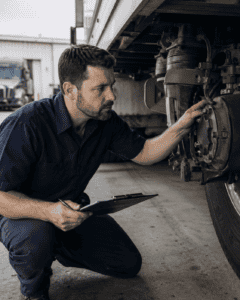
Does a CDL air brake endorsement qualify you as a brake inspector?
No, and FMCSA has answered this question in writing. In its published regulatory guidance for 49 CFR 396.25, the agency was asked whether a CDL with an air brake endorsement qualifies a person as a brake inspector. The answer given was a single word: no. That is worth pausing on, because the regulation itself does mention the CDL air brake test. The two are not in conflict, and understanding why is the whole point of this article.There is no such thing as an air brake endorsement
Start with the terminology, because the confusion begins here. The CDL does not have an air brake endorsement. It has an air brake restriction. If you take your CDL skills test in a vehicle without air brakes, or you fail the air brake knowledge test, you get an L restriction on your license that prohibits you from operating a commercial vehicle with air brakes. Passing the air brake knowledge and skills test removes that restriction. So the CDL air brake test is not a credential you earn. It is a limitation you avoid. It establishes that you can safely operate a vehicle equipped with air brakes. It says nothing about whether you can inspect, adjust, service, or repair the brake system on that vehicle, and those are entirely different skills.What does the CDL air brake test actually count for?
It reaches one narrow task, and it is important to be precise rather than overstating the case in either direction. Section 396.25(d)(3)(i) lists, among the qualifying pathways, a certificate from a state that qualifies a person to perform the assigned brake task, and it specifically includes passage of the CDL air brake tests in the case of a brake inspection. Section 396.25(e) adds that a carrier does not have to maintain evidence of qualifications to inspect air brake systems when the inspection is performed by someone who has passed the CDL air brake knowledge and skills test. Read carefully, that is a narrow allowance for inspecting an air brake system. It is not a general qualification. Here is what it does not reach: Brake maintenance, service, or repairs. Section 396.25(b) defines a brake inspector as an employee responsible for ensuring that brake inspections, maintenance, service, or repairs meet the federal standards. The CDL test covers none of the last three. Anything other than air brakes. Hydraulic brake systems are outside it entirely. The annual inspection. That is a separate qualification under 49 CFR 396.19, with its own criteria and its own documentation requirement. This is why FMCSA can point to the CDL test in the regulation and still answer no to the question. The test touches a task. It does not make you a qualified brake inspector.What does 396.25 actually require?
Three things, and all of them must be true. The person must understand the brake service or inspection task and be able to perform it. The person must be knowledgeable of and have mastered the methods, procedures, tools, and equipment used for that task. And the person must be capable of performing it by reason of experience, training, or both, through one of these routes: The program route. Successful completion of an apprenticeship program sponsored by a state, a Canadian province, a federal agency, or a labor union, or a training program approved by a state, provincial, or federal agency, or a state certificate qualifying the person for the assigned task. The training and experience route. Brake-related training or experience, or a combination, totaling at least one year. That can be a training program sponsored by a brake or vehicle manufacturer or a similar commercial training program, experience performing brake maintenance or inspection in a motor carrier maintenance program, or the same experience at a commercial garage, fleet leasing company, or similar facility. Notice the number. One year. Not one afternoon, and not one test.Is brake inspector qualification task-specific?
Yes, and this is a nuance most carriers miss. FMCSA guidance confirms that an employee can be qualified to perform brake adjustments without being qualified to perform other brake-related tasks such as repair or replacement. Qualification attaches to the task, not to the person as a blanket status. The practical effect is that a shop cannot qualify a technician once and then assign them anything brake-related. If you widen someone’s duties from adjustment to component replacement, you have to be able to show they are qualified for the new task. One related allowance worth knowing: FMCSA guidance permits a driver without the necessary experience to perform a brake adjustment at a roadside inspection under the direction of a qualified brake adjuster, provided the carrier is willing to assume responsibility for the adjustment being done properly. That is a narrow roadside accommodation, not a general workaround.Who fills out the 396.25 brake inspector qualification form?
The carrier owns the record, and the inspector certifies the content. There is no mandatory federal form. FMCSA publishes a sample Brake Inspector Qualifications form through its Safety Planner, and it is a reasonable template, but any format that captures the required evidence will do. What matters is what the record proves: that the person understands and can perform the task, has mastered the methods and tools, and meets one of the qualification routes, with the supporting detail filled in. The inspector signs to certify the information is accurate. Section 396.25(e) then tells you where it lives. The carrier must maintain the evidence at its principal place of business, or at the location where the brake inspector is employed, for the entire period that person serves as a brake inspector and for one year afterward. No motor carrier may employ a person as a brake inspector unless that evidence is on file. A qualified mechanic with no paperwork is, to an auditor, an unqualified mechanic.How does a diesel technician actually get qualified?
Through training, experience, or a combination totaling at least one year, documented by the employer. For a technician already working in a shop, brake work performed in a motor carrier maintenance program or at a commercial garage counts toward the year. The gap is almost never the skill. It is that nobody wrote it down, and there is no training record showing the person was formally instructed in the federal standards rather than simply picking it up on the job. That is where a commercial training program fits. Section 396.25(d)(3)(ii)(A) expressly recognizes participation in a training program sponsored by a brake or vehicle manufacturer or a similar commercial training program designed to train students in brake maintenance or inspection. A structured course that covers the federal standards and issues a certificate gives the carrier the documented evidence the rule demands, and gives the technician a defensible qualification record instead of a verbal claim. If you also perform annual inspections, you need the separate qualification under 396.19. We cover who is allowed to do those in our guide to who can perform DOT annual inspections, and the full brake requirements in our DOT air brake certification requirements guide.Why this gets caught
Brakes are the single most cited area in commercial vehicle enforcement. According to CVSA, brake-related violations comprise the largest percentage of all out-of-service violations cited during roadside inspections. The numbers from the last dedicated enforcement week are blunt. During Brake Safety Week 2025, inspectors examined 15,175 commercial motor vehicles across North America and placed 2,296 of them out of service for brake-related violations, an out-of-service rate of 15.1%. Roughly one in seven vehicles inspected was pulled off the road. Brake Safety Week 2026 runs August 23 through 29, with inspectors placing special emphasis on brake drums and air disc brake rotors. When a vehicle is inspected and a brake defect surfaces, the question of who was responsible for that brake system, and whether they were qualified, follows immediately behind.The bottom line
A CDL air brake test proves a driver can operate a vehicle with air brakes. It does not make them a qualified brake inspector under 396.25, FMCSA has said so directly, and the qualification it does touch is limited to inspecting the air brake system rather than maintaining, servicing, or repairing it. If your shop or fleet has people doing brake work, the standard is one year of training or experience, matched to the specific tasks assigned, with the evidence on file at your place of business. Assuming the license covers it is exactly the gap auditors look for. Our DOT Annual Inspection Training Course covers the federal standards behind both 396.19 and 396.25, and issues the certificate and training record your qualification file needs. See the full course outline here.Get the Training Record on File
For a working technician, the experience side of the one-year requirement is usually already covered. What is missing is documented proof of formal instruction in the federal standards, and that is the record an auditor asks for.
Our DOT Annual Inspection Training Course covers the federal standards behind both §396.19 and §396.25, built around 49 CFR Part 393 and Appendix A to Part 396. Every enrollment includes three deliverables:
- Certificate of completion — documented training under §396.19(a)(3)(ii)(A) and §396.25(d)(3)(ii)(A)
- Inspector qualification form — the record your carrier retains on file
- Inspection checklist — the working document for performing and recording annual inspections
The course is fully online and self-paced. It is a commercial training program under the training-and-experience route, not a state or federally sponsored program — it supplies the training component and the documentation, which for most technicians is the piece that is missing.
Qualifying more than one mechanic? Group registration with volume discounts is available for shops and fleets.
Frequently Asked Questions
Does a CDL air brake endorsement qualify you as a brake inspector?
No. FMCSA guidance states directly that a CDL with an air brake endorsement does not qualify a person as a brake inspector under 49 CFR 396.25. Passing the CDL air brake test can cover the narrow task of inspecting an air brake system, but it does not cover maintenance, service, or repairs.Is there an air brake endorsement on a CDL?
Not exactly. The CDL has an air brake restriction, not an endorsement. Failing or skipping the air brake test places an L restriction on the license prohibiting operation of vehicles with air brakes. Passing the test removes the restriction.What qualifies someone as a brake inspector under 396.25?
The person must understand the task, have mastered the methods and tools, and qualify through either a state, provincial, federal, or union apprenticeship or approved training program, or through brake-related training or experience totaling at least one year.Can a mechanic be qualified for brake adjustments but not brake repairs?
Yes. FMCSA guidance confirms qualification is task-specific. An employee can be qualified to perform brake adjustments without being qualified to perform other brake tasks such as repair or replacement.Who keeps the brake inspector qualification records?
The motor carrier. Under 396.25(e), the evidence must be maintained at the carrier’s principal place of business or at the location where the brake inspector is employed, for the entire period of service plus one year afterward. No carrier may employ a person as a brake inspector without that evidence on file.Is a brake inspector qualification the same as an annual inspector qualification?
No. Brake inspector qualification falls under 49 CFR 396.25. Annual inspector qualification falls under 49 CFR 396.19. They are separate requirements with separate criteria, and a person performing both needs to satisfy both.Josh Lopez has spent more than 10 years in the trucking and freight industry, working across shippers, carriers, brokerage, and reefer LTL. He writes about DOT compliance, FMCSA regulations, and commercial vehicle inspection to help mechanics, owner-operators, and fleet managers understand the rules that govern their operations and stay compliant on the road.