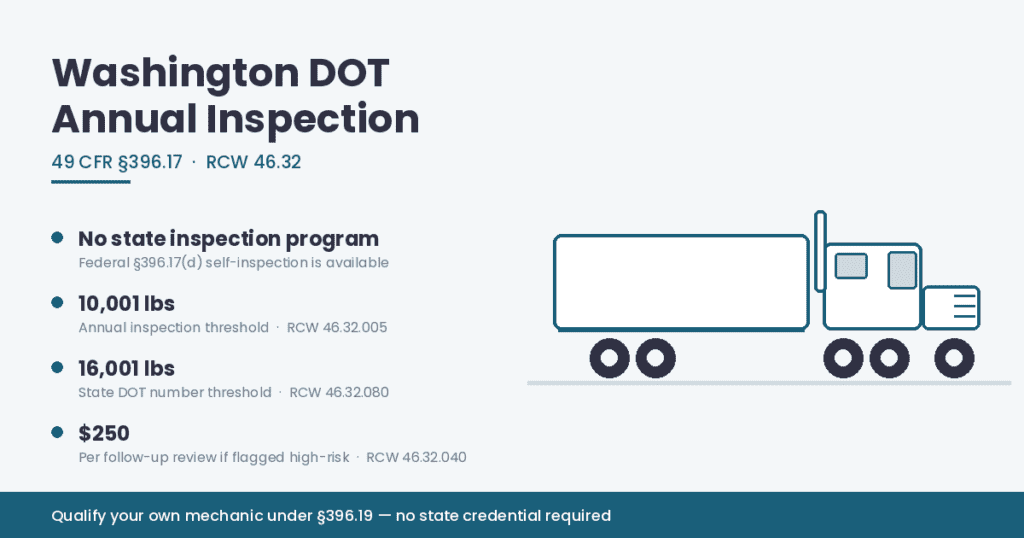
Quick Answer: The Washington DOT annual inspection is the federal annual inspection under 49 CFR §396.17. Washington does not appear on FMCSA’s list of states with approved periodic inspection programs, so §396.23(a)(1) does not bind you and §396.17(d) self-inspection is fully available — a Washington carrier can qualify its own mechanic under §396.19 and inspect its own equipment. But Washington layers a substantial state enforcement statute on top. Under RCW 46.32.085, Washington State Patrol rules must be as rigorous as the federal regulations at 49 CFR Parts 40 and 380 through 397, and RCW 46.32 adds several requirements the federal rules do not have, including a 24-hour re-inspection after damage, a $250 fee for high-risk carrier follow-up reviews, and a statutory penalty schedule with license plate confiscation.
Washington is a state where the federal route is open to you and the state enforcement is unusually specific. Most guides cover one or the other. This one covers both: how the Washington DOT annual inspection actually works, which agency regulates you (there are two, and it depends on what you haul), and the state-only rules a purely federal reading of Part 396 will not tell you about.
Does Washington Require a DOT Annual Inspection?
Yes — through the federal rule.
Every commercial motor vehicle must pass a periodic inspection at least once every 12 months under 49 CFR §396.17, performed against the criteria in Appendix A to Part 396. Each unit of a combination vehicle counts separately — a tractor, semitrailer, full trailer, and converter dolly each need their own inspection and their own report.
Washington’s own statute reinforces it. Under RCW 46.32.010(3), it is unlawful for any vehicle required to be inspected to be operated over the public highways of this state unless and until it has been approved periodically as to equipment.
Is Washington on the FMCSA Approved-Program List?
No — and that is the most important fact for a Washington carrier.
Washington does not appear on FMCSA’s list of states whose periodic inspection programs have been determined comparable to, or as effective as, the federal requirement. States like California, Texas, and Pennsylvania run mandatory programs carriers must route equipment through. Washington does not.
The consequence is financial. Under 49 CFR §396.23(a)(1), a vehicle subject to an approved mandatory state program must satisfy §396.17 through that program. Because no such program applies in Washington, that constraint does not bind you — and §396.17(d), which permits a motor carrier to perform its own annual inspection, is available.
Be precise about what that does and does not mean. It means there is no state station network you are compelled to use and no state inspector credential to obtain. It does not mean Washington is hands-off. RCW 46.32 gives the State Patrol broad authority to inspect at roadside, to conduct compliance reviews, and to place vehicles and carriers out of service. You meet §396.17 the federal way, and Washington enforces it aggressively.
For the national picture, see do state DOT inspection requirements replace the federal annual inspection.
RCW 46.32.085: Washington’s Rules Must Be “As Rigorous As” Federal
This is the provision that ties the two systems together, and almost nobody covers it.
Under RCW 46.32.085(1), the Washington State Patrol, in consultation with the Department of Licensing, must adopt rules regulating vehicle safety requirements for motor carriers who own, control, manage, or operate a commercial motor vehicle in the state. And those rules must be as rigorous as the federal regulations at 49 CFR Parts 40 and 380 through 397 — a range that includes Part 396, the inspection, repair, and maintenance rules.
The statute goes further. The State Patrol must amend those rules periodically to maintain standards as rigorous as the federal regulations, and must submit a report to the legislature by December 31st of each year outlining new rules or rule changes and explaining how the state rules compare to the federal regulations.
The practical effect: Washington’s floor is the federal standard, by statute, with an annual reconciliation. If you are compliant with Part 396, you are meeting the substance of what Washington requires — but the state can and does add requirements above that floor, which is what the rest of this guide covers.
Two Agencies Regulate Commercial Vehicles in Washington
This catches operators constantly, because which agency governs you depends on what you haul.
Under RCW 46.32.080(1), the Washington State Patrol is responsible for enforcement of safety requirements for commercial motor vehicles, including safety audits and compliance reviews. Motor carriers with operations in the state are subject to the Patrol’s programs.
But the same subsection assigns a different set of carriers to a different agency: the Utilities and Transportation Commission is responsible for adoption and enforcement of safety requirements for vehicles operated by entities holding authority under chapters 81.66, 81.68, 81.70, and 81.77 RCW, and by household goods carriers holding authority under chapter 81.80 RCW.
RCW 46.32.085(2) repeats the split for rulemaking: those carriers must comply with vehicle safety rules adopted by the UTC rather than the State Patrol.
| If you are… | Your safety regulator is |
|---|---|
| A general freight carrier | Washington State Patrol |
| A household goods carrier (ch. 81.80) | Utilities and Transportation Commission |
| Holding authority under ch. 81.66, 81.68, 81.70, or 81.77 | Utilities and Transportation Commission |
Either way, the underlying federal annual inspection requirement in §396.17 still applies to your vehicles. What changes is who writes and enforces the state-level safety rules on top of it.
What Counts as a Commercial Motor Vehicle in Washington?
RCW 46.32.005 defines it for purposes of the inspection chapter, and the definition reaches interstate or intrastate commerce. A vehicle is a commercial motor vehicle when it:
- Has a GVWR, GCWR, gross weight, or gross combination weight of 10,001 pounds or more; or
- Is designed or used to transport more than eight passengers, including the driver, for compensation; or
- Is designed or used to transport more than fifteen passengers, including the driver, and is not used to transport passengers for compensation; or
- Is used in transporting placarded hazardous materials.
A recreational vehicle used for noncommercial purposes is excluded, and the statute specifies that “recreational vehicle” includes a vehicle towing a horse trailer for a noncommercial purpose.
Note the passenger thresholds. Washington’s “more than eight for compensation” is lower than the federal 9-or-more-for-compensation framing people usually quote, and it catches small shuttle and van operations.
The 16,001-Pound USDOT Number Threshold
Separate from the inspection requirement, Washington has its own registration threshold, and the two numbers are different.
Under RCW 46.32.080(4)(b), all motor carriers operating in the state who have not already applied for a department of transportation number, and who have a commercial motor vehicle with a gross vehicle weight rating of 7,258 kilograms (16,001 pounds) or more, were required to apply for one by January 1, 2011. Carriers already holding a current USDOT number are exempt from applying separately.
So the practical map for a Washington operator:
| Requirement | Threshold | Source |
|---|---|---|
| Annual inspection | 10,001 lbs GVWR/GCWR and above | RCW 46.32.005; 49 CFR §390.5 |
| State DOT number | 16,001 lbs GVWR and above | RCW 46.32.080(4)(b) |
The inspection threshold is lower than the registration threshold. A Washington operator running a 12,000-pound truck may not need a state DOT number under that provision but is squarely inside the annual inspection requirement. That band — service trucks, box trucks, contractor rigs, landscaping and HVAC fleets — is full of businesses that do not think of themselves as trucking companies.
Washington Rules the Federal Regulations Don’t Have
Four provisions in RCW 46.32 with no federal equivalent. These are the ones that catch carriers who only read Part 396.
1. Re-inspection within 24 hours after damage (RCW 46.32.070). If a vehicle required to be inspected becomes damaged or deteriorated so that it has become unsafe for operation, it is unlawful to operate it on a public highway upon its return to service unless the owner or operator presents it for equipment inspection within twenty-four hours after its return to service. There is no federal counterpart to this.
2. Improvised repairs are a traffic infraction (RCW 46.32.010(7)). It is a traffic infraction for any person to perform false or improvised repairs, or repairs in any manner not in accordance with acceptable and customary repair practices, upon a motor vehicle. A field fix that gets a truck home can itself be the violation.
3. Inspection markers must stay put (RCW 46.32.010(5)-(6)). Where an insignia, sticker, or marker is adopted for display, it must be displayed as the State Patrol’s rules require, and it is a traffic infraction to mutilate, destroy, remove, or otherwise interfere with the display. It is also a traffic infraction to refuse inspection, to refuse to place a marker after inspection, to fraudulently obtain one, or to refuse to put the vehicle in proper condition after examination.
4. Impound authority for defective vehicles (RCW 46.32.060). Any vehicle found defective in equipment such that it may be considered unsafe is an unlawful vehicle, and any peace officer is empowered to impound it until it has been placed in satisfactory condition. The owner pays the impound and storage costs, and that is in addition to any penalties.
One more worth knowing, on the other side: under RCW 46.32.050, State Patrol inspection station employees may not order, direct, recommend, or influence who corrects your defects, may not perform repairs themselves, and it is unlawful for anyone to solicit repair work on inspection station property or on the adjacent highway. Nobody at a Washington inspection station is steering you to a particular shop.
Data-Driven Targeting and the $250 High-Risk Fee
Washington does not select carriers for scrutiny at random, and it is written into the statute.
Under RCW 46.32.020(2), the chief of the State Patrol shall use data-driven analysis to prioritize for inspections and compliance reviews those motor carriers whose relative safety fitness identifies them as higher risk.
And under RCW 46.32.040(2), there is a price attached. Routine equipment inspection is free. But when a motor carrier is identified as a high-risk carrier through data-driven analysis due to formerly or recently identified deficiencies or violations, the fee for each motor carrier compliance review follow-up to confirm those deficiencies have been corrected is $250, collected by the State Patrol.
Read those together and the incentive is unusually direct. Poor inspection records raise your risk profile, a raised risk profile brings you compliance reviews, and every follow-up review costs you $250 until the deficiencies clear. Your CSA scores are not an abstraction in Washington — they are a targeting input with a fee schedule behind them.
See DOT compliance enforcement in 2026 for how the federal scoring side changed this year.
Washington’s Statutory Penalty Schedule
Most states leave penalties to general provisions. Washington writes them into RCW 46.32.100, and the amounts are specific.
| Violation | Penalty |
|---|---|
| General violation of the chapter or a State Patrol rule | $100 per violation |
| Moving a vehicle placed out of service before defects are repaired (49 CFR §396.9(c)(2)) | $500 |
| Driver convicted of violating an out-of-service order | At least $2,500 first; not less than $5,000 second or subsequent |
| Employer allowing operation under an out-of-service order | At least $2,750, up to $25,000 |
| Refusing entry or records to a State Patrol agent | At least $5,000, plus an out-of-service order on the DOT number |
| Operating after a final unsatisfactory rating or out-of-service | Up to $11,000 per violation |
| High-risk carrier repeating the same violation on follow-up review | Double the prior penalty |
Each violation is a separate and distinct offense, and for continuing violations every day’s continuance is a separate and distinct violation.
Washington also writes its drug and alcohol program penalties into the same chapter. Under RCW 46.32.110, a person or employer who begins or conducts commercial motor vehicle operations without a controlled substance and alcohol testing program compliant with 49 CFR Part 382 is subject to a penalty of up to $1,500, plus up to an additional $500 for each driver employed who is not in compliance with the testing requirements. An employer with actual knowledge that a driver tested positive who allows that person to continue performing a safety-sensitive function is subject to a $1,500 penalty.
Two further consequences are worth naming. The State Patrol may place an out-of-service order on your DOT number for violations or for nonpayment of assessed penalties, which revokes vehicle registrations — and law enforcement must confiscate, and may recycle or destroy, the license plates of a carrier operating while its registration is revoked, suspended, or canceled. That applies to trucks, truck tractors, and tractors.
If you receive a penalty, RCW 46.32.100(3) gives you twenty days from receipt of the notice to apply in writing for mitigation, and twenty days to request an administrative hearing under chapter 34.05 RCW. Miss the window and the right to a hearing is waived. High-risk carriers penalized for a repeat violation during a follow-up review cannot apply for mitigation at all.
Two Washington Exemptions Worth Knowing
Farmers hauling their own products. Under RCW 46.32.080(2), motor vehicles owned and operated by farmers transporting their own farm, orchard, or dairy products — including livestock and plant or animal wastes — from point of production to market or disposal, or supplies to be used on the farm, must have a DOT number but are exempt from safety audits and compliance reviews.
Agricultural transporters, year-round. RCW 46.32.130 is a clever piece of drafting. For purposes of the federal agricultural transporter exemption in 49 CFR §395.1 and §395.2, Washington declares that the planting and harvesting seasons are January 1st through December 31st of each year — making the seasonal exemption effectively permanent within the state.
Neither exemption touches the annual inspection requirement. They address audits and hours of service, not Part 396 inspection obligations.
One structural exclusion is worth noting alongside them: under RCW 46.32.120, the chapter does not apply to vehicles exempted from registration by RCW 46.16A.170, which covers certain state and publicly owned vehicles.
Who Can Perform a DOT Annual Inspection in Washington?
A person qualified under 49 CFR §396.19. There is no federal DOT inspector certification or license, and Washington does not issue one either. The motor carrier qualifies its own inspectors and retains the evidence.
The standard has three parts, all of which must be true. The inspector must understand the inspection criteria in Part 393 and Appendix A to Part 396 and be able to identify defective components. The inspector must be knowledgeable of and have mastered the methods, procedures, tools, and equipment used when performing an inspection. And under §396.19(a)(3), the inspector must be capable through one of exactly two routes:
Route 1 — §396.19(a)(3)(i): a Federal- or State-sponsored training program, or a certificate from a State or Canadian Province qualifying the person to perform commercial motor vehicle safety inspections.
Route 2 — §396.19(a)(3)(ii): a combination of training and/or experience totaling at least one year.
Route 2 is where most working mechanics land. If you have a year or more of commercial vehicle maintenance behind you, the experience component is there. What is usually missing is documented training in the federal inspection standards rather than knowledge picked up on the job — and that documentation gap is exactly what a compliance review finds.
See who can perform DOT annual inspections, our guide to FMCSA §396.19, and for owner-operators, can I do my own DOT annual inspection.
Brakes Require a Second, Separate Qualification
Every annual inspection includes the brake system, and brakes carry their own qualification requirement under 49 CFR §396.25. It is not part of §396.19. It is a separate rule applying to anyone who inspects, maintains, services, or repairs brakes on a commercial vehicle, with its own evidence and its own retention period.
A CDL air brake endorsement does not satisfy §396.25 — FMCSA has stated that directly. See does a CDL air brake endorsement make you a qualified brake inspector, 396.19 vs 396.25, and our DOT air brake certification requirements guide.
The enforcement record justifies the emphasis. During CVSA’s 2026 International Roadcheck, inspectors conducted 54,575 inspections and placed 10,350 vehicles out of service — 19%. Brake system violations accounted for 3,379 out-of-service violations, 24.3% of the vehicle total and the largest single category, essentially unchanged from 24.4% in 2025. Cargo securement, the 2026 focus area, produced 1,724 violations at 12.4%.
See why trucks fail DOT inspections.
What Records Does a Washington Carrier Need to Keep?
Because Washington runs no FMCSA-approved state program, the §396.19(b) exception for inspections performed under a State periodic inspection program does not apply. Washington carriers keep the full record set.
| Record | Regulation | Retention |
|---|---|---|
| Annual inspection report | §396.21(b)(1) | 14 months |
| Inspector qualification evidence | §396.19(b) | Period of service + 1 year |
| Brake inspector qualification | §396.25(e) | Employment in that role + 1 year |
| Driver vehicle inspection report | §396.11(a)(4) | 3 months |
Washington adds an access requirement on top. Under RCW 46.32.080(3), all records and documents required of motor carriers with operations in the state must be available for review during normal business hours, and duly authorized State Patrol agents may enter your place of business, or any location where records or equipment are kept, at reasonable times and without advance notice. Refusing entry carries a penalty of at least $5,000 plus an out-of-service order on your DOT number.
Proof of the current inspection must also be on the vehicle — either the §396.21(a) report or a decal carrying the four items §396.17(c)(2) requires. See what goes on the truck and what stays in the file, our FMCSA inspector qualifications form guide, and DVIR requirements under §396.11.
Bring Inspections In-House
The Washington DOT annual inspection gives you the federal self-inspection route, and then the state enforces hard against carriers who use it badly. Those two facts point the same direction: qualify someone properly, keep the records, and the state’s targeting model works in your favor rather than against you.
Washington targets high-risk carriers by design. Stay off that list.
RCW 46.32.020(2) directs the State Patrol to use data-driven analysis to prioritize inspections toward carriers whose safety fitness marks them as higher risk — and every follow-up compliance review costs $250 until the deficiencies clear. A clean inspection program is the cheapest way to stay out of that queue.
Our DOT Annual Inspection Training Course covers 49 CFR Part 393 and Appendix A to Part 396 — the criteria §396.19(a)(1) requires an inspector to understand — and produces three records for your file:
- Certificate of completion — documented training under §396.19(a)(3)(ii)(A)
- Inspector qualification form — the §396.19(b) record your carrier retains
- Inspection checklist — for performing and recording annual inspections
100% online and self-paced. Lifetime access, and the qualification does not expire.
Qualifying a whole shop? Group registration with volume discounts.
For the step-by-step path, see how to get certified to do DOT inspections, and if you manage a maintenance team, DOT inspection training for fleet mechanics.
Operating in more than one state? See our guides for California, Texas, Georgia, North Carolina, Florida, Pennsylvania, Illinois, and Ohio, plus the federal requirement in our guide to 49 CFR §396.17.
Washington DOT Annual Inspection Frequently Asked Questions
Does Washington require a DOT annual inspection?
Yes, through the federal rule. Every commercial motor vehicle must pass a periodic inspection at least once every 12 months under 49 CFR §396.17. RCW 46.32.010(3) reinforces it, making it unlawful to operate a vehicle required to be inspected on Washington highways unless it has been approved periodically as to equipment.
Can I self-inspect my trucks in Washington?
Yes. Washington does not appear on FMCSA’s list of states with approved periodic inspection programs, so the constraint in 49 CFR §396.23(a)(1) does not apply and §396.17(d) self-inspection is available. The inspection must be performed by someone qualified under §396.19, and the carrier retains evidence of that qualification. Washington still enforces at roadside and through compliance reviews under RCW 46.32.
Which agency regulates commercial vehicle safety in Washington?
It depends on your authority. Under RCW 46.32.080(1), the Washington State Patrol enforces safety requirements for commercial motor vehicles generally, including safety audits and compliance reviews. The Utilities and Transportation Commission adopts and enforces safety requirements for entities holding authority under chapters 81.66, 81.68, 81.70, and 81.77 RCW, and for household goods carriers under chapter 81.80 RCW.
What is a commercial motor vehicle under Washington law?
Under RCW 46.32.005, a vehicle used in interstate or intrastate commerce with a GVWR, GCWR, gross weight, or gross combination weight of 10,001 pounds or more; or designed or used to transport more than eight passengers including the driver for compensation; or more than fifteen passengers including the driver not for compensation; or used to transport placarded hazardous materials. Recreational vehicles used for noncommercial purposes are excluded.
What weight requires a Washington DOT number?
Under RCW 46.32.080(4)(b), carriers operating a commercial motor vehicle with a gross vehicle weight rating of 7,258 kilograms (16,001 pounds) or more were required to apply for a department of transportation number by January 1, 2011, unless they already held a current USDOT number. Note this threshold is higher than the 10,001-pound inspection threshold, so a vehicle can be inside the inspection requirement without triggering this registration provision.
Does Washington charge for compliance reviews?
Routine equipment inspection is free under RCW 46.32.040(1). But when a carrier is identified as high-risk through data-driven analysis due to identified deficiencies or violations, each motor carrier compliance review follow-up carries a $250 fee collected by the State Patrol. RCW 46.32.020(2) directs the State Patrol to use data-driven analysis to prioritize higher-risk carriers for inspection and review.
Do I have to re-inspect a truck after it’s damaged in Washington?
Yes. Under RCW 46.32.070, if a vehicle required to be inspected becomes damaged or deteriorated so that it is unsafe for operation, it is unlawful to operate it on a public highway upon its return to service unless it is presented for equipment inspection within twenty-four hours after its return to service. There is no federal equivalent to this requirement.
What are the penalties for commercial vehicle violations in Washington?
RCW 46.32.100 sets a statutory schedule: $100 for a general violation; $500 for moving a vehicle placed out of service before repairs; at least $2,500 for a driver convicted of violating an out-of-service order and not less than $5,000 for a repeat; at least $2,750 up to $25,000 for an employer allowing operation under an out-of-service order; at least $5,000 for refusing entry or records; and up to $11,000 for operating after a final unsatisfactory rating. A high-risk carrier repeating the same violation on a follow-up review is liable for double the prior penalty, and each day of a continuing violation is a separate offense.
Can Washington take my license plates?
Yes. Under RCW 46.32.100(2), the State Patrol may place an out-of-service order on a carrier’s DOT number for violations or for nonpayment of assessed penalties, which revokes vehicle registrations. Law enforcement must confiscate, and may recycle or destroy, the license plates of a carrier operating a commercial motor vehicle while its registration is revoked, suspended, or canceled. That applies to trucks, truck tractors, and tractors.
Do I need a separate qualification to inspect brakes in Washington?
Yes. Under 49 CFR §396.25, anyone who inspects, maintains, services, or repairs brakes on a commercial vehicle needs documented brake inspector qualification in addition to §396.19, and the carrier keeps that evidence on file. A CDL air brake endorsement does not satisfy it.
Does your course qualify me to inspect in Washington?
The course covers the federal inspection standards in Part 393 and Appendix A and issues a certificate documenting the training component of your qualification under 49 CFR §396.19(a)(3)(ii). Combined with your commercial vehicle maintenance experience, that satisfies the federal qualification requirement — which, because Washington has no approved state program, is the qualification standard that applies. RCW 46.32.085 also requires State Patrol rules to be as rigorous as the federal regulations, so the federal standard is the operative floor either way.
The Bottom Line
The Washington DOT annual inspection is the federal annual inspection under 49 CFR §396.17, and because the state runs no FMCSA-approved substitute program, §396.17(d) self-inspection is fully available to you. There is no state station to route equipment through and no state inspector credential to obtain.
What Washington does have is one of the more specific enforcement statutes in the country: a legislative mandate that State Patrol rules stay as rigorous as the federal regulations, data-driven targeting of higher-risk carriers, a $250 fee for follow-up compliance reviews, a statutory penalty schedule, and the authority to confiscate license plates.
All of which points to the same conclusion. The qualification is the cheap part. Qualify your mechanic under §396.19, add the §396.25 brake record, keep the documentation retrievable, and Washington’s targeting model becomes something that works for you rather than against you.
Qualifying several mechanics? Group registration with volume discounts is available for shops and fleets.
About the Author
Josh Lopez has spent more than 10 years in trucking and freight, working across shippers, carriers, brokerage, and reefer LTL. He founded dotinspectioncourse.com to give mechanics, owner-operators, and fleet managers accurate, regulation-first training on 49 CFR Part 396. Every regulatory citation on this site is verified against the current primary source before publication.