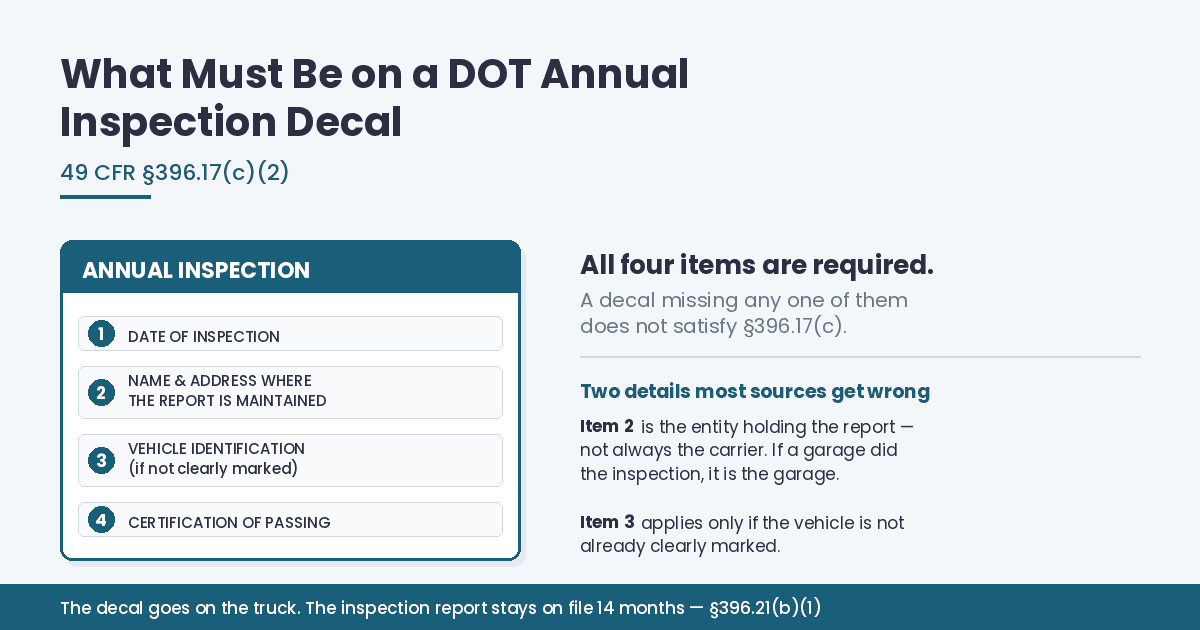
Quick Answer: Under 49 CFR §396.17(c), documentation of the annual inspection must be on the vehicle. You can satisfy that two ways: carry the inspection report itself, or use a sticker or decal containing four specific items — the date of inspection, the name and address of the entity where the inspection report is maintained, information uniquely identifying the vehicle if it is not already clearly marked, and a certification that the vehicle passed an inspection in accordance with §396.17. The sticker replaces carrying the report on the truck. It does not replace keeping it: under §396.21(b)(1) the report must be retained for 14 months where the vehicle is housed or maintained.
This is one of the most misunderstood pieces of Part 396 compliance. Carriers who slap a decal on the door and throw the paperwork away have a violation waiting for them at their next audit, and carriers who carry the full report in the cab often do not realize a decal would have been simpler. This guide covers exactly what has to be on the vehicle, exactly what has to be in the file, and the details that catch fleets out.
What Documentation Must Be on the Vehicle After a DOT Annual Inspection?
Section §396.17(c) is direct about this. A motor carrier must not use a commercial motor vehicle, and an intermodal equipment provider must not tender equipment for interchange, unless each component identified in Appendix A has passed an inspection within the preceding 12 months and documentation of that inspection is on the vehicle.
The regulation then gives two acceptable forms:
- The inspection report prepared in accordance with §396.21(a), or
- Other forms of documentation based on the inspection report — the regulation gives “sticker or decal” as the example — containing four specific items.
Either one satisfies the requirement. There is no federal preference between them, and no federally issued or approved sticker. You are not buying an official document; you are producing evidence in a format the regulation accepts.
What Information Must a DOT Annual Inspection Sticker Contain?
Section §396.17(c)(2) lists exactly four items. A decal that carries all four is compliant; one that misses any of them is not.
- The date of inspection.
- Name and address of the motor carrier, intermodal equipment provider, or other entity where the inspection report is maintained.
- Information uniquely identifying the vehicle inspected, if not clearly marked on the motor vehicle.
- A certification that the vehicle has passed an inspection in accordance with §396.17.
Two details in that list are routinely misread.
Item 2 is not necessarily your company. The regulation says the entity where the inspection report is maintained. If a commercial garage performed the inspection and holds the report, the garage’s name and address belong on the decal — not yours. Putting your own name on a sticker when someone else is holding the paperwork points an inspector to a file that does not exist at that address.
Item 3 is conditional. It applies only if the vehicle is not already clearly marked. If your unit number or VIN is visibly displayed on the vehicle, you do not have to repeat it on the decal. If your trailers are unmarked, you do.
Do I Have to Use a Sticker, or Can I Carry the Inspection Report?
Either is acceptable. Section §396.17(c)(1) permits the §396.21(a) inspection report itself to serve as the on-vehicle documentation.
Most fleets use decals for practical reasons. A paper report in a cab gets lost, soaked, or left in a truck that changed drivers, and a report is a multi-page document that an officer has to read. A decal on the door frame is visible in seconds.
The tradeoff is that a decal carries less information. If an officer wants detail on which components were inspected or what defects were found, that is in the report, and under §396.21(b)(2) the report must be available for inspection upon demand of an authorized Federal, State, or local official.
Where Do I Get DOT Annual Inspection Stickers?
Any commercial supplier. Annual inspection decals are sold by truck supply houses and compliance vendors, and most offer versions you can customize with your company name and address, which is exactly what item 2 requires. Many come in year-coded colors with punch-out month tabs so the inspection date can be marked at the time of inspection.
There is no approved vendor list and no federal source for these. What matters is that the decal carries the four required items and reflects an inspection that actually happened.
Some carriers print their own. That is permitted. The regulation specifies content, not manufacturing.
What Must the Inspection Report Itself Contain?
Whether or not you use a decal, someone has to prepare a report. Section §396.21(a) requires the qualified inspector performing the inspection to prepare a report that:
- Identifies the individual performing the inspection
- Identifies the motor carrier operating the vehicle, or the intermodal equipment provider intending to interchange it
- Identifies the date of the inspection
- Identifies the vehicle inspected
- Identifies the vehicle components inspected and describes the results, including identification of those components not meeting the minimum standards in Appendix A
- Certifies the accuracy and completeness of the inspection as complying with all requirements of the section
Item 5 is the one carriers shortchange. A report that says “passed” without identifying components inspected and describing results does not meet §396.21(a). The regulation expects a component-level record, including defects found — a report showing zero defects on every vehicle every year invites scrutiny rather than avoiding it.
The inspection report is only as good as the inspector who signed it.
Section §396.21(a) requires a qualified inspector. Our DOT Annual Inspection Training Course covers Part 393 and Appendix A to Part 396 — the criteria §396.19(a)(1) requires an inspector to understand — and includes three records for your file:
- Certificate of completion — documented training under §396.19(a)(3)(ii)(A)
- Inspector qualification form — the §396.19(b) record
- Inspection checklist — the working document for performing and recording inspections
How Long Do I Have to Keep the Inspection Report?
Fourteen months from the date of the inspection report, under §396.21(b)(1). The original or a copy must be retained where the vehicle is either housed or maintained — not at a corporate office three states away, if that is not where the truck lives.
Fourteen months, not twelve. The extra two months exist because the annual inspection cycle and the retention period are not the same clock. A report from March of last year is still a required record in April of this year, even though a newer inspection has replaced it.
This is the point most carriers get wrong about decals. The sticker satisfies §396.17(c) — documentation on the vehicle. It has no effect on §396.21(b)(1). Throwing away the report because a decal is on the door creates a recordkeeping violation that a decal cannot cure.
Does Each Trailer Need Its Own Sticker?
Yes. Section §396.17(a) states that the term commercial motor vehicle includes each vehicle in a combination vehicle, and gives the example directly: for a tractor semitrailer, full trailer combination, the tractor, the semitrailer, and the full trailer — including the converter dolly if so equipped — must each be inspected.
Each of those is a separately inspected vehicle, which means each needs its own annual inspection, its own report, and its own on-vehicle documentation. A tractor pulling two trailers and a dolly is four inspections and four sets of documentation, not one.
Fleets running drop trailers or pooled equipment are the most likely to have gaps here, because trailers sitting at a customer yard for months are easy to forget in an inspection schedule.
What If I Bought a Truck and Didn’t Perform the Last Inspection?
You are still responsible for the record. Section §396.21(b)(3) provides that if the motor carrier operating the vehicle did not perform its last annual inspection — or if an intermodal equipment provider did not itself perform the annual inspection on interchange equipment — that carrier or provider is responsible for obtaining the original or a copy of the last annual inspection report upon demand of an authorized Federal, State, or local official.
The practical consequence: when you buy a used truck, get the last annual inspection report as part of the transaction. A decal on the door proves an inspection happened, but if an officer or auditor asks for the report and you cannot produce it, the obligation is yours, not the previous owner’s.
The same applies to leased and interchanged equipment.
How Long Is the Inspection Valid?
Twelve months from the inspection. For a vehicle inspected under an FMCSA-approved state program, §396.17(f) sets the clock more precisely: the inspection is considered to meet the annual requirement for 12 months commencing from the last day of the month in which the inspection was performed. An inspection performed March 3 runs through March 31 of the following year.
Whether a state program applies to you at all depends on your state and your vehicle type. We cover that in do state DOT inspection requirements replace the federal annual inspection.
Who Can Perform the Inspection and Sign the Report?
A person qualified under 49 CFR §396.19. There is no federal DOT inspector certification or license — no agency issues one. The motor carrier qualifies its own inspectors and retains the evidence on file for as long as the individual performs annual inspections, plus one year after.
Under §396.17(d), a motor carrier may perform the annual inspection itself for vehicles under its control that are not subject to an inspection under §396.23(a)(1). Under §396.17(e), a carrier may instead have a commercial garage, fleet leasing company, truck stop, or other similar commercial business perform the inspection as its agent — provided that business operates and maintains facilities appropriate for commercial vehicle inspections and employs qualified inspectors as required by §396.19.
Note what that means for the decal: if the garage holds the report, the garage’s name and address go on the sticker under §396.17(c)(2)(ii).
For the qualification standard in detail, see how to get certified to do DOT inspections and who can perform DOT annual inspections. For the documentation the carrier keeps on the inspector, see our FMCSA inspector qualifications form guide.
What Happens If the Documentation Is Missing?
Section §396.17(h) is explicit: failure to properly perform the annual inspection required by the section subjects the motor carrier or intermodal equipment provider to the penalty provisions of 49 U.S.C. 521(b).
In practice, documentation failures surface in three places. At roadside, missing on-vehicle documentation is a violation regardless of whether the inspection actually happened. During a compliance review, auditors request inspection reports and inspector qualification records together, and a gap in either is a finding. And annual inspection violations feed the Vehicle Maintenance BASIC under CSA, which affects your safety profile, insurance renewals, and broker relationships.
The uncomfortable version: a perfectly inspected fleet with no paperwork looks identical to an uninspected fleet from an auditor’s chair.
A Practical Compliance Checklist
- On every vehicle: a decal with all four §396.17(c)(2) items, or the inspection report itself
- Each unit separately: tractor, semitrailer, full trailer, and converter dolly each need their own
- In the file, 14 months: the §396.21(a) report, retained where the vehicle is housed or maintained
- The report must name the inspector and identify components inspected with results, not just “passed”
- On file separately: §396.19(b) qualification evidence for every person who signs an inspection
- Also on file: §396.25 brake inspector qualification for anyone performing brake work — see our air brake certification guide
- When buying used equipment: obtain the last annual inspection report at purchase
- Decal name and address must match wherever the report is actually kept
Bring Your Inspections In-House
Everything above assumes someone qualified is performing the inspection and signing the report. For most fleets, the cheapest way to get there is qualifying a mechanic you already employ, rather than paying a shop per vehicle per year.
Our DOT Annual Inspection Training Course is built around 49 CFR Part 393 and Appendix A to Part 396 (formerly Appendix G), the inspection criteria §396.19(a)(1) requires an inspector to understand. It covers brakes, steering, suspension, lighting, tires, coupling devices, frame, fuel systems, and every other Appendix A component category, along with the inspection report requirements described in this article.
Every enrollment includes three deliverables:
- Certificate of completion — documenting the training component of qualification under §396.19(a)(3)(ii)(A)
- Inspector qualification form — the §396.19(b) record your carrier retains on file
- Inspection checklist — the working document for performing and recording annual inspections
The course is fully online and self-paced, with lifetime access.
Qualifying more than one mechanic? Group registration with volume discounts is available for shops and fleets.
Frequently Asked Questions
What has to be on a DOT annual inspection sticker?
Under 49 CFR §396.17(c)(2), a sticker or decal must contain four items: the date of inspection; the name and address of the motor carrier, intermodal equipment provider, or other entity where the inspection report is maintained; information uniquely identifying the vehicle inspected if not clearly marked on the vehicle; and a certification that the vehicle has passed an inspection in accordance with §396.17.
Is a DOT annual inspection sticker required?
A sticker specifically is not required, but documentation on the vehicle is. Section §396.17(c) allows either the inspection report prepared under §396.21(a) or other documentation based on that report, such as a sticker or decal, containing the four required items. Most fleets use a decal because it is more durable and faster for an officer to read.
Whose name and address goes on the inspection decal?
The entity where the inspection report is maintained. That is often the motor carrier, but if a commercial garage performed the inspection and holds the report, the garage’s name and address belong on the decal. The purpose of the requirement is to tell an inspector where the underlying report can be found.
Does a sticker replace keeping the inspection report?
No. The sticker satisfies the on-vehicle documentation requirement in §396.17(c). It has no effect on §396.21(b)(1), which requires the original or a copy of the inspection report to be retained for 14 months from the date of the report, where the vehicle is housed or maintained. Discarding the report because a decal is on the truck creates a recordkeeping violation.
How long must DOT annual inspection reports be kept?
Fourteen months from the date of the inspection report, under §396.21(b)(1). The original or a copy must be retained where the vehicle is either housed or maintained, and must be available for inspection upon demand of an authorized Federal, State, or local official.
Does each trailer need its own annual inspection sticker?
Yes. Section §396.17(a) states that commercial motor vehicle includes each vehicle in a combination vehicle, and gives the example of a tractor semitrailer full trailer combination in which the tractor, semitrailer, and full trailer, including the converter dolly if so equipped, must each be inspected. Each unit needs its own inspection, report, and on-vehicle documentation.
What must a DOT annual inspection report contain?
Under §396.21(a), the qualified inspector must prepare a report that identifies the individual performing the inspection; identifies the motor carrier operating the vehicle or the intermodal equipment provider intending to interchange it; identifies the date of the inspection; identifies the vehicle inspected; identifies the components inspected and describes the results, including components not meeting the Appendix A minimum standards; and certifies the accuracy and completeness of the inspection.
Where do I buy DOT annual inspection decals?
From any truck supply or compliance vendor. Most sell customizable decals that let you print your company name and address, which is what §396.17(c)(2)(ii) requires. There is no federally approved vendor and no official government-issued sticker. Carriers may also print their own, since the regulation specifies content rather than manufacture.
What if I bought a used truck and don’t have the last inspection report?
Section §396.21(b)(3) makes the operating carrier responsible for obtaining the original or a copy of the last annual inspection report upon demand of an authorized official, even if the carrier did not perform that inspection. Request the report as part of any used equipment purchase or lease.
How long is a DOT annual inspection valid?
Twelve months. For inspections performed under an FMCSA-approved state program, §396.17(f) provides that the vehicle is considered to have met the annual inspection requirement for 12 months commencing from the last day of the month in which the inspection was performed. An inspection on March 3 is therefore valid through March 31 of the following year.
About the Author
Josh Lopez has spent more than 10 years in trucking and freight, working across shippers, carriers, brokerage, and reefer LTL. He founded dotinspectioncourse.com to give mechanics, owner-operators, and fleet managers accurate, regulation-first training on 49 CFR Part 396. Every regulatory citation on this site is verified against the current eCFR text before publication.