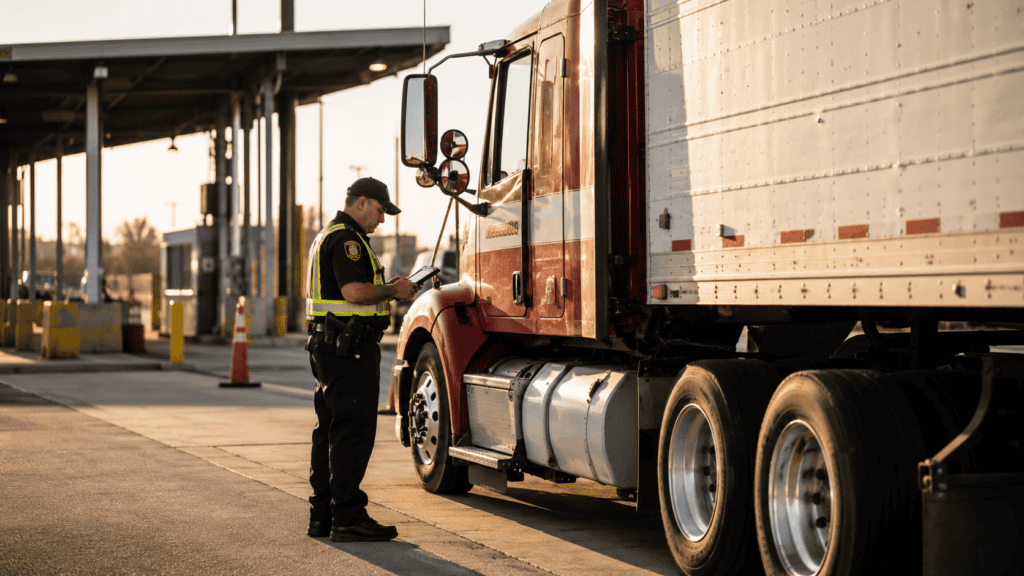
Quick Answer: DOT compliance enforcement intensified sharply in 2025 and 2026. Since June 2025, more than 20,000 truckers have been placed out of service, over 28,000 improperly issued non-domiciled CDLs have been revoked, and FMCSA has audited roughly 1,500 driver-training providers. FMCSA also overhauled its Safety Measurement System in February 2026, splitting Vehicle Maintenance into two scored categories and adding a new “Vehicle Maintenance: Driver Observed” category for defects a driver should have caught on a pre-trip. For carriers, the practical consequence is simple: roadside and audit scrutiny is higher than it has been in years, and a weak inspection program — unqualified inspectors or missing documentation — is now one of the fastest ways to get parked, downrated, or fined.
If you run a fleet, work in a shop, or hold the safety role at a carrier, you already feel it. Enforcement is not easing up. Under Transportation Secretary Sean P. Duffy, FMCSA has spent the past year reshaping how it operates, and the agency has been public that it is, in its own words, just getting started. This guide lays out what actually changed, which numbers are real, and why inspection readiness is the part of this that is squarely within your control.
What Changed in DOT Compliance Enforcement in 2025 and 2026?
The enforcement posture shifted from routine to aggressive, and the numbers are documented by DOT and FMCSA directly.
According to the Department of Transportation and FMCSA, since June 2025 more than 20,000 truckers have been placed out of service for failing to meet basic federal requirements. FMCSA mobilized more than 300 investigators across all 50 states to audit approximately 1,500 driver-training providers, and identified 30-plus states issuing non-compliant commercial licenses, sending formal enforcement actions to 26 of them. More than 28,000 improperly issued non-domiciled CDLs have been revoked nationwide.
The agency also ran Operation SafeDRIVE, a multi-state enforcement surge. In its first wave, FMCSA and state partners conducted targeted enforcement across 26 states and the District of Columbia, removing nearly 2,000 unqualified truckers and vehicles from the road in a three-day effort focused on driver qualification and unsafe vehicles.
On the licensing side, FMCSA finalized a rule in February 2026 restricting who can obtain a non-domiciled CDL, and took direct funding action against states it found non-compliant, including withholding $40 million from California in October 2025 over English Language Proficiency enforcement. California began enforcing ELP in January 2026.
Whatever your view of the politics driving it, the operational reality of DOT compliance enforcement is the same for every carrier: there are more investigators, more roadside enforcement, and a lower tolerance for the paperwork and qualification gaps that audits are built to find.
The 2026 CSA Scoring Overhaul
Alongside the enforcement surge, FMCSA rebuilt how carriers are scored. The Safety Measurement System overhaul took effect in February 2026 and is the largest change to the scoring methodology since the program launched.
Four things changed at once:
- Roughly 950 violation codes were consolidated into 116 groups. Fewer, broader categories mean each individual violation carries more weight.
- The BASICs were renamed “compliance categories” and reorganized.
- Severity weighting was simplified from a 1-to-10 scale to a two-tier structure based on crash correlation.
- Vehicle Maintenance was split into two separately scored categories: “Vehicle Maintenance” for defects found during full mechanical inspections, and a brand-new “Vehicle Maintenance: Driver Observed” for defects a driver should have caught during a pre-trip walkaround.
That last one is the change carriers are least prepared for. DVIR quality is now a directly scored safety behavior. A burned-out lamp or an obviously flat tire found at roadside no longer just dings your maintenance score — it lands in a category whose entire purpose is to record that your driver missed something visible.
Because scores were recalculated under the new methodology, many carriers saw their percentiles move without a single new inspection. If your score shifted in early 2026 and you could not work out why, this is likely the reason.
The practical response is straightforward: tighten your DVIR program. See our guide to DVIR requirements under §396.11 and the 2026 electronic DVIR rule.
Note: FMCSA’s own documentation is the authority here. Details of the transition, thresholds, and preview tools are on the agency’s CSA site — verify current specifics before making decisions based on any third-party summary, including this one.
What Does Roadside Enforcement Actually Look Like Now?
The clearest window into roadside posture is CVSA’s International Roadcheck, the annual 72-hour inspection blitz across the U.S., Canada, and Mexico.
During the 2026 International Roadcheck, inspectors conducted 54,575 inspections and placed 10,350 commercial vehicles out of service, a vehicle out-of-service rate of 19%. Roughly one in five inspected vehicles was pulled off the road until its violations were fixed. Drivers were placed out of service at a 5.8% rate.
Here is the part that matters for your shop: the violations grounding those trucks were overwhelmingly the kind a good inspection program catches before the truck leaves the yard. Brake system violations alone accounted for 3,379 out-of-service violations, 24.3% of all vehicle out-of-service findings — the single largest category, and essentially unchanged from 24.4% in 2025. In the 2025 event, brake-related issues combined made up roughly 41% of all vehicle out-of-service violations, and tires were second at 21.4%.
These are not exotic mechanical failures. They are the exact items a qualified inspector examines during a 49 CFR §396.17 annual inspection and a driver checks during a pre-trip.
One more number worth noting: on the driver side, the top out-of-service violation in 2026 was not having a current medical card, at 1,072 violations or 27% of driver out-of-service violations — displacing hours of service for the first time in years. That is a calendar problem, not a driving problem, and it is entirely preventable.
For the full breakdown, see why trucks fail DOT inspections and our 2026 CVSA International Roadcheck guide.
Why the Crackdown Accelerated
The enforcement push intensified after a series of high-profile fatal crashes involving unqualified and improperly licensed drivers.
The most widely covered was on February 3, 2026, in Jay County, Indiana, near the Ohio border. According to Indiana State Police, a 2022 Freightliner failed to stop for slowed traffic on State Road 67, swerved into the oncoming lane, and struck a van head-on, killing four men from the local Amish community. The driver held a non-domiciled commercial driver’s license issued in Pennsylvania and was subsequently taken into ICE custody; federal authorities stated he was in the country unlawfully. Secretary Duffy publicly announced that FMCSA was investigating the carrier that put the driver behind the wheel, and the case became part of the federal government’s argument for the non-domiciled CDL rule and the broader enforcement surge.
Cases like that one are the political engine behind everything above. For a compliant carrier, the relevant lesson is not the politics. It is that regulators are now actively looking for the gaps that let unqualified people and unsafe equipment operate, and they are following those gaps back to the carriers responsible.
The Quiet Risk: A Conditional Safety Rating
Getting shut down is the dramatic outcome. The more common and more insidious one is a conditional safety rating, which can hollow out a small carrier without a single dramatic event.
Brokers, shippers, and insurance underwriters all see your safety rating. Many large brokers and 3PLs run automated systems that flag conditional and unsatisfactory carriers and quietly stop offering them freight. You do not get a notice that you have been filtered out. The freight just slows down and then stops.
For an owner-operator or small fleet, that is the difference between a phone that rings and one that does not. And the ratings that trigger this are driven substantially by the Vehicle Maintenance categories, which are populated by exactly the brake, tire, lighting, and documentation violations a strong inspection program prevents.
What “Inspection Readiness” Actually Means in 2026
Inspection readiness is not a slogan. It is the part of DOT compliance enforcement you actually control, and it is an operational standard with four parts.
Qualified inspectors performing real annual inspections. The person performing your §396.17 annual inspection must meet the qualification standard in 49 CFR §396.19 (read it on eCFR), and if they touch brakes, the separate standard in §396.25. Not rubber-stamped. Not handed to whoever is cheapest. See who can perform DOT annual inspections and 396.19 vs 396.25.
Drivers trained on pre-trip and DVIR procedures. Drivers are the first line of defense, and their misses now show up in their own scored category. The 2026 electronic DVIR rule under §396.11 makes those records easier for an auditor to pull; we cover it in our guide to FMCSA §396.11 and the 2026 DVIR rule.
Documentation that survives an audit. Inspection reports, repair certifications, and inspector qualification evidence, all retained and retrievable. Missing paperwork is a violation even when the underlying work was done correctly.
In-house capability where it makes sense. More carriers are qualifying their own mechanics under §396.19 rather than outsourcing, for lower cost per inspection, faster turnaround, and a paper trail they control. See can I do my own DOT annual inspection.
The three records, and three different clocks
| Record | Regulation | Retention |
|---|---|---|
| Annual inspection report | §396.21(b)(1) | 14 months |
| Inspector qualification evidence | §396.19(b) | Service + 1 year |
| Driver vehicle inspection report | §396.11(a)(4) | 3 months |
See what the qualification record should contain and what goes on the truck and what stays in the file.
What the Penalties Look Like
Federal civil penalties are adjusted annually for inflation and vary by violation type, so treat any specific figure as a point-in-time reference and confirm the current schedule before relying on it.
As a general picture, operating a vehicle placed out of service, hours-of-service and ELD violations, and serious recordkeeping failures each carry penalties that run into the tens of thousands of dollars per violation, and continuing violations are assessed per day.
One category is worth calling out because it is unique: under the federal hazardous materials penalty structure, training violations are the only category that carries a mandatory minimum civil penalty. Everything else has a ceiling but no floor. That tells you how seriously the agency treats training and qualification specifically.
But the fines are often not the largest cost. Downtime from an out-of-service order, a lost contract after a conditional rating, and higher insurance premiums frequently add up to more than the penalty itself.
What to Do Now
The work is straightforward, even when it is not easy.
Audit your own inspection records. Pull the last three months of annual inspection reports and DVIRs and ask honestly whether they would survive a desk audit today. Missing dates, missing signatures, and inspections signed by someone whose qualification you cannot document are the common findings.
Confirm your inspectors are actually qualified. Under §396.19, the person performing annual inspections must meet a specific standard, and the motor carrier must retain evidence of it. Many small carriers either have no qualified inspector on file or are relying on documentation that would not hold up.
Tighten your DVIR program. With the new Driver Observed category, pre-trip quality is now scored separately and visibly. Make sure drivers are actually walking the vehicle, that defects get reported, and that repair certifications close the loop.
Check your medical certificates. A lapsed medical card became the number one driver out-of-service violation in 2026. It is pure administration and entirely preventable with a tracked expiration date.
Watch your CSA scores monthly, not annually. By the time a problem shows up on an annual review, the damage to your freight relationships may already be done. This matters more than usual right now, since the 2026 recalculation moved many carriers’ percentiles without new inspections.
Verify where your training came from. FMCSA’s audit of driver-training providers removed a large number from its registry. That registry governs entry-level driver training rather than inspector qualification, but the broader lesson holds: training documentation is only as good as the standard behind it, and auditors are looking more closely than they used to.
Get Your Team Qualified to Perform DOT Annual Inspections
Under §396.19, every motor carrier must ensure that whoever performs its annual inspections meets the federal qualification standard, and must keep evidence of that qualification on file. Most small carriers either outsource this entirely or operate with documentation that would not pass a real audit. In an enforcement environment this active, that gap is a liability.
More investigators. Tighter scoring. The same four failure categories.
Brakes, tires, lights, and documentation drive the overwhelming majority of out-of-service orders — and every one of them is an Appendix A component your own qualified inspector examines during the annual inspection.
Our DOT Annual Inspection Training Course covers the federal inspection criteria in 49 CFR Part 393 and Appendix A to Part 396, and produces three records for your file:
- Certificate of completion — documented training under §396.19(a)(3)(ii)(A)
- Inspector qualification form — the §396.19(b) record your carrier retains
- Inspection checklist — for performing and recording annual inspections
Self-paced and mobile-friendly. The qualification does not expire.
Qualifying multiple mechanics or supervisors? Group registration with volume discounts.
For the qualification standard itself, see what FMCSA §396.19 requires and how to get certified to perform DOT inspections. And because brakes drive the largest share of out-of-service violations, it is worth understanding the separate brake qualification in our DOT air brake certification requirements guide.
Frequently Asked Questions
Is DOT enforcement actually increasing in 2026?
Yes. According to DOT and FMCSA, more than 20,000 truckers have been placed out of service since June 2025, over 28,000 improperly issued non-domiciled CDLs have been revoked, and FMCSA deployed more than 300 investigators to audit roughly 1,500 driver-training providers. Roadside and audit scrutiny is measurably higher than in recent years.
What was Operation SafeDRIVE?
Operation SafeDRIVE was a multi-state FMCSA enforcement surge focused on driver qualification and unsafe vehicles. In its first wave, FMCSA and state partners conducted targeted enforcement across 26 states and the District of Columbia and removed nearly 2,000 unqualified truckers and vehicles from the road over three days.
What is the new Vehicle Maintenance: Driver Observed category?
Under FMCSA’s February 2026 Safety Measurement System overhaul, the Vehicle Maintenance BASIC was split into two separately scored categories: Vehicle Maintenance, for defects found during full mechanical inspections, and Vehicle Maintenance: Driver Observed, for defects a driver should have caught during a pre-trip walkaround. The effect is that DVIR quality is now a directly scored safety behavior with its own percentile.
Why did my CSA score change without any new inspections?
FMCSA recalculated carrier scores under the new methodology introduced in February 2026, which consolidated roughly 950 violation codes into 116 groups, simplified severity weighting into a two-tier structure, and split Vehicle Maintenance into two categories. Many carriers saw percentile movement from the recalculation alone. Confirm current details on FMCSA’s CSA site.
What were the 2026 CVSA Roadcheck results?
Inspectors conducted 54,575 inspections and placed 10,350 vehicles out of service, a 19% vehicle out-of-service rate, along with 3,184 drivers at 5.8%. Brake system violations accounted for 3,379 out-of-service findings, 24.3% of the vehicle total and the largest single category. The 2025 event produced an 18.1% vehicle rate with brakes at 24.4%.
How does a weak inspection program affect my CSA score?
Brake, tire, lighting, and documentation violations feed the Vehicle Maintenance categories, which drive safety ratings. Since February 2026, defects a driver should have caught also feed the separate Driver Observed category. A pattern of these violations can push a carrier toward a conditional or unsatisfactory rating, which brokers, shippers, and insurers see and often act on by reducing or withholding freight.
What is a conditional safety rating and why does it matter?
A conditional safety rating is assigned to motor carriers with significant compliance issues identified during a safety review. Brokers, shippers, insurance underwriters, and large 3PLs see these ratings, and many run automated systems that filter out flagged carriers. The effect is usually silent — freight offers slow down without any notice being sent.
Who is required to perform DOT annual inspections?
A person qualified under 49 CFR §396.19: an in-house mechanic under §396.17(d), a qualified owner-operator, or a commercial garage acting as the carrier’s agent under §396.17(e). If the inspector performs brake work, they also need separate qualification under §396.25. The motor carrier must keep evidence of the qualification on file.
How much can FMCSA fines cost a motor carrier?
Civil penalties vary by violation type and are adjusted annually for inflation, so confirm the current schedule rather than relying on a fixed figure. Operating a vehicle placed out of service, hours-of-service and ELD violations, and serious recordkeeping failures each run into the tens of thousands of dollars per violation, with continuing violations assessed per day. Downtime, lost contracts, and higher insurance premiums frequently exceed the penalty itself.
What is the single best thing a small carrier can do to prepare?
Audit your inspection records and confirm your inspectors’ qualifications are documented. The most common audit failure is not unqualified work — it is missing documentation, a qualified inspector with nothing in the file to prove it. Fixing that is inexpensive and entirely within your control.
Josh Lopez has spent more than 10 years in the trucking and freight industry, working across shippers, carriers, brokerage, and reefer LTL. He writes about DOT compliance, FMCSA enforcement trends, and commercial vehicle inspection to help mechanics, owner-operators, and fleet managers stay audit-ready in a changing regulatory landscape.