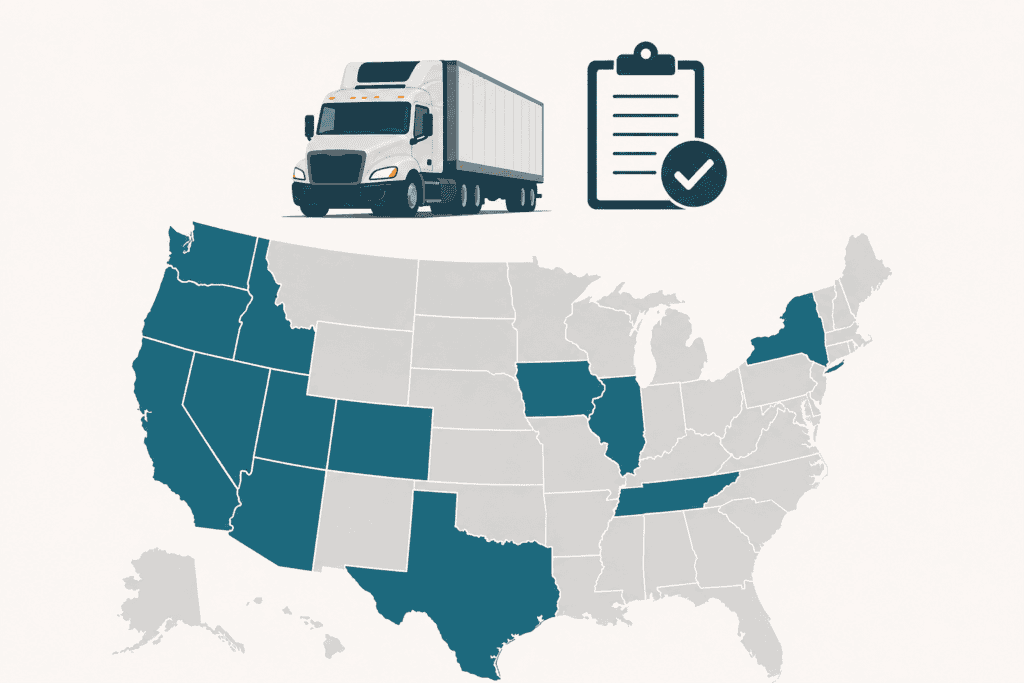
Quick Answer: In 22 states plus the District of Columbia, a state periodic inspection program has been determined by FMCSA to be as effective as the federal requirement — and under 49 CFR §396.23(a)(1), if your vehicle is subject to that program, you must satisfy the federal annual inspection through it. In every other state, you meet the requirement under §396.17 using an inspector qualified under §396.19. The trap is scope: several approved state programs cover only buses, so a trucking fleet in one of those states still needs a federally qualified annual inspector.
This is one of the most common points of confusion in commercial vehicle compliance, and getting it wrong goes in one of two directions. Some carriers assume their state inspection sticker covers everything and skip the federal requirement. Others pay for federal annual inspections they were required to obtain through a state program. Both are violations.
This guide explains how the federal and state requirements interact, which states have approved programs, and how to determine what applies to your fleet.
Does a State Inspection Satisfy the Federal DOT Annual Inspection?
Yes, when the state program has been approved. 49 CFR §396.17(f) provides that vehicles passing periodic inspections performed under the auspices of any state government, or an equivalent jurisdiction in the Canadian Provinces, the Yukon Territory, and Mexico, meeting the minimum standards contained in Appendix A to Part 396, are considered to have met the annual inspection requirement for 12 months, commencing from the last day of the month in which the inspection was performed.
Note the clock. It does not run 12 months from the inspection date — it runs from the last day of the month the inspection was performed. An inspection on March 3 carries you through March 31 of the following year.
The legal foundation is Section 210 of the Motor Carrier Safety Act of 1984 (49 U.S.C. 31142), which established that state inspections meeting federally approved criteria must be recognized by every other state. A valid inspection under an approved program travels with the vehicle across state lines.
If My State Has an Approved Program, Can I Still Do My Own Federal Inspection?
No — and this is the part most operators get backwards.
Under 49 CFR §396.23(a)(1), if a commercial motor vehicle is subject to a mandatory inspection program that the Administrator has determined to be as effective as §396.17, the motor carrier or intermodal equipment provider must meet the requirement of §396.17 through that inspection program.
FMCSA has stated the same thing plainly: if the agency determines a state’s periodic inspection program is comparable to, or as effective as, the requirements of Part 396, then a motor carrier must ensure all of its CMVs that are required by that state to be inspected are inspected through the state’s program.
The approved state program is not an alternative you may choose. For vehicles it covers, it is the required route.
The inspection itself may be conducted by government personnel, at commercial facilities authorized by the state, or by the carrier itself under a state-authorized self-inspection program.
Which States Have FMCSA-Approved Inspection Programs?
FMCSA has determined the following state programs are comparable to, or as effective as, the federal periodic inspection requirements:
- Alabama (Liquefied Petroleum Gas Board)
- California
- Connecticut
- District of Columbia
- Hawaii
- Illinois
- Louisiana
- Maine
- Maryland
- Massachusetts
- Michigan
- Minnesota
- New Hampshire
- New Jersey
- New York
- Ohio
- Pennsylvania
- Rhode Island
- Texas
- Utah
- Vermont
- Virginia
- West Virginia
- Wisconsin
FMCSA also accepts the programs of the 10 Canadian Provinces — Alberta, British Columbia, Manitoba, New Brunswick, Newfoundland, Nova Scotia, Ontario, Prince Edward Island, Quebec, and Saskatchewan — and the Yukon Territory.
Two states were removed from the list. Arkansas no longer has a periodic inspection program for buses comparable to the federal program, and Oklahoma repealed its inspection requirements. Motor carriers in Arkansas and Oklahoma must ensure the periodic inspection required by §396.17 is performed on all CMVs under their control.
All other states either have no periodic inspection program for CMVs, or their programs have not been determined by FMCSA to be comparable to the federal requirements. If your state is not on this list — Georgia, Florida, North Carolina, Tennessee, Indiana, Missouri, Arizona, and most of the Mountain West and Plains among them — the federal §396.17 inspection is your path, performed by an inspector qualified under §396.19.
This list is revised periodically through Federal Register notices. Verify current status with FMCSA or your state agency before making a compliance decision.
Does My State Program Cover All of My Vehicles?
This is the question almost nobody asks, and it is where carriers get caught.
Being on the approved list does not mean the state program covers every commercial vehicle in that state. The approval applies to the program as the state defined it, and several approved programs are narrow:
- Connecticut’s approved program is a bus inspection program.
- Wisconsin’s approved program is a bus inspection program.
- Ohio’s approved program is an inspection program for church buses.
- Alabama’s approval covers the Liquefied Petroleum Gas Board program, not general commercial trucking.
The practical consequence: a freight carrier running tractor-trailers in Ohio, Connecticut, Wisconsin, or Alabama is generally not covered by the approved state program. Those vehicles fall back to the federal requirement under §396.17, which means the carrier needs an inspector qualified under §396.19 — or must use a commercial garage that employs one.
The statutory language in §396.23(a)(1) is limited to a vehicle “subject to” the mandatory program. If your vehicle is not subject to it, the federal route applies.
This is why the answer to “does my state cover me?” is never just a yes or no by state. It depends on your vehicle type, weight, and use.
Does My Federal §396.19 Inspector Qualification Work in My State?
For federal annual inspections, yes — §396.19 qualification is federal and is not tied to any state. A qualified inspector in Georgia is a qualified inspector in Nevada. There is no state registration, no federal registry, and no reciprocity issue, because there is no credential being issued in the first place.
Under §396.19(b), the motor carrier retains the evidence of qualification at its principal place of business or wherever the inspector is employed, for the period the individual performs annual inspections and for one year thereafter. Nothing is filed with any agency. You produce it when an auditor or officer asks.
Qualification is established under §396.19(a)(3) through one of two routes: completion of a federal or state-sponsored training program or a state or Canadian Province certificate; or a combination of training or experience totaling at least one year, which may include a manufacturer-sponsored or similar commercial training program, experience in a motor carrier maintenance program, experience at a commercial garage or fleet leasing company, or experience as a government CMV inspector.
There is no federal DOT inspector certification or license. No agency issues one. Qualification is documented and retained by the carrier.
What If My State Requires Its Own Inspector Certification?
Some states that run approved programs also certify the inspectors who perform them — and that certification is separate from federal §396.19 qualification.
Minnesota is the clearest example. Its Mandatory Inspection Program (MIP) is administered by the Minnesota State Patrol, and inspectors must re-certify every two years through State Patrol-certified instructors. If certification lapses, the inspector can no longer perform those inspections; after six months, the certification is revoked and the full certification course must be retaken. Federal §396.19 training does not satisfy Minnesota MIP certification, and MIP certification is not a substitute for federal qualification where the federal route applies.
Pennsylvania, New Jersey, New York, Texas, and California similarly administer their own state programs with their own inspector or station requirements. If you are performing inspections under a state program, you must meet that state’s requirements for its program — full stop.
The reverse is equally true. A state inspector certification does not qualify someone to perform the federal §396.17 annual inspection on vehicles outside that state program’s scope. Those still require §396.19 qualification.
Do I Need Both Federal and State Qualification?
It depends on what you inspect.
- State has no approved program (Georgia, Florida, North Carolina, and most others): federal §396.19 qualification only. Your inspector performs §396.17 annual inspections in-house.
- State program covers all your vehicles and you use state-authorized facilities: you comply through the state program. You may not need your own qualified inspector at all, though many fleets keep one for pre-inspection and maintenance.
- State program is narrow and your vehicles fall outside it (a truck fleet in Ohio or Connecticut, for instance): federal §396.19 qualification for those vehicles.
- Mixed fleet, or you self-inspect under a state-authorized self-inspection program: you may need both. State certification for the state-covered vehicles, federal §396.19 qualification for the rest.
Separately, and regardless of which route you take, anyone inspecting, installing, or maintaining brakes must meet §396.25 brake inspector qualification, and the carrier must retain that evidence too.
How Do I Determine What Applies to My Fleet?
Work through it in this order:
- Is your state on the approved list above? If no, you are on the federal route. Skip to step 4.
- Does the state program cover your vehicle type? Check weight thresholds, vehicle class, and whether the program is bus-only. Contact the state agency that administers it — the state patrol, DPS, or DOT, depending on the state.
- If covered: comply through the state program. Understand its inspector certification requirements and its recordkeeping rules, which FMCSA accepts along with the program.
- If not covered, or your state has no program: perform the §396.17 annual inspection using an inspector qualified under §396.19, or use a commercial garage that employs one. Retain the inspection report for 14 months under §396.21(b)(1), and keep documentation of inspector qualification on file.
- Interstate operation: a valid inspection under any approved program is recognized in every state under 49 U.S.C. 31142. You do not re-inspect at each border.
For the full federal requirement, see our guide to 49 CFR §396.17 periodic inspection requirements.
Get Your Mechanics Qualified Under §396.19
If you operate in a state without an approved program, or your vehicles fall outside your state program’s scope, the federal route requires a qualified annual inspector — and bringing that in-house is usually cheaper than paying a shop per vehicle per year.
Our DOT Annual Inspection Training Course is built around Part 393 and Appendix A to Part 396 (formerly Appendix G), the criteria §396.19(a)(1) requires an inspector to understand. Every enrollment includes three deliverables:
- Certificate of completion — documenting the training component of qualification under §396.19(a)(3)(ii)
- Inspector qualification form — the §396.19(b) record your company retains on file
- Inspection checklist — the working document for performing and recording annual inspections
Qualifying more than one mechanic? Group registration with volume discounts is available for shops and fleets.
One honest note: this course qualifies inspectors under the federal §396.19 standard. It does not satisfy state-specific inspector certifications such as Minnesota’s MIP. If you need a state certification, contact that state’s administering agency.
Frequently Asked Questions
Does a state inspection count as a DOT annual inspection?
Yes, if the state program has been approved by FMCSA. Under 49 CFR §396.17(f), a vehicle passing a periodic inspection under an approved state program meets the federal annual inspection requirement for 12 months, commencing from the last day of the month in which the inspection was performed.
Which states have FMCSA-approved periodic inspection programs?
Alabama (LPG Board), California, Connecticut, District of Columbia, Hawaii, Illinois, Louisiana, Maine, Maryland, Massachusetts, Michigan, Minnesota, New Hampshire, New Jersey, New York, Ohio, Pennsylvania, Rhode Island, Texas, Utah, Vermont, Virginia, West Virginia, and Wisconsin. FMCSA also accepts the programs of 10 Canadian Provinces and the Yukon Territory. Arkansas and Oklahoma were removed from the list.
Can I perform my own federal annual inspection if my state has an approved program?
Not for vehicles the state program covers. Under §396.23(a)(1), if a commercial motor vehicle is subject to a mandatory state inspection program determined to be as effective as §396.17, the carrier must meet the federal requirement through that state program. The state route is mandatory, not optional, for covered vehicles.
Does an approved state program cover every commercial vehicle in that state?
No. Approval applies to the program as the state defined it, and several are narrow. Connecticut’s and Wisconsin’s approved programs are bus inspection programs, Ohio’s covers church buses, and Alabama’s approval covers the Liquefied Petroleum Gas Board program. Trucks falling outside a state program’s scope revert to the federal §396.17 requirement and need a §396.19 qualified inspector.
Do I need a DOT inspection in Georgia?
Georgia is not on FMCSA’s list of states with approved periodic inspection programs, so the federal §396.17 annual inspection applies. Georgia has adopted the Federal Motor Carrier Safety Regulations for most intrastate carriers, meaning the federal Part 396 requirements apply whether you operate interstate or only within the state. The inspection must be performed by an inspector qualified under §396.19.
Is my DOT inspector qualification valid in other states?
Yes for federal annual inspections. Section 396.19 qualification is federal and not tied to any state. There is no state registration and no federal registry — the carrier retains the qualification evidence and produces it on request. Separately, under 49 U.S.C. 31142, an inspection performed under any federally approved state program must be recognized by every other state.
Does federal §396.19 training satisfy Minnesota’s inspector certification?
No. Minnesota’s Mandatory Inspection Program is administered by the Minnesota State Patrol, and its inspectors must certify and re-certify every two years through State Patrol-certified instructors. Federal §396.19 training is a separate standard and does not substitute for MIP certification. The reverse is also true where the federal route applies.
How long is a state commercial vehicle inspection valid for federal purposes?
Twelve months, commencing from the last day of the month in which the inspection was performed. An inspection performed on March 3 is valid through March 31 of the following year.
What happens if my state was removed from the approved list?
The federal requirement applies directly. When Arkansas and Oklahoma were delisted, motor carriers in those states became responsible for ensuring the periodic inspection required by §396.17 is performed on all CMVs under their control — which means using an inspector qualified under §396.19.
Who can perform the federal annual inspection if my state has no program?
An inspector qualified under §396.19, which the motor carrier documents and retains evidence of. A carrier may perform the inspection itself, or under §396.17(e) may use a commercial garage, fleet leasing company, truck stop, or similar commercial business as its agent, provided that business maintains facilities appropriate for commercial vehicle inspections and employs qualified inspectors.
About the Author
Josh Lopez has spent more than 10 years in trucking and freight, working across shippers, carriers, brokerage, and reefer LTL. He founded dotinspectioncourse.com to give mechanics, owner-operators, and fleet managers accurate, regulation-first training on 49 CFR Part 396. Every regulatory citation on this site is verified against the current eCFR text and primary FMCSA sources before publication.