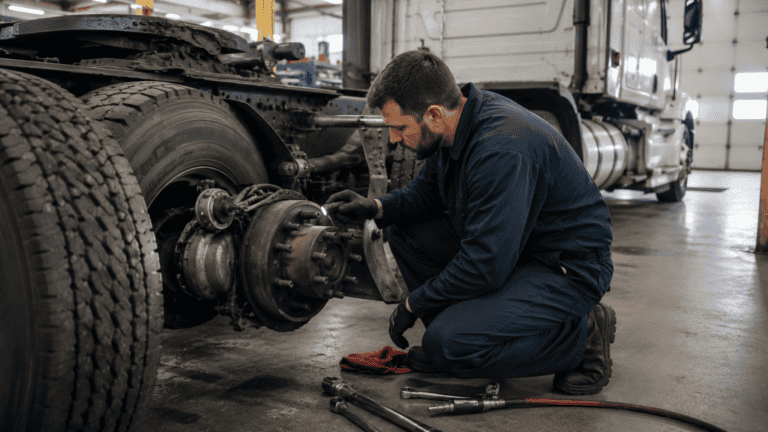
If you work as a mechanic on commercial motor vehicles, manage a fleet's maintenance program, or operate your own trucks, you've probably asked whether you need a separate DOT air brake certification to legally inspect and service brake systems. It's one of the most common questions in fleet maintenance, and the answer involves understanding how two different federal regulations work together.
The short answer is yes. Federal law under 49 CFR §396.25 requires anyone performing brake inspections, installations, or repairs on commercial motor vehicles to be a qualified brake inspector. But the longer answer involves what qualification actually means, how it connects to the broader DOT annual inspection process, and which training path makes the most sense for your situation.
This guide covers the federal requirements, the qualification pathways, the technical standards a qualified inspector must know, what happens during enforcement, and how brake inspector certification fits with the annual inspector qualification under §396.19.
What Is DOT Air Brake Certification?
DOT air brake certification refers to meeting the qualification requirements under 49 CFR §396.25 for inspecting, installing, or maintaining brake systems on commercial motor vehicles. The Federal Motor Carrier Safety Administration (FMCSA) requires motor carriers to ensure that any person who performs brake-related work on commercial vehicles meets specific knowledge and experience standards.
The regulation applies to anyone whose job duties include inspecting, installing, or maintaining brakes on a commercial motor vehicle. This covers brake inspectors at fleet maintenance facilities, commercial garage mechanics working on commercial vehicles, and inspectors performing the brake portion of a DOT annual inspection under 49 CFR §396.25.
The motor carrier is responsible for ensuring brake qualification standards are met and for maintaining documentation that proves it.
Why DOT Air Brake Certification Matters in 2026
Brake-related violations remain among the most commonly cited issues during DOT roadside inspections and compliance reviews. According to the Commercial Vehicle Safety Alliance, brake-related violations comprise the largest percentage of all out-of-service violations cited during roadside inspections.
The enforcement numbers make the point. During Brake Safety Week 2025, inspectors examined 15,175 commercial motor vehicles across North America and placed 2,296 of them out of service for brake-related violations, an out-of-service rate of 15.1%. Roughly one in seven vehicles inspected was pulled off the road. Brake Safety Week 2026 runs August 23 through 29, with inspectors placing special emphasis on brake drums and air disc brake rotors.
Beyond roadside enforcement, brake-related issues are a major factor in commercial vehicle crashes. When a brake-related incident occurs, post-crash investigation often examines whether the brake work was performed by a qualified inspector. If documentation is missing or the inspector wasn't qualified, the motor carrier faces significant liability exposure on top of regulatory penalties.
For more on the broader enforcement environment, see DOT Compliance Enforcement Is Intensifying in 2026.
What Does 49 CFR §396.25 Actually Require?
The regulation establishes that a brake inspector must understand the brake service or inspection task to be accomplished and be able to perform it, must be knowledgeable of and have mastered the methods, procedures, tools, and equipment used for that task, and must be capable of performing it by reason of experience, training, or both.
FMCSA also requires the motor carrier to maintain evidence of each brake inspector's qualifications. There is no mandatory federal form. FMCSA publishes a sample Brake Inspector Qualifications form through its Safety Planner, and it is a reasonable template, but any format that captures the required evidence is acceptable. What matters is what the record proves.
This is the documentation piece that often gets overlooked. Even if your mechanic technically has the skills, without the qualification evidence on file, you have a compliance gap during any FMCSA audit or compliance review.
The Qualification Pathways for DOT Air Brake Certification
Under §396.25(d)(3), there are two routes to qualify as a brake inspector, and the second route can be satisfied three different ways. Understanding which one applies to your situation is the first step.
Route 1: A sponsored apprenticeship, an approved training program, or a state certificate. Successful completion of an apprenticeship program sponsored by a state, a Canadian province, a federal agency, or a labor union qualifies you. So does a training program approved by a state, provincial, or federal agency, or a certificate from a state or Canadian province that qualifies you to perform the assigned brake task.
Route 2: Brake-related training or experience totaling at least one year. This is the route most working mechanics use. It can be satisfied through any of the following, alone or in combination:
Participation in a training program sponsored by a brake or vehicle manufacturer, or a similar commercial training program designed to train students in brake maintenance or inspection similar to the assigned task.
Experience performing brake maintenance or inspection in a motor carrier or intermodal equipment provider maintenance program.
Experience performing brake maintenance or inspection at a commercial garage, fleet leasing company, or similar facility.
Note the number. One year. Not one afternoon, and not one test.
Does a CDL Air Brake Endorsement Qualify You?
No. FMCSA has published guidance answering this question directly, and the answer is no. A CDL with an air brake endorsement does not qualify a person as a brake inspector under §396.25.
The nuance matters. Passing the CDL air brake knowledge and skills test can cover the narrow task of inspecting an air brake system, and §396.25(e) even waives the documentation requirement in that specific case. But it does not make a person a qualified brake inspector, and it does not reach brake maintenance, service, or repairs, which is most of what §396.25 actually covers.
We break down the full distinction, including why there is technically no such thing as an air brake endorsement, in does a CDL air brake endorsement make you a qualified brake inspector.
Is Brake Inspector Qualification Task-Specific?
Yes. FMCSA guidance confirms that an employee can be qualified to perform brake adjustments without being qualified to perform other brake-related tasks such as repair or replacement. Qualification attaches to the assigned task, not to the person as a blanket status.
The practical effect is that a shop cannot qualify a technician once and then assign them anything brake-related. If you widen someone's duties, you have to be able to show they are qualified for the new task.
What Standards Must a Qualified Brake Inspector Know?
Section §396.25 requires that a brake inspector has mastered the methods, procedures, tools and equipment for the assigned task. In practice that means knowing the federal criteria a brake will be measured against, which are the same standards a CVSA inspector applies at roadside.
Brake lining and pad thickness under §393.47(d)
- Steering axle brakes, §393.47(d)(1): not less than 4.8 mm (3/16 inch) at the shoe center for a shoe with a continuous strip of lining; not less than 6.4 mm (1/4 inch) at the shoe center for a shoe with two pads; or worn to the wear indicator if so marked, for air drum brakes. Not less than 3.2 mm (1/8 inch) for air disc brakes, or 1.6 mm (1/16 inch) or less for hydraulic disc, drum, and electric brakes.
- Non-steering axle brakes, §393.47(d)(2): air braked vehicles shall not operate with lining or pad thickness less than 6.4 mm (1/4 inch), or worn to the wear indicator if so marked, measured at the shoe center for drum brakes; or less than 3.2 mm (1/8 inch) for disc brakes. Hydraulic or electric braked vehicles shall not operate with lining or pad thickness less than 1.6 mm (1/16 inch), measured at the shoe center, for disc or drum brakes.
A distinction that catches experienced technicians: Appendix A to Part 396 and §393.47 do not state the steering-axle drum requirement identically. Appendix A rejects steering-axle lining thinner than 1/4 inch at the shoe center for drum brakes. Section §393.47(d)(1) distinguishes by shoe type. When performing a periodic inspection, Appendix A is the governing minimum inspection standard.
Pushrod stroke and brake adjustment under §393.47(e)
Section §393.47(e) sets the readjustment limits by chamber type. For actuator types not listed in the tables, stroke must not exceed 80 percent of the rated stroke marked by the manufacturer, or the manufacturer's marked readjustment limit.
Appendix A specifies the measurement conditions: engine off, reservoir pressure of 80 to 90 psi, brakes fully applied. Any brake stroke exceeding the readjustment limit is rejected. Measuring under different conditions produces different numbers and an inspection that will not hold up under review.
For wedge brakes, §393.47(f) limits movement of the scribe mark on the lining to 1.6 mm (1/16 inch).
Brake drums and rotors under §393.47(g) and Appendix A
There is no federal minimum thickness figure for brake drums or rotors. Section §393.47(g) requires only that thickness not fall below the limits established by the drum or rotor manufacturer, typically cast or stamped into the component or published in the manufacturer's service literature. Any source quoting a single federal thickness number is citing something that does not exist.
Structural condition is separate. Appendix A to Part 396 requires rejection of a drum or rotor with any external crack or cracks that open upon brake application, and cautions explicitly against confusing short hairline heat check cracks with flexural cracks. It also requires rejection where any portion of the drum or rotor is missing or in danger of falling away.
The CVSA 20-percent out-of-service rule
A vehicle is placed out of service when 20 percent or more of its service brakes are defective, counted across every wheel position. On a five-axle tractor-trailer with 10 brakes, two defective brakes crosses the threshold. It was the single most-cited out-of-service reason during Brake Safety Week 2025, accounting for 1,199 violations.
For the full inspection picture, see our Brake Safety Week 2026 guide.
Does DOT Air Brake Certification Expire?
The §396.25 qualification itself does not expire. Once you meet one of the qualification routes and have the evidence documented, you can continue performing brake inspector duties as long as the documentation is maintained.
However, best practice is periodic refresher training. Brake technology evolves, federal standards get updated, and a brake inspector who hasn't reviewed the regulations in five years may be missing recent changes. Many carriers require refresher training every two to three years even though the regulation doesn't mandate recurrence.
How DOT Air Brake Certification Relates to Annual Inspector Qualification (§396.19)
This is where many fleets get confused. There are two related but distinct qualifications under federal law.
§396.25 brake inspector qualification applies to anyone who inspects, installs, or maintains brake systems specifically. It's a narrower, more focused qualification.
§396.19 annual inspector qualification applies to anyone who performs the federal DOT annual inspection on a commercial motor vehicle. This is the comprehensive yearly inspection that covers brakes, steering, suspension, lighting, tires, frame, fuel system, and other systems under 49 CFR §396.19.
The annual inspection itself is required by 49 CFR §396.17, which mandates that every commercial motor vehicle pass a periodic inspection at least once every 12 months.
Here's the practical reality: if you're performing the DOT annual inspection, you're inspecting brakes as part of that process. The brake portion of the annual inspection requires §396.25 qualification, and the overall inspection requires §396.19 qualification. For most mechanics and inspectors performing the full annual inspection, both qualifications are needed.
This is why most fleets find it more practical to train inspectors to the §396.19 annual inspector standard rather than chasing standalone brake-only certification. A §396.19 qualified inspector who also has brake-specific knowledge can perform the complete annual inspection in-house. A brake-only certified person can do brake work but cannot perform the full annual inspection.
For more on who can perform the comprehensive annual inspection, see Who Can Perform DOT Annual Inspections.
What Happened to Appendix G?
If you have been in this industry for a while, you learned the inspection criteria as Appendix G to Subchapter B. A lot of training material, purchase orders, and shop checklists still say Appendix G, and people still search for it by that name.
Appendix G was consolidated into Appendix A to Part 396. The substance did not disappear; the minimum periodic inspection standards live in Appendix A now, and that is the appendix the current regulations point to. Section §396.19(a)(1) requires an annual inspector to understand the inspection criteria set forth in Part 393 and Appendix A to Part 396.
Practically, this means two things. If a training provider or checklist still references Appendix G, the underlying content is likely still correct, but the citation is outdated. And if you are documenting inspector qualification or writing a maintenance program today, cite Appendix A to Part 396, because that is the appendix an auditor will be working from.
What Happens During Brake-Related Enforcement?
When FMCSA or a state DOT enforcement officer inspects a commercial vehicle, the brake system receives significant attention. Common roadside violations include brakes out of adjustment, defective brake components, missing or damaged brake hoses, and inadequate brake performance during testing.
Each brake violation impacts the carrier's CSA Vehicle Maintenance BASIC score. Repeated brake violations can trigger compliance reviews, intervention from FMCSA, increased insurance premiums, and difficulty securing freight contracts.
During a compliance review, auditors specifically check whether brake work has been performed by qualified inspectors. They review qualification evidence, training documentation, and employment records. Carriers operating without proper brake inspector documentation face significant exposure even if no roadside violation has occurred.
What Documentation Do You Need on File?
The motor carrier is responsible for maintaining brake inspector qualification evidence for each person who performs brake-related work. The record should document the inspector's name, the qualification route used under §396.25, and supporting evidence such as training certificates, completion records, or experience verification from prior employers.
Section §396.25(e) tells you where it lives and for how long. The evidence must be maintained at the carrier's principal place of business, or at the location where the brake inspector is employed, for the entire period that person serves as a brake inspector and for one year afterward. No motor carrier may employ a person as a brake inspector unless that evidence is on file.
During a compliance review, this is one of the records FMCSA auditors specifically request. If you're operating without it, you have a documentation gap even if your mechanics are technically qualified through experience. A qualified mechanic with no paperwork is, to an auditor, an unqualified mechanic.
Should You Pursue Brake-Only Certification or Annual Inspector Certification?
For most fleets and mechanics, annual inspector certification under §396.19 is the more practical choice for these reasons:
Broader scope. §396.19 annual inspector qualification covers all the systems required for the federal DOT annual inspection, including brakes. A qualified annual inspector can perform the complete yearly inspection in-house.
Better return on training investment. Training to the §396.19 standard takes a similar time investment but produces a more useful qualified inspector. You can perform annual inspections, brake inspections, and roadside-style component checks rather than just brake work.
One certificate covers multiple compliance needs. An annual inspector who also meets brake inspector qualifications through their training is documented for both §396.25 and §396.19 purposes.
Brake-only certification is more limited. A brake-only qualified person can perform brake work but cannot sign off on the annual inspection report. For fleets bringing inspections in-house, that's a significant limitation.
The exception is large fleet maintenance operations with dedicated brake specialists who only perform brake work. In those cases, §396.25 brake-only qualification may be appropriate.
Our DOT Annual Inspection Training Course is built to qualify mechanics and inspectors under §396.19, which includes the brake system inspection knowledge required under §396.25. The course covers brake systems, steering, suspension, lighting, tires, coupling devices, frame, and all other systems FMCSA requires inspectors to evaluate.
How to Get Qualified Through Training
The training route is the most accessible one for most mechanics and fleet personnel. Section §396.25(d)(3)(ii) expressly recognizes participation in a training program sponsored by a brake or vehicle manufacturer, or a similar commercial training program designed to train students in brake maintenance or inspection, as counting toward the required year of training and experience.
Complete a course that covers the federal brake standards in Part 393 and the inspection criteria in Appendix A to Part 396 (formerly Appendix G), pass the assessment, receive the completion certificate, and document everything in your qualification record.
Online training is fully compliant under both §396.25 and §396.19 when the curriculum covers the federal standards and proper documentation is maintained. The advantage of online training is the ability to complete it on your own schedule without taking time off work or traveling.
For owner-operators and individual mechanics, training is a one-time process. Once qualified, you can perform brake inspections and annual inspections for as long as you maintain the documentation.
For fleets training multiple inspectors, group enrollment makes more sense. You can certify your entire maintenance team at once and have everyone's qualification records aligned.
Every enrollment includes three deliverables: a certificate of completion documenting the training component of qualification, the inspector qualification form your company retains on file, and the inspection checklist used to perform and record annual inspections.
Qualifying more than one mechanic? Group registration with volume discounts is available for shops and fleets.
Frequently Asked Questions
Do you need DOT air brake certification?
Yes. Under 49 CFR §396.25, anyone performing brake inspections, installations, or maintenance on commercial motor vehicles must be a qualified brake inspector. The motor carrier must also maintain evidence of that qualification on file.
How do I get DOT brake certified?
Under §396.25(d)(3), you qualify either by completing an apprenticeship sponsored by a state, province, federal agency, or labor union, a training program approved by a state, provincial, or federal agency, or holding a qualifying state certificate; or by accumulating brake-related training or experience totaling at least one year. That year can come from a manufacturer or commercial training program, brake work in a motor carrier maintenance program, or brake work at a commercial garage or similar facility.
What does 49 CFR 396.25 require?
Section 396.25 requires motor carriers and intermodal equipment providers to ensure that all brake inspections, maintenance, service, and repairs on their commercial motor vehicles are performed by a qualified brake inspector, and to retain evidence of that qualification. The inspector must understand the assigned task and be able to perform it, must have mastered the methods, procedures, tools and equipment used, and must be capable by reason of experience, training, or both. Under §396.25(e) the evidence is kept at the carrier's principal place of business or where the inspector is employed, for the period of employment in that capacity plus one year.
What is a qualified brake inspector as defined in FMCSA regulations, section 396.25?
A qualified brake inspector is a person the motor carrier has determined meets the §396.25(d) conditions for the specific brake task assigned, and for whom the carrier retains qualification evidence under §396.25(e). Qualification is established either through a sponsored apprenticeship, an agency-approved training program, or a qualifying state or provincial certificate; or through brake-related training or experience totaling at least one year. No federal agency issues a brake inspector license or credential.
Do you need air brake adjustment certification?
Brake adjustment falls under §396.25, so the person performing it must be a qualified brake inspector and the carrier must have the qualification evidence on file. FMCSA guidance confirms that qualification is task-specific: someone can be qualified to perform brake adjustments without being qualified for other brake tasks such as repair or replacement. There is no separate federal "brake adjustment certification" issued by any agency.
Does a CDL air brake endorsement make you a qualified brake inspector?
No. FMCSA guidance states directly that a CDL with an air brake endorsement does not qualify a person as a brake inspector under §396.25. Passing the CDL air brake test can cover the narrow task of inspecting an air brake system, but it does not cover brake maintenance, service, or repairs.
Is Appendix G still the DOT inspection standard?
No. Appendix G was consolidated into Appendix A to Part 396, and Appendix A now contains the minimum periodic inspection standards. Section §396.19(a)(1) requires annual inspectors to understand the inspection criteria in Part 393 and Appendix A to Part 396. Older training materials and checklists still reference Appendix G, and the underlying content is generally still accurate, but current documentation should cite Appendix A.
Does DOT air brake certification expire?
No. The §396.25 qualification does not expire. Once you meet the qualification requirements and have the evidence on file, you can continue performing brake inspector duties as long as the documentation is maintained. Periodic refresher training is best practice but not federally required.
Is DOT brake certification the same as DOT annual inspector certification?
No. §396.25 brake inspector qualification covers brake-related work only. §396.19 annual inspector qualification covers the comprehensive DOT annual inspection of the entire vehicle, including brakes. For most fleets, §396.19 annual inspector qualification is the more practical certification because it covers brake inspections plus all other required systems.
Can online training satisfy DOT brake certification requirements?
Yes. Online training is fully compliant under §396.25 as long as the curriculum covers the federal brake standards in 49 CFR Part 393 and the inspection criteria in Appendix A to Part 396 (formerly Appendix G), and proper completion documentation is maintained.
Who is responsible for maintaining brake inspector qualification records?
The motor carrier. Under §396.25(e), the evidence must be kept at the carrier's principal place of business or at the location where the brake inspector is employed, for as long as the person performs brake inspector duties, plus one additional year after they stop.
How does brake inspector qualification apply during Brake Safety Week?
Brake Safety Week is a CVSA enforcement campaign, running August 23-29 in 2026 with a focus on brake drums and air disc brake rotors. It does not create a separate qualification requirement. The relevance is that the defects inspectors find at roadside are the same ones a qualified brake inspector is responsible for catching during maintenance and annual inspections. During Brake Safety Week 2025, 15.1 percent of the more than 15,000 vehicles inspected were placed out of service for brake violations.
What is the penalty for performing brake work without qualification?
The work is non-compliant, and the motor carrier faces FMCSA penalties including CSA score impacts on the Vehicle Maintenance BASIC score. Carriers also face significant civil liability exposure if a vehicle is later involved in a crash where brake work performed by an unqualified person becomes relevant.
The Bottom Line
DOT air brake certification under §396.25 is required for anyone performing brake inspections, installations, or maintenance on commercial motor vehicles. The qualification is achievable through a sponsored apprenticeship or approved training program, or through brake-related training and experience totaling at least one year. A CDL air brake endorsement does not get you there.
For most fleets and mechanics, the more practical certification is §396.19 annual inspector qualification, which covers brake systems as part of the comprehensive federal annual inspection and qualifies you to perform the complete yearly inspection in-house. One certificate satisfies multiple compliance requirements and produces a more useful qualified inspector for your operation.
If you're operating commercial vehicles without proper brake inspector qualification documented on file, the time to fix that is now, not after an audit notice arrives.
About the Author
Josh Lopez is the founder of DOT Inspection Course, an online training platform for federal DOT annual inspector certification under 49 CFR §396.19. He works with mechanics, owner-operators, and fleet managers across the country to help them meet FMCSA inspector qualification requirements and bring annual inspections in-house. Josh writes regularly about DOT compliance, FMCSA enforcement trends, and the federal regulations that affect commercial vehicle operators in 2026.