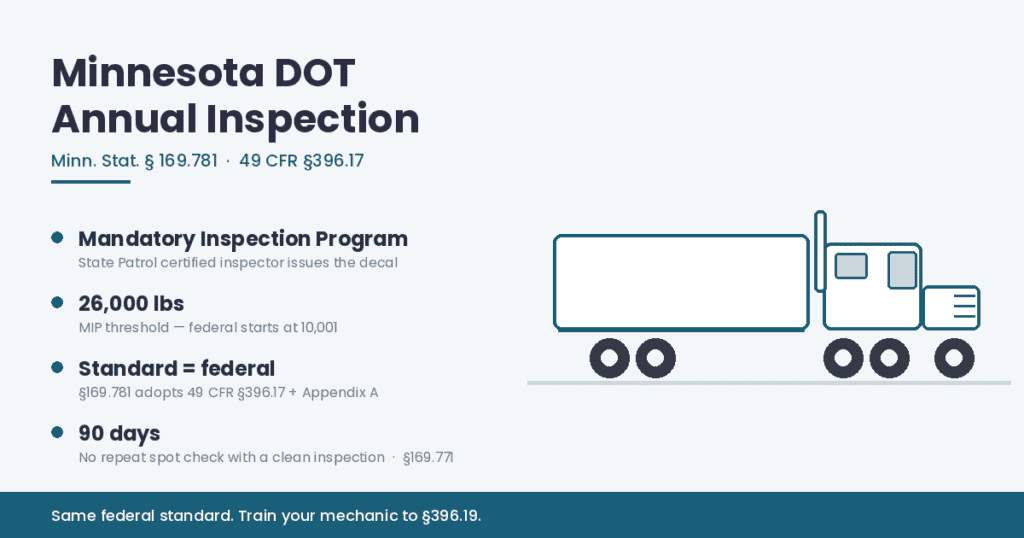
Quick Answer: The Minnesota DOT annual inspection runs through the state’s own Mandatory Inspection Program under Minn. Stat. § 169.781, administered by the Minnesota State Patrol. A commercial motor vehicle registered in Minnesota must display a valid safety inspection decal issued by a State Patrol–certified inspector — a federal §396.19 qualification does not substitute for that certification. But Minnesota’s inspection standard is the federal standard: § 169.781 requires the commissioner to adopt the criteria prescribed in 49 CFR §396.17 and Appendix A to Part 396. And there is a federal route: a Minnesota-registered vehicle housed and maintained in another state that has been inspected under the federal regulations may be eligible for a certificate of compliance. The Minnesota threshold is also higher than the federal one — gross vehicle weight over 26,000 pounds, versus 10,001 federally.
The Minnesota DOT annual inspection sits in one of the stricter state programs in the country, and one of the most precisely written statutes. The statute tells you exactly what standard applies, exactly who may perform the inspection, and exactly when the federal route opens up. This guide covers all three, plus a protection in Minnesota law that most carriers do not know they have.
Does Minnesota Require a DOT Annual Inspection?
Yes, and through its own program rather than the federal rule alone.
Minn. Stat. § 169.781 requires commercial motor vehicles to be inspected annually and to display an annual inspection decal. The program is known as the Mandatory Inspection Program, or MIP, and it is administered by the Minnesota State Patrol’s Commercial Vehicle Enforcement Section together with MnDOT.
Under subdivision 2, a covered vehicle must either display a valid safety inspection decal issued by an inspector certified by the commissioner, or carry both proof that the vehicle complies with federal motor vehicle inspection requirements for vehicles in interstate commerce and a certificate of compliance with federal requirements issued by the commissioner.
Separately, any commercial motor vehicle operating in interstate commerce must meet the federal annual inspection requirement under 49 CFR §396.17. For the national picture of how state programs interact with the federal rule, see do state DOT inspection requirements replace the federal annual inspection.
Minnesota’s Standard Is the Federal Standard — By Statute
This is the detail that makes Minnesota unusual, and it is written directly into the law.
Section 169.781, subdivision 3(d) states it directly:
“…the standards adopted by the commissioner for commercial motor vehicle inspections under sections 169.781 to 169.783 must be the standards prescribed in Code of Federal Regulations, title 49, section 396.17, and Appendix A to part 396 — Minimum Periodic Inspection Standards.”
— Minn. Stat. § 169.781, subd. 3(d)
Minnesota did not write its own inspection criteria. The legislature required the commissioner to adopt the federal ones. So a Minnesota MIP inspection and a federal annual inspection are measured against identical component standards.
What differs is not the standard but the credential — who is permitted to sign off, and what decal goes on the truck. That distinction is the whole of Minnesota compliance, and it is where most confusion lives.
Which Vehicles Does the Minnesota MIP Cover?
The Minnesota threshold is considerably higher than the federal one, which catches carriers off guard in both directions.
| Requirement | Threshold |
|---|---|
| Minnesota MIP decal — Minn. Stat. § 169.781 | Gross vehicle weight greater than 26,000 lbs, or a combination over 26,000 lbs |
| Federal annual inspection — 49 CFR §396.17 | Commercial motor vehicle per §390.5 — generally 10,001 lbs and above |
Beyond the weight test, the MIP also covers:
- Any vehicle, regardless of size, transporting a quantity of hazardous materials requiring placards
- Self-propelled special mobile equipment mounted on a commercial motor vehicle chassis with a gross vehicle weight over 26,000 pounds
- Vehicles used to transport passengers by a motor carrier of railroad employees under § 221.0255
The gap between the two thresholds matters. A Minnesota carrier running a 15,000-pound box truck in interstate commerce is below the MIP threshold but squarely inside the federal annual inspection requirement under §396.17. The state decal is not required; the federal inspection still is.
For the federal scope question in full, see what vehicles require a DOT annual inspection.
One exemption worth knowing: a covered farm vehicle, as defined in 49 CFR §390.5, is not required to be inspected or to display an annual inspection decal.
Who Can Perform a Minnesota MIP Inspection?
This is the part that cannot be worked around, and it is worth being direct about.
Under § 169.781, subdivision 3(a), an inspection required by the section may be performed only by:
- An employee of the Department of Public Safety or MnDOT who has been certified by the commissioner after receiving training provided by the State Patrol; or
- Another person certified by the commissioner after receiving State Patrol training or other training approved by the commissioner, who is one of the following:
- An owner, or an employee of the owner, of one or more commercial motor vehicles that are power units
- A dealer licensed under § 168.27 engaged in buying and selling commercial motor vehicles, or an employee of that dealer
- Engaged in the business of repairing and servicing commercial motor vehicles
- Employed by a governmental agency that owns commercial vehicles
| Minnesota MIP inspector | Federal §396.19 inspector | |
|---|---|---|
| Authority | Minn. Stat. § 169.781, subd. 3 | 49 CFR §396.19 |
| How you qualify | Certified by the commissioner after State Patrol or approved training | Carrier determines you meet the standard; two routes under §396.19(a)(3) |
| Who is eligible | Limited to the five categories in subd. 3(b) | Anyone meeting the standard |
| Standard applied | 49 CFR §396.17 + Appendix A | 49 CFR §396.17 + Appendix A — the same |
| Can issue an MN decal? | Yes | No |
| Record kept by | Owner, under subd. 4; State Patrol may audit | Motor carrier, under §396.19(b) |
A federal 49 CFR §396.19 qualification does not make you a Minnesota certified vehicle inspector. No training course does. Minnesota certification comes through the State Patrol, or through training the commissioner has approved, and the State Patrol partners with several Minnesota technical colleges to deliver it.
The certification also carries ongoing obligations. Under subdivision 3(f), the commissioner may suspend a certificate for failure to meet annual certification requirements or for failing to inspect vehicles in accordance with State Patrol procedures — and must revoke it if a certified person issued a decal for a vehicle that was not inspected or did not meet the standards.
When the Federal Route Applies in Minnesota
The statute leaves three situations where federal qualification is what matters.
1. Minnesota-registered vehicles housed and maintained out of state. Under subdivision 2, a covered vehicle may satisfy the requirement by carrying proof of compliance with federal inspection requirements plus a certificate of compliance issued by the commissioner. Minnesota DPS confirms that a Minnesota-registered commercial motor vehicle housed and maintained in another state, inspected in accordance with federal regulations, may be eligible for that certificate. All certificate of compliance requests are reviewed by Minnesota State Patrol inspectors.
That federal inspection must be performed by an inspector qualified under 49 CFR §396.19.
2. Equipment plated outside Minnesota. The MIP reaches commercial motor vehicles registered in Minnesota. A carrier operating in Minnesota with equipment registered elsewhere meets the annual inspection requirement under the rules of the plating state, which for most states is the federal route.
3. Vehicles below the MIP threshold but above the federal one. As above — between 10,001 and 26,000 pounds, the federal requirement applies and the state decal does not.
Which route applies to your equipment
| Your situation | What you need |
|---|---|
| MN-registered, over 26,000 lbs, housed in Minnesota | MIP decal from a State Patrol–certified inspector |
| MN-registered, housed and maintained out of state | Federal inspection by a §396.19 inspector + certificate of compliance from the commissioner |
| Registered outside Minnesota | The plating state’s rules — for most, the federal route |
| 10,001–26,000 lbs, interstate | Federal §396.17 inspection; no MIP decal required |
| Placarded hazmat, any weight | Covered by the MIP regardless of size |
| Covered farm vehicle per §390.5 | Not required to be inspected or display a decal |
| Anyone doing brake work | §396.25 qualification — in every row above |
For the qualification standard itself, see who can perform DOT annual inspections and our guide to FMCSA §396.19.
The 90-Day Spot-Check Protection
Here is a provision in Minnesota law most carriers do not know they have.
Under Minn. Stat. § 169.771, State Patrol personnel may not conduct another spot inspection of a commercial motor vehicle if the operator can show evidence of an inspection free of critical defects, conducted in Minnesota under § 169.771 or § 169.781 within the previous 90 days, and a state trooper does not have probable cause to believe the vehicle or its equipment is unsafe or that the operator has engaged in illegal activity.
The practical effect: a clean, recent inspection document is worth carrying. It is a statutory basis for declining a repeat spot check, provided no probable cause exists.
The same section also provides that a vehicle stopped and determined to be a covered farm vehicle under 49 CFR §390.5, not carrying placarded hazardous materials, is exempt from further inspection under that section.
How Do You Find a Certified Minnesota Inspector?
Because certification is limited to the categories in § 169.781, subdivision 3(b), the people who can issue a Minnesota decal are a defined group, and one of them is easy to overlook.
Your own shop may already qualify. An owner, or an employee of the owner, of one or more commercial motor vehicles that are power units can be certified. So can anyone engaged in the business of repairing and servicing commercial motor vehicles. If you operate power units or run a commercial repair shop, your people are eligible for certification — they simply have to complete State Patrol training or training the commissioner has approved. The Minnesota State Patrol partners with several Minnesota technical colleges to deliver it.
Licensed dealers can be certified too. A dealer licensed under § 168.27 engaged in buying and selling commercial motor vehicles, or an employee of that dealer, is an eligible category. Worth knowing if you are buying equipment — the selling dealer may be able to deliver the truck with a current decal already on it.
And government fleets have their own route. Someone employed by a governmental agency that owns commercial vehicles is eligible, alongside certified DPS and MnDOT employees.
Contact the Minnesota State Patrol’s Commercial Vehicle Enforcement Section for current certification requirements, training schedules, and the process for finding a certified inspector near you.
Brakes Require a Separate Federal Qualification — Regardless
This one is federal, it attaches to the person rather than the program, and it applies in Minnesota no matter which inspection route your equipment falls under.
Under 49 CFR §396.25, anyone who inspects, maintains, services, or repairs brakes on a commercial motor vehicle must meet brake inspector qualification requirements, and the motor carrier must retain evidence of that qualification. Holding a Minnesota inspector certificate does not satisfy §396.25, and §396.25 does not satisfy Minnesota certification. They are separate requirements from separate authorities.
A CDL air brake endorsement does not satisfy §396.25 either — FMCSA has stated that directly. See does a CDL air brake endorsement make you a qualified brake inspector, 396.19 vs 396.25, and our DOT air brake certification requirements guide.
Brakes are where enforcement concentrates. In CVSA’s 2026 International Roadcheck, brake system violations accounted for 3,379 out-of-service violations, 24.3% of all vehicle out-of-service findings — the largest single category, essentially unchanged from 24.4% in 2025. See why trucks fail DOT inspections.
Records, Audits, and Penalties
Minnesota gives the State Patrol and MnDOT direct audit authority at your facility.
Under § 169.781, subdivision 6, employees of the State Patrol and motor transportation representatives of MnDOT may review the records required to be kept under subdivision 4, and may conduct random vehicle inspections and audits at the facility of an owner of a commercial motor vehicle.
Note what that means practically: subdivision 4 obliges the vehicle owner to keep inspection records, and subdivision 6 gives the State Patrol authority to come to your yard and review them without the process being tied to a roadside stop. Confirm the current record-retention specifics with the Minnesota State Patrol, since the statute delegates detail to the commissioner.
There is also a fee element. Under subdivision 7, the commissioner pays all revenues received under the section to the commissioner of management and budget for deposit in the trunk highway fund — so the program is fee-supported. Current amounts are set administratively and should be confirmed with DPS rather than taken from a third-party source.
Under subdivision 8, a violation of the section is a misdemeanor.
If you rely on the federal route for any equipment, the federal recordkeeping applies as well:
| Record | Regulation | Retention |
|---|---|---|
| Annual inspection report | §396.21(b)(1) | 14 months |
| Inspector qualification evidence | §396.19(b) | Service + 1 year |
| Brake inspector qualification | §396.25(e) | Employment in role + 1 year |
| Driver vehicle inspection report | §396.11(a)(4) | 3 months |
See what the qualification record should contain, what goes on the truck and what stays in the file, and DVIR requirements under §396.11.
Where Training Fits, and Where It Does Not
Being straight about this matters, because Minnesota is one of the states where a training course cannot do everything.
Training does not make you a Minnesota certified vehicle inspector. No course does. Minnesota certification comes through State Patrol training or training approved by the commissioner, and it is limited to the categories of person listed in § 169.781, subdivision 3(b). If you need to issue Minnesota decals, that is the path.
Training is what qualifies the people doing federal work. Minnesota-registered vehicles housed out of state rely on a federal inspection performed by a §396.19-qualified inspector. Equipment plated outside Minnesota falls under the federal route entirely. Vehicles between 10,001 and 26,000 pounds need the federal inspection and no state decal. And brake work needs §396.25 qualification regardless of route.
There is also a knowledge argument that is not a paperwork argument. Because § 169.781 requires Minnesota’s standards to be the federal ones in §396.17 and Appendix A, a mechanic trained to the federal criteria is trained to exactly the standard a Minnesota inspection applies. The certification is separate; the technical content is the same.
Minnesota’s standard is the federal standard. Train to it.
Minn. Stat. § 169.781 requires the commissioner to adopt the criteria in 49 CFR §396.17 and Appendix A to Part 396. Whatever route your equipment takes, those are the components being measured.
Our DOT Annual Inspection Training Course covers Part 393 and Appendix A in full, and produces the three records a carrier keeps on file for federal work:
- Certificate of completion — documented training under §396.19(a)(3)(ii)(A)
- Inspector qualification form — the §396.19(b) record your carrier retains
- Inspection checklist — for performing and recording annual inspections
To be clear about what it is not: this does not make you a Minnesota certified vehicle inspector and does not authorize issuing Minnesota MIP decals. That certification comes through the State Patrol.
Several mechanics or a multi-state fleet? Group registration with volume discounts.
For the step-by-step path, see how to get certified to do DOT inspections, and if you manage a maintenance team, DOT inspection training for fleet mechanics.
Operating in more than one state? See our guides for Texas, California, Pennsylvania, Georgia, North Carolina, Florida, Washington, Illinois, and Ohio, plus the federal requirement in our guide to 49 CFR §396.17.
Minnesota DOT Annual Inspection Frequently Asked Questions
Does Minnesota require a DOT annual inspection?
Yes. Minn. Stat. § 169.781 requires commercial motor vehicles to be inspected annually and to display an annual inspection decal, under the Mandatory Inspection Program administered by the Minnesota State Patrol. Alternatively, a vehicle may carry proof of compliance with federal inspection requirements plus a certificate of compliance issued by the commissioner.
What is the Minnesota Mandatory Inspection Program?
The MIP is Minnesota’s state commercial vehicle inspection program under Minn. Stat. § 169.781, administered by the Minnesota State Patrol’s Commercial Vehicle Enforcement Section with MnDOT. Covered vehicles must be inspected annually by a State Patrol–certified inspector and display a valid safety inspection decal.
What weight requires a Minnesota MIP inspection?
Gross vehicle weight greater than 26,000 pounds, or a combination of vehicles over 26,000 pounds. The MIP also covers any vehicle regardless of size transporting placarded hazardous materials, self-propelled special mobile equipment on a commercial motor vehicle chassis over 26,000 pounds, and vehicles transporting passengers by a motor carrier of railroad employees under § 221.0255. Note this is higher than the federal 10,001-pound threshold in 49 CFR §390.5.
Can I perform my own DOT inspections in Minnesota?
Only if you are certified by the commissioner. Under § 169.781, subd. 3, an inspection may be performed only by a certified DPS or MnDOT employee, or by another person certified by the commissioner after State Patrol training or approved training, who is an owner or employee of an owner of commercial power units, a licensed dealer or dealer employee, someone engaged in repairing and servicing commercial motor vehicles, or an employee of a governmental agency owning commercial vehicles. A federal §396.19 qualification does not substitute.
Does a federal 396.19 qualification work in Minnesota?
Not for issuing Minnesota MIP decals on Minnesota-registered vehicles housed in the state. It does apply in three situations: Minnesota-registered vehicles housed and maintained in another state seeking a certificate of compliance, equipment plated outside Minnesota, and vehicles between 10,001 and 26,000 pounds that fall under the federal requirement but below the MIP threshold. Brake work also requires federal §396.25 qualification regardless of route.
How do I find a certified Minnesota vehicle inspector?
Certified inspectors come from the categories in Minn. Stat. § 169.781, subd. 3(b): certified DPS or MnDOT employees, owners or employees of owners of commercial power units, licensed dealers under § 168.27 or their employees, people engaged in the business of repairing and servicing commercial motor vehicles, and employees of governmental agencies that own commercial vehicles. If you operate power units or run a commercial repair shop, your own people are eligible for certification through State Patrol training. Contact the Minnesota State Patrol Commercial Vehicle Enforcement Section for current requirements and training schedules.
Are Minnesota inspection standards different from federal standards?
No. Under § 169.781, subd. 3(d), the standards adopted by the commissioner must be the standards prescribed in 49 CFR §396.17 and Appendix A to Part 396, Minimum Periodic Inspection Standards. Minnesota adopted the federal criteria by statute. What differs is the credential required to perform the inspection and issue the decal, not the technical standard being applied.
What if my Minnesota-registered truck is based in another state?
A Minnesota-registered commercial motor vehicle housed and maintained in another state that has been inspected in accordance with federal regulations may be eligible for a certificate of compliance from the commissioner. All certificate of compliance requests are reviewed by Minnesota State Patrol inspectors. The federal inspection must be performed by an inspector qualified under 49 CFR §396.19.
Can the State Patrol spot-check my truck repeatedly?
Not without probable cause if you have a recent clean inspection. Under Minn. Stat. § 169.771, State Patrol personnel may not conduct another spot inspection if the operator shows evidence of an inspection free of critical defects conducted in Minnesota under § 169.771 or § 169.781 within the previous 90 days, and a trooper does not have probable cause to believe the vehicle or equipment is unsafe or that the operator has engaged in illegal activity.
Are farm vehicles exempt in Minnesota?
A covered farm vehicle as defined in 49 CFR §390.5 is not required to be inspected or to display an annual inspection decal. Separately, under Minn. Stat. § 169.771, a vehicle stopped and determined to be a covered farm vehicle that is not carrying placarded hazardous materials is exempt from further inspection under that section, though enforcement may still be initiated if probable cause exists.
Do I need a separate qualification to inspect brakes in Minnesota?
Yes. Under 49 CFR §396.25, anyone who inspects, maintains, services, or repairs brakes on a commercial motor vehicle needs documented brake inspector qualification, and the carrier retains that evidence. This is federal and attaches to the person, so it applies regardless of which inspection route the equipment falls under. A Minnesota inspector certificate does not satisfy §396.25, and a CDL air brake endorsement does not either.
What are the penalties for a Minnesota inspection violation?
Under Minn. Stat. § 169.781, subd. 8, a violation of the section is a misdemeanor. The State Patrol and MnDOT may also review records and conduct random vehicle inspections and audits at the facility of a commercial motor vehicle owner under subdivision 6. A certified inspector’s certificate may be suspended for procedural failures and must be revoked if the inspector issued a decal for a vehicle that was not inspected or did not meet the standards.
Does your course qualify me to inspect in Minnesota?
The course documents the training component of qualification under 49 CFR §396.19(a)(3)(ii), which is what applies to Minnesota-registered vehicles housed out of state, equipment plated outside Minnesota, and vehicles below the 26,000-pound MIP threshold. It does not make you a Minnesota certified vehicle inspector and does not authorize issuing MIP decals — that certification comes through State Patrol training or training approved by the commissioner. Because § 169.781 requires Minnesota’s standards to be the federal criteria in §396.17 and Appendix A, the technical content is the same either way.
The Bottom Line
Minnesota runs a mandatory state inspection program under Minn. Stat. § 169.781, and for a Minnesota-registered commercial vehicle over 26,000 pounds housed in the state, a State Patrol–certified inspector issues the decal. No training course substitutes for that certification.
But the standard being applied is the federal one, written into the statute. And the federal route governs in three real situations: Minnesota-registered equipment housed out of state, equipment plated elsewhere, and vehicles between 10,001 and 26,000 pounds. Brake qualification under §396.25 applies in all of them.
For a Minnesota fleet, the practical answer on the Minnesota DOT annual inspection is to know which of your units falls where, and to make sure whoever signs each inspection holds the right credential for that route.
Qualifying several mechanics? Group registration with volume discounts is available for shops and fleets.
About the Author
Josh Lopez has spent more than 10 years in trucking and freight, working across shippers, carriers, brokerage, and reefer LTL. He founded dotinspectioncourse.com to give mechanics, owner-operators, and fleet managers accurate, regulation-first training on 49 CFR Part 396. Every regulatory citation on this site is verified against the current primary source before publication.