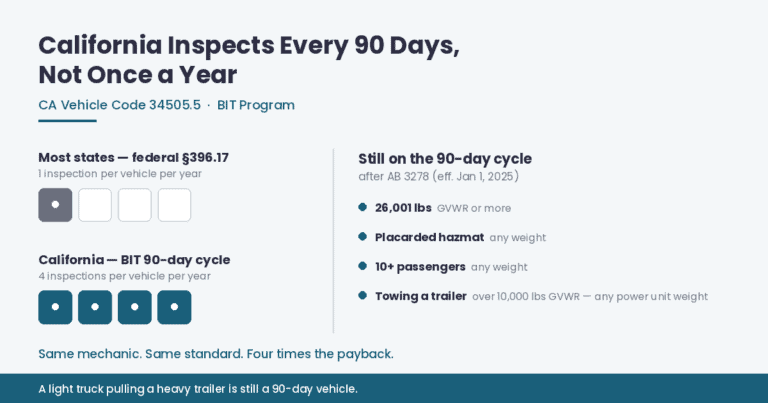
Quick Answer: The California DOT annual inspection does not work like it does in most states. California runs the Basic Inspection of Terminals (BIT) program through the California Highway Patrol under Vehicle Code 34501.12, and FMCSA has deemed it equivalent to the federal Part 396 periodic inspection. Regulated vehicles must be inspected every 90 days, not once a year, and carriers perform those inspections themselves using an inspector qualified under 49 CFR §396.19. Assembly Bill 3278 narrowed the program: effective January 1, 2025, vehicles under 26,001 pounds GVWR left the 90-day cycle and moved to the federal annual inspection, unless they haul placarded hazmat, carry 10 or more passengers, or tow a trailer over 10,000 pounds.
California is the most demanding inspection state in the country for heavy fleets, and it is also the one where qualifying your own inspector pays for itself fastest. Four inspections per vehicle per year instead of one is the reason. This guide breaks down how BIT works, what AB 3278 actually changed and when, and who is allowed to perform the inspections.
Does California Require a DOT Annual Inspection?
Yes, but California meets the federal requirement through its own program rather than a standalone annual inspection. The California Highway Patrol administers the Basic Inspection of Terminals program under Section 34501.12 of the California Vehicle Code, with the 90-day inspection mandate in Section 34505.5. FMCSA has determined that California’s program is equivalent to the federal periodic inspection requirement in 49 CFR Part 396, so complying with the California program satisfies the federal annual inspection obligation.
The key difference is frequency. California requires regulated vehicles to be inspected every 90 days, four times more often than the federal minimum of once every 12 months. For heavier commercial vehicles based in California, the state standard is substantially stricter than the federal baseline.
For how the state-versus-federal question works generally, see do state DOT inspection requirements replace the federal annual inspection.
What Is the BIT Program?
BIT stands for Basic Inspection of Terminals. The program was created by Assembly Bill 529, signed in 2013, though CHP has conducted terminal inspections since 1965.
Rather than inspecting each truck at a station, the CHP inspects motor carrier terminals, meaning the locations where vehicles are garaged, maintained, or dispatched. During a terminal inspection, the CHP reviews your maintenance program, your 90-day inspection records, driver records, and hazardous materials records if applicable, and samples vehicles on site. Inspectors typically want to see roughly 20 percent of the fleet and will go over those units in detail.
Terminals are selected on a performance basis using CSA Safety Measurement System percentiles. Carriers above the federal alert level get priority, as do carriers CHP has never inspected and terminals that ship hazardous materials. A carrier that does not exceed the performance thresholds will not be inspected more than once every six years.
The takeaway is that BIT is an audit of your entire maintenance and recordkeeping system, and the 90-day vehicle inspections are the backbone of what the CHP checks. The most common audit failure is not being able to produce a complete, unbroken history of the 90-day inspection records.
What Did AB 3278 Actually Change, and When?
This is the update most California carriers get wrong, including the date.
Assembly Bill 3278 was signed on September 12, 2024. It amended California’s mandatory 90-day vehicle inspection program. Effective January 1, 2025, only commercial motor vehicles with a gross vehicle weight rating of 26,001 pounds or more remained subject to the mandatory 90-day BIT inspection requirement. Vehicles under 26,001 pounds GVWR left the 90-day cycle and instead comply with the federal annual inspection requirement under 49 CFR §396.17. A related restructuring of Vehicle Code 34501.12, which governs BIT program scope, became operative January 1, 2026.
Do not deregister your fleet too quickly. The weight threshold is a simplification, and three categories stay on the 90-day cycle regardless of individual vehicle weight:
Placarded hazardous materials. Any vehicle or combination transporting hazmat in quantities requiring placards, a California hazardous materials transportation license, or a California hazardous waste transporter registration.
Passenger vehicles carrying 10 or more. Buses and passenger configurations stay in.
Combination vehicles. A commercial motor vehicle of any GVWR towing a trailer, semitrailer, pole or pipe dolly, auxiliary dolly, or logging dolly with a GVWR of more than 10,000 pounds remains on the 90-day cycle. This is the one that catches people. A light truck under 26,001 pounds pulling a heavy trailer is still a 90-day vehicle.
If any of those apply to your operation, the 90-day cycle and the terminal program still govern. Confirm scope with your CHP Motor Carrier Safety Unit before withdrawing a terminal designation.
Who Can Perform a DOT Inspection in California?
Whether it is a 90-day BIT inspection or a federal annual inspection, the person performing it must meet the federal inspector qualification standard in 49 CFR §396.19. That standard has three parts.
The inspector must understand the inspection criteria in Part 393 and Appendix A to Part 396 and be able to identify defective components. The inspector must be knowledgeable of and have mastered the methods, procedures, tools, and equipment used when performing an inspection. And under §396.19(a)(3), the inspector must be capable of performing the inspection either through a Federal- or State-sponsored training program or a qualifying state certificate, or through a combination of training and/or experience totaling at least one year.
Here is what makes California different from a state like Texas or Pennsylvania. California does not route your trucks through a state inspection station. The CHP’s own guidance is that carriers must ensure each regulated vehicle is inspected at least every 90 days, and BIT is an audit of whether the carrier’s own maintenance program is doing that properly. In-house inspection is not a loophole in California. It is the design of the program.
That means qualifying your own inspector is not just permitted, it is the practical backbone of California compliance. For the full breakdown, see who can perform DOT annual inspections, our guide to FMCSA §396.19, and can I do my own DOT annual inspection.
Brakes Require a Second, Separate Qualification
This matters more in California than anywhere else, and most carriers miss it entirely.
The 90-day inspection covers brake adjustment, brake system components and leaks, steering and suspension systems, tires and wheels, and vehicle connecting devices. Brakes are the first item on that list, and they carry their own federal qualification requirement.
Under 49 CFR §396.25, anyone who inspects, maintains, services, or repairs brakes on a commercial motor vehicle must meet separate brake inspector qualification requirements, and the carrier must maintain evidence of that qualification at its principal place of business. If your mechanic is checking brake adjustment four times a year on every truck in the yard, that person needs documented §396.25 qualification, and the CHP is going to be looking at your maintenance program during a terminal inspection.
A CDL air brake endorsement does not satisfy §396.25. FMCSA has said so directly. See does a CDL air brake endorsement make you a qualified brake inspector, who fills out the §396.25 brake inspector qualification form, and our DOT air brake certification requirements guide.
The emphasis is justified by the enforcement data. In CVSA’s 2026 International Roadcheck, brake system violations accounted for 3,379 out-of-service violations — 24.3% of all vehicle out-of-service violations and the largest single category. See why trucks fail DOT inspections.
What Records Are Required?
Inspections must be documented and must include the signature of the carrier’s authorized representative attesting to the inspection and to the completion of all required repairs. CHP reviews these records during a terminal inspection, along with the write-ups and the corresponding invoices or work orders showing the repairs were actually made.
Keep the 90-day inspection records for at least two years. CHP will typically ask to see the full inspection history across that window, and a gap in the sequence is the single most common finding.
If you also perform federal annual inspections, whether for lighter vehicles that left the 90-day cycle under AB 3278 or for equipment plated outside California, 49 CFR §396.21 requires the periodic inspection report to be retained for 14 months, with proof of the current inspection on the vehicle. You also keep evidence of your inspector’s §396.19 qualification for the duration of their service plus one year, and separate §396.25 evidence for anyone performing brake work.
For what the documentation on the vehicle itself must contain, see what goes on the truck and what stays in the file, and for the qualification record structure, our FMCSA inspector qualifications form guide.
Why Qualifying an Inspector Pays Off Fastest in California
Run the arithmetic. A carrier in most states needs one inspection per vehicle per year. A California carrier with regulated vehicles needs four. Every one of those inspections either goes to an outside shop or gets done in-house by a qualified inspector.
For a fleet of any size, the cost of routing every truck to a shop four times a year is not close to the cost of qualifying a mechanic once. And the qualification does not expire. This is why California is the state where in-house inspection capability has the clearest payback.
Most working mechanics already have the experience component of §396.19(a)(3)(ii). What is usually missing is documented training in the federal inspection standards rather than knowledge picked up on the job, and that documentation gap is exactly what a CHP terminal inspection surfaces.
Four inspections a year, every year. One course that doesn’t expire.
Our DOT Annual Inspection Training Course covers the inspection criteria in 49 CFR Part 393 and Appendix A to Part 396 — the brake systems, steering, suspension, tires, wheels, and connecting devices that make up the California 90-day inspection. Every enrollment includes three records for your file, which is exactly what CHP reviews during a terminal inspection:
- Certificate of completion — documented training under §396.19(a)(3)(ii)(A)
- Inspector qualification form — the §396.19(b) record your carrier retains
- Inspection checklist — for performing and recording inspections
Multiple terminals or several mechanics? Group registration with volume discounts.
For the step-by-step path to qualification, see how to get certified to do DOT inspections.
Operating in more than one state? See our state guides for Texas, Pennsylvania, North Carolina, Illinois, and Ohio, and the underlying federal requirement in our guide to 49 CFR §396.17.
California DOT Inspection Frequently Asked Questions
Does California require a DOT annual inspection?
California meets the federal requirement through its own BIT program, which FMCSA has deemed equivalent to the federal Part 396 periodic inspection. Regulated vehicles are inspected every 90 days rather than once a year. Vehicles that fall outside the 90-day cycle follow the federal annual inspection under 49 CFR §396.17.
What is the BIT program?
The Basic Inspection of Terminals program, administered by the California Highway Patrol under Vehicle Code 34501.12. CHP inspects motor carrier terminals and reviews the maintenance program, 90-day inspection records, driver records, and hazmat records, sampling vehicles on site, rather than inspecting each truck at a station.
What did AB 3278 change, and when?
AB 3278 was signed September 12, 2024. Effective January 1, 2025, only commercial motor vehicles with a GVWR of 26,001 pounds or more remain subject to the mandatory 90-day BIT inspection. Lighter vehicles moved to the federal annual inspection under 49 CFR §396.17. A related restructuring of Vehicle Code 34501.12 became operative January 1, 2026.
My trucks are under 26,001 pounds. Am I off the 90-day cycle?
Not necessarily. Placarded hazmat vehicles, passenger vehicles carrying 10 or more, and any commercial vehicle of any GVWR towing a trailer with a GVWR over 10,000 pounds all remain on the 90-day cycle regardless of the power unit’s weight. Confirm your scope with your CHP Motor Carrier Safety Unit before withdrawing a terminal designation.
Can I inspect my own vehicles in California?
Yes, and it is how the program is designed. California does not route commercial vehicles through state inspection stations. Carriers must ensure each regulated vehicle is inspected at least every 90 days, and the person performing the inspection must be qualified under 49 CFR §396.19. BIT is CHP’s audit of whether your maintenance program is doing that properly.
Do I need a separate qualification to inspect brakes in California?
Yes. Under 49 CFR §396.25, anyone who inspects, maintains, services, or repairs brakes on a commercial vehicle needs documented brake inspector qualification in addition to §396.19, and the carrier keeps that evidence on file. Brake adjustment is the first item on the California 90-day inspection list. A CDL air brake endorsement does not satisfy it.
How long must California inspection records be kept?
Keep 90-day inspection records for at least two years. They must be documented and signed by the carrier’s authorized representative attesting to the inspection and to the completion of all required repairs. Federal periodic inspection reports are kept for 14 months under 49 CFR §396.21, and inspector qualification evidence for the duration of service plus one year.
How often is a BIT inspection required in California?
Regulated vehicles must be inspected every 90 days under Vehicle Code Section 34505.5, which is four times per year rather than the federal minimum of once every 12 months. Separately, CHP terminal inspections are scheduled on a performance basis using CSA Safety Measurement System percentiles, and a carrier that does not exceed the performance thresholds will not be inspected more than once every six years.
Does your course qualify me to inspect in California?
The course covers the federal inspection standards in Part 393 and Appendix A, which are the standards behind both California’s 90-day inspection and the federal annual inspection, and issues a certificate documenting the training component of your qualification under 49 CFR §396.19(a)(3)(ii). Combined with your commercial vehicle maintenance experience, that is what qualifies you to perform 90-day and annual inspections on your own equipment.
About the author: Josh Lopez has spent more than 10 years in the trucking and freight industry, working across shippers, carriers, brokerage, and reefer LTL. He writes about DOT compliance, FMCSA regulations, and commercial vehicle inspection to help mechanics, owner-operators, and fleet managers understand the rules that govern their operations and stay compliant on the road.