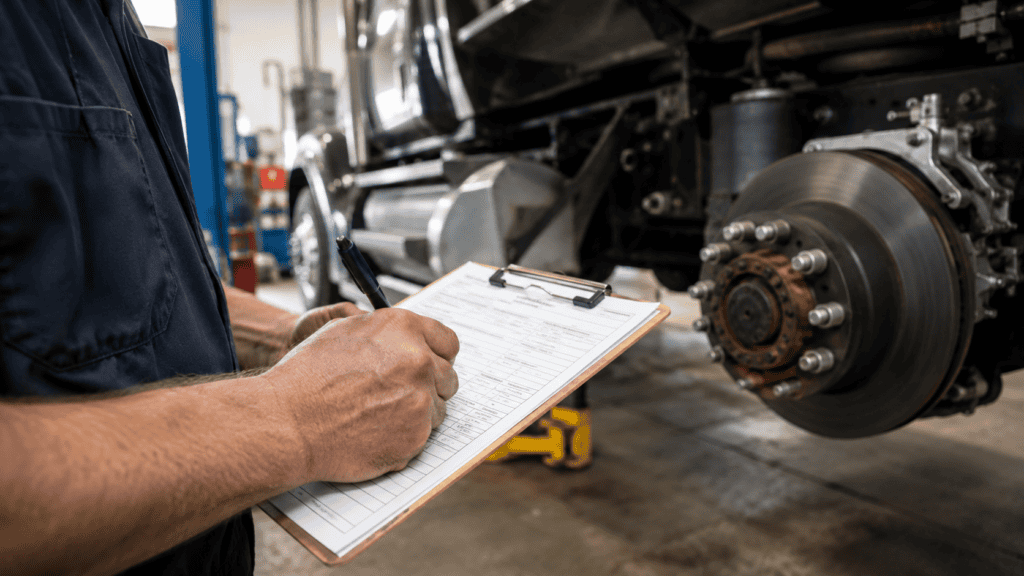
Quick Answer: There is no FMCSA-mandated 396.25 brake inspector qualification form, but the documentation still has to exist. In practice, two people are involved: the brake inspector (the mechanic or technician) provides and attests to their qualifications, and the motor carrier or their employer/supervisor reviews and certifies them. The carrier, not the inspector, is legally responsible for keeping that evidence on file at its principal place of business for as long as the person works as a brake inspector, plus one year. FMCSA publishes an optional sample brake inspector form through its CSA Safety Planner, and it has signature lines for both the inspector and the employer.
If you’re trying to get your §396.25 brake inspector documentation right, the “who fills it out and who signs it” question is where people get stuck. It’s a fair question, because the regulation puts the responsibility on one party and the qualifications on another. This guide breaks down exactly who does what, what the record needs to contain, and the one exception that lets you skip it.
Who Fills Out the 396.25 Brake Inspector Form?
There is no single government form you’re required to use, so “fills out” really means “who provides the information and who certifies it.” Two roles are involved:
The brake inspector (the mechanic or technician) supplies and attests to their own qualifications, which route under §396.25 they meet, what training or experience they have, and signs to confirm it.
The employer or supervisor reviews those qualifications and signs to certify the carrier has verified them. This matters because under the regulation, it is the motor carrier, not the inspector, that is legally on the hook for making sure the inspector is qualified and that the evidence is on file.
On FMCSA’s optional sample form (published through the CSA Safety Planner), you’ll see exactly this: a signature line for the mechanic/inspector and a separate signature line for the employer/supervisor, plus a line noting where the qualification evidence is kept. That two-signature structure is the practical answer to “who fills it out.”
Is There an Official FMCSA 396.25 Form?
No. FMCSA does not mandate a specific brake inspector qualification form. Section §396.25 requires the carrier to maintain evidence of the inspector’s qualifications, but it does not prescribe a format.
FMCSA does publish an optional sample brake inspector qualifications form through its CSA Safety Planner, and many carriers use it as a template. But you are free to use your own format, a training provider’s certificate, or any documentation that captures the required elements. What matters is the substance — that the evidence proves qualification, not that you used a particular piece of paper.
This mirrors the §396.19 annual inspector qualification rule, which also has no mandated form. If you’re documenting both, our FMCSA inspector qualifications form guide covers the §396.19 side, and 396.19 vs 396.25 explains how the two standards relate.
Who Is Legally Responsible for the Documentation?
The motor carrier. This is the part that trips up owner-operators and small fleets.
Under 49 CFR §396.25(e), no motor carrier may employ a person as a brake inspector unless the evidence of that inspector’s qualifications is maintained by the carrier at its principal place of business, or at the location where the inspector works. The inspector provides the qualifications; the carrier is responsible for holding the proof.
For an owner-operator who inspects their own brakes, you’re both the inspector and the carrier, so you wear both hats: you document your own qualifications and you keep the evidence on file. For a fleet, the shop’s mechanics are the inspectors, and the company is responsible for keeping each one’s qualification record. See can I do my own DOT annual inspection for the owner-operator version in full.
What Does “Brake Inspector” Actually Mean Here?
The regulation defines it broadly. Under 49 CFR §396.25(b), a brake inspector is any employee responsible for ensuring that brake inspections, maintenance, service, or repairs on the carrier’s commercial vehicles meet the federal standards.
That’s wider than most people expect. It’s not just the person doing the annual inspection. Anyone who inspects, services, adjusts, or repairs brakes on your commercial vehicles falls under §396.25 and needs documented qualification. If a technician touches the brakes in a compliance-relevant way, the rule applies to them.
One useful flexibility: FMCSA guidance confirms that §396.25 qualification is task-specific. A motor carrier may qualify an employee to perform a limited number of brake tasks — inspecting and adjusting brakes, for instance — without qualifying them to repair or replace brake components. The record should name the tasks the person is qualified for.
How Does Someone Qualify as a Brake Inspector?
Under 49 CFR §396.25(d), the carrier must ensure each brake inspector meets three conditions, and all three have to be true. The inspector must understand the brake service or inspection task and be able to perform it; must be knowledgeable of and have mastered the methods, procedures, tools, and equipment used for that task; and must be capable of performing it by reason of experience, training, or both.
That third condition, §396.25(d)(3), has two routes:
Route 1 — §396.25(d)(3)(i): a sponsored apprenticeship program (State, Canadian Province, Federal agency, or labor union), a training program approved by a State, Provincial, or Federal agency, or a certificate from a State or Canadian Province qualifying the person for the assigned task — which the regulation notes includes passage of Commercial Driver’s License air brake tests in the case of a brake inspection.
Route 2 — §396.25(d)(3)(ii): brake-related training or experience, or a combination, totaling at least one year.
The documentation you keep should capture which route the inspector meets and the supporting evidence — a training certificate, an apprenticeship record, or experience verification. For the full breakdown of how someone qualifies, see our DOT air brake certification requirements guide.
The One Exception: The CDL Air Brake Test
There is a narrow exception worth knowing, and it’s frequently misunderstood.
Under §396.25(e), a carrier does not have to maintain evidence of qualifications to inspect air brake systems for inspections performed by a person who has passed the air brake knowledge and skills test for a Commercial Driver’s License.
Read that carefully, because it’s narrower than “a CDL covers brake qualification.” It applies only to air brake system inspection, and only to someone who actually passed the CDL air brake test — meaning they do not have the air brake restriction on their CDL. It does not extend to hydraulic brakes, or to brake repair and maintenance beyond that air-brake-inspection scope.
And note what it is and is not. Section §396.25(e) is a recordkeeping waiver, not a grant of qualification. Passing the CDL air brake test satisfies condition (3) of §396.25(d) for a brake inspection, but conditions (1) and (2) — understanding the task and having mastered the methods and tools — remain the carrier’s determination. That is why FMCSA guidance answers no when asked directly whether a CDL with an air brake endorsement qualifies a person as a brake inspector under §396.25. We explain the distinction in detail in does a CDL air brake endorsement make you a qualified brake inspector.
For everything outside that narrow exception, the documented qualification requirement stands.
How Long Do You Keep the Record?
Under §396.25(e), the evidence must be maintained for the period during which the person is employed as a brake inspector, plus one year after they stop. If a mechanic leaves or moves off brake work, you keep their qualification record for one more year.
This is the same retention structure as the §396.19 annual inspector record, which is convenient because the two records are usually kept together. But Part 396 sets several different clocks, and mixing them up is a common audit finding:
| Record | Regulation | Retention |
|---|---|---|
| Brake inspector qualification | §396.25(e) | Employment as brake inspector + 1 year |
| Annual inspector qualification | §396.19(b) | Period of service + 1 year |
| Annual inspection report | §396.21(b)(1) | 14 months |
| Driver vehicle inspection report | §396.11(a)(4) | 3 months |
See DVIR requirements under §396.11 and what goes on the truck and what stays in the file for the other two.
Sample Brake Inspector Qualification Record
No format is required. This is a structure that captures what §396.25 asks for:
BRAKE INSPECTOR QUALIFICATION RECORD
Evidence retained under 49 CFR §396.25(e)
Inspector Name: [Full legal name]
Position: [Title]
Employed as brake inspector since: [Date]
Brake tasks this person is qualified to perform
[e.g. inspection and adjustment only / inspection, adjustment, repair and replacement]
Qualification route — §396.25(d)(3)
– [ ] (i) Sponsored apprenticeship, agency-approved training program, or State/Provincial certificate
– [ ] (ii) Brake-related training and/or experience totaling at least one year
Supporting evidence attached
– Training: [Course name, provider, completion date]
– Experience: [Employer, position, dates, total duration]
Inspector attestation
I certify the information above is true and accurate to the best of my knowledge.
Signed: __________________________ Date: __________
Motor carrier certification
I have reviewed the above and determined that [Inspector Name] meets the requirements of 49 CFR §396.25(d) for the brake tasks identified.
Signed: __________________________ Date: __________
Name / Title: [Employer or supervisor]
Evidence maintained at: [Principal place of business or inspector’s work location]
Putting It Together: Who Does What
To summarize the roles clearly:
The brake inspector provides their qualifications, identifies the route they meet, and signs to attest to it.
The employer or supervisor reviews and certifies those qualifications and signs.
The motor carrier keeps the evidence on file at its principal place of business or the inspector’s work location, for employment plus one year.
For an owner-operator, all three roles are you. For a fleet, the mechanic is the inspector and the company handles the certification and recordkeeping.
Get Your Brake Inspectors Properly Documented
The most common §396.25 failure isn’t unqualified work — it’s missing documentation. A mechanic who can do the job but has nothing in the file to prove qualification is a violation during an audit even when the brake work was done correctly.
And brakes are where enforcement concentrates. In CVSA’s 2026 International Roadcheck, brake system violations accounted for 3,379 out-of-service violations, 24.3% of all vehicle out-of-service violations and the largest single category. See why trucks fail DOT inspections.
You came here for the form. We include it.
Our DOT Annual Inspection Training Course covers the brake inspection standards along with the full annual inspection, and produces the paperwork this article is about:
- Certificate of completion — documented training for the qualification record
- Inspector qualification form — ready to fill out and sign for your §396.19 and §396.25 files
- Inspection checklist — printable, for use during the actual inspection
No hunting for a template, no guessing what an auditor wants to see. 100% online and self-paced — your mechanic can finish it in an afternoon.
Training more than one mechanic? Group registration with volume discounts.
For the broader question of who’s allowed to perform inspections at all, see who can perform DOT annual inspections and our guide to FMCSA §396.19.
Frequently Asked Questions
Who fills out the 396.25 brake inspector qualification form?
Two parties. The brake inspector (mechanic or technician) provides and signs off on their qualifications, and the employer or supervisor reviews and certifies them. On FMCSA’s optional sample form, there are signature lines for both. The motor carrier is responsible for keeping the completed record on file.
Is there an official FMCSA 396.25 form?
No. FMCSA does not mandate a specific form. It requires the carrier to maintain evidence of the brake inspector’s qualifications but does not prescribe a format. FMCSA publishes an optional sample brake inspector form through its CSA Safety Planner that many carriers use as a template.
Who is responsible for keeping the 396.25 record?
The motor carrier. Under §396.25(e), the carrier must maintain evidence of each brake inspector’s qualifications at its principal place of business or the inspector’s work location. For an owner-operator, you are both the inspector and the carrier, so you keep your own record.
What should the brake inspector qualification record contain?
The inspector’s name and position, the specific brake tasks they are qualified to perform, which route under §396.25(d)(3) they meet, the supporting evidence for that route, the inspector’s attestation, the carrier’s certification that it reviewed and accepted the qualifications, and where the evidence is maintained. No particular format is required.
Does a CDL cover the 396.25 requirement?
Only narrowly. A carrier doesn’t have to maintain air brake inspection qualification evidence for someone who passed the CDL air brake knowledge and skills test. But that exception applies only to air brake system inspection, not to all brake work, hydraulic brakes, or repairs. It is a recordkeeping waiver rather than a grant of qualification, and FMCSA guidance answers no when asked whether a CDL air brake endorsement qualifies a person as a brake inspector.
Who counts as a brake inspector under 396.25?
Under §396.25(b), any employee responsible for ensuring brake inspections, maintenance, service, or repairs on the carrier’s commercial vehicles meet federal standards. It’s broader than just the annual inspector — it covers anyone doing compliance-relevant brake work.
Can a mechanic be qualified for only some brake tasks?
Yes. FMCSA guidance confirms that a motor carrier may qualify an employee under §396.25 to perform a limited number of brake tasks, such as inspecting and adjusting brakes, without qualifying them to repair or replace brake components. The qualification record should identify which tasks are covered.
How long do I keep the brake inspector qualification record?
For as long as the person works as a brake inspector, plus one year after they stop, under §396.25(e). This matches the §396.19 annual inspector retention period, and the two records are usually kept together. Inspection reports themselves are kept 14 months under §396.21.
The Bottom Line
Nobody hands you a mandatory government form for §396.25, but the documentation still has to exist and it involves two signatures: the inspector attesting to their qualifications, and the employer certifying them. The motor carrier holds the record, for employment plus one year. Get those roles right, keep the evidence on file, and your brake qualification holds up when an auditor asks — which, given that brakes are the top out-of-service category in enforcement, they very well might.
Josh Lopez has spent more than 10 years in the trucking and freight industry, working across shippers, carriers, brokerage, and reefer LTL. He writes about DOT compliance, FMCSA regulations, and commercial vehicle inspection to help mechanics, owner-operators, and fleet managers stay compliant on the road.