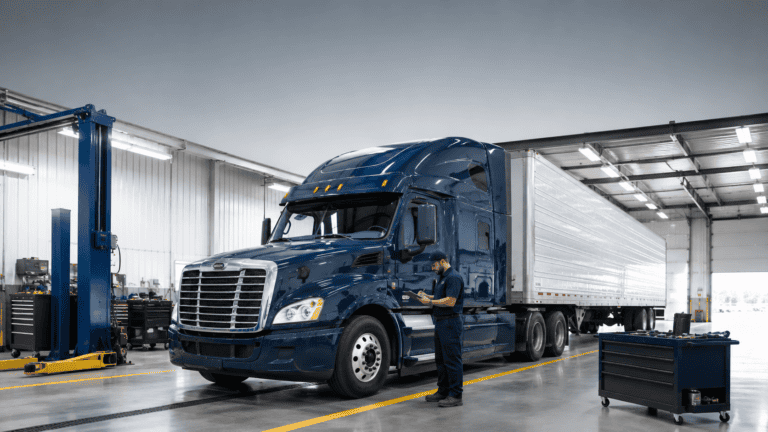
Quick Answer: Commercial vehicles operating in Illinois must pass a DOT annual inspection. Illinois runs its own state inspection program through IDOT Official Testing Stations, and that program is approved by FMCSA as equivalent to the federal periodic inspection standard. But interstate carriers with a US DOT number are not required to use an Illinois testing station. They can instead meet the requirement under the federal rule, 49 CFR §396.17, by having the inspection performed by an inspector qualified under 49 CFR §396.19. That federal route lets a carrier qualify its own in-house inspector and self-inspect.
If you run trucks in Illinois, you have two legitimate ways to satisfy the Illinois DOT annual inspection requirement, and most operators do not realize the second one exists. You can take the vehicle to an Illinois Official Testing Station, or you can meet the federal standard directly and inspect your own equipment using a qualified inspector. This guide explains how the Illinois program works, how it connects to the federal rule, which path makes sense for an interstate carrier, and one recordkeeping difference between the two routes that almost nobody talks about.
Does Illinois Require a DOT Annual Inspection?
Yes. Commercial vehicles operating on Illinois highways must be inspected on a periodic basis under Illinois law, and interstate commercial motor vehicles must also meet the federal annual inspection requirement. Illinois administers its inspection program through the Illinois Department of Transportation, which oversees roughly 250 Official Testing Stations across the state where trucks, trailers, and buses are inspected.
So the requirement applies on two levels. Illinois has its own state inspection law, and the federal government requires an annual inspection for any commercial motor vehicle operating in interstate commerce. The good news for carriers is that these two requirements are designed to line up, and meeting one can satisfy the other.
How Does the Illinois Inspection Program Connect to the Federal Rule?
Illinois is one of the states whose periodic inspection program FMCSA has determined is equivalent to the federal standard. Under 49 CFR §396.23, when a state inspection program is approved as being as effective as the federal periodic inspection, a carrier can meet the federal requirement of 49 CFR §396.17 through that state program. Illinois is on the FMCSA approved list.
What that means in practice: if your vehicle passes an inspection at an Illinois Official Testing Station that meets the minimum federal standards, that inspection satisfies the federal annual inspection requirement for 12 months, starting from the last day of the month the inspection was performed. You do not have to do two separate inspections. One qualifying inspection covers both.
For the full picture of which states run approved programs and how the rule works nationally, see do state DOT inspection requirements replace the federal annual inspection.
Do Interstate Carriers Have to Use an Illinois Testing Station?
No, and this is the part most carriers miss. Interstate carriers of property that display a US DOT number can choose to use Illinois Official Testing Stations, but they are not required by FMCSA to do so. They have the option to meet the annual inspection requirement under the federal rule instead.
The federal route is §396.17, which requires the inspection to be performed by an inspector who meets the qualification standard in §396.19. Under that rule, a carrier can use its own qualified in-house inspector under §396.17(d), a commercial garage acting as its agent under §396.17(e), or a state program under §396.17(f). So an interstate Illinois carrier has a real choice: route every truck through an IDOT testing station, or qualify an inspector under the federal standard and inspect its own equipment.
For a carrier running more than a few trucks, the federal self-inspection route is often the more practical and cheaper option. You stop scheduling around testing stations, you stop paying per vehicle, and you control your own inspection paperwork.
Illinois is unusual in offering this choice. A Texas-plated commercial vehicle must go through a certified Texas station, and a Pennsylvania-registered power unit must go to an Official PennDOT Inspection Station. Illinois exempts interstate carriers from its mandatory program, which puts the decision back in your hands.
The Two Routes Compared
| IDOT Official Testing Station | Federal self-inspection | |
|---|---|---|
| Who inspects | Certified safety tester at the station | Your own §396.19-qualified inspector |
| Standard applied | Appendix A to Part 396 | Appendix A to Part 396 — the same |
| Scheduling | Around the station’s availability | Your own shop, your own schedule |
| Cost | Per vehicle, every year | One-time qualification, then your labor |
| Inspector qualification record | Not required — §396.19(b) exception | Required, service + 1 year |
| Inspection report | Kept 14 months | Kept 14 months |
The Recordkeeping Difference Between the Two Routes
Here is a detail buried in the regulation that almost nobody writes about, and it is a real trade-off worth knowing before you choose a route.
Under 49 CFR §396.19(b), motor carriers must retain evidence of each annual inspector’s qualifications for as long as that person performs inspections, plus one year afterward. But the same subsection carves out an exception: carriers do not have to maintain documentation of inspector qualifications for inspections performed as part of a State periodic inspection program.
Illinois runs an FMCSA-approved State periodic inspection program. So the two routes carry different paperwork burdens:
Route the truck through an IDOT Official Testing Station. The inspection is performed under the state program, and you are not required to keep inspector qualification records for it. You still keep the inspection report itself.
Self-inspect under the federal route. You keep evidence of your inspector’s §396.19 qualification on file, for the duration of their inspection work plus one year.
We are telling you this even though it is a point in favor of the state route, because it is true and you should know it before you decide. In practice, keeping one qualification record per inspector is a small burden compared to scheduling every truck through a testing station and paying per vehicle. But it is a real difference, and it is one an auditor will look for if you self-inspect. Our FMCSA inspector qualifications form guide shows what that record should contain.
Who Can Perform a DOT Annual Inspection in Illinois?
It depends on the route you choose. If you use the Illinois state program, the inspection is performed by a certified safety tester at an IDOT Official Testing Station. If you use the federal route, the inspection must be performed by a person who meets the inspector qualification standard in 49 CFR §396.19.
The federal §396.19 standard has three parts. The inspector must understand the inspection criteria in Part 393 and Appendix A to Part 396 and be able to identify defective components. The inspector must be knowledgeable of and have mastered the methods, procedures, tools, and equipment used when performing an inspection. And under §396.19(a)(3), the inspector must be capable of performing the inspection either through a Federal- or State-sponsored training program or a qualifying state certificate, or through a combination of training and/or experience totaling at least one year.
A carrier can qualify its own mechanic, or an owner-operator can qualify themselves. The carrier then keeps evidence of that qualification on file. This is the route that lets you bring inspections in-house instead of depending on a testing station. For the complete breakdown, see our guide on who can perform DOT annual inspections and can I do my own DOT annual inspection.
Brakes Require a Second, Separate Qualification
Every DOT annual inspection includes the brake system, and brakes carry their own qualification requirement under 49 CFR §396.25. It is not part of §396.19. It is a separate rule that applies to anyone who inspects, maintains, services, or repairs brakes on a commercial vehicle, with its own evidence and its own retention requirement.
If you are an Illinois carrier bringing inspections in-house, this is the piece most operations miss. Your in-house inspector needs documented qualification under both §396.19 and §396.25.
And a CDL air brake endorsement does not satisfy §396.25. FMCSA has stated that directly. See does a CDL air brake endorsement make you a qualified brake inspector, 396.19 vs 396.25, and our full DOT air brake certification requirements guide.
Brakes are also where enforcement concentrates. In CVSA’s 2026 International Roadcheck, brake system violations accounted for 3,379 out-of-service violations — 24.3% of all vehicle out-of-service violations and the largest single category. See why trucks fail DOT inspections.
What Does the Annual Inspection Actually Cover?
The inspection is a measured, pass-or-fail check against the federal minimum standards in Appendix A to Part 396. It covers brakes, steering, suspension, frame, tires and wheels, lighting, coupling devices, the fuel system, exhaust, and the other components listed in the standard. In a combination vehicle, each unit is inspected separately — a tractor and its trailer are inspected individually, not as one rig.
Illinois testing stations inspect against these federal criteria, which is why a passing Illinois inspection satisfies the federal requirement. The standard is the same whether the inspection happens at an IDOT station or through a federally qualified in-house inspector.
One thing worth knowing before you measure: the annual inspection standard is not identical to the roadside out-of-service threshold, and neither matches the Part 393 minimum for lawful operation. We separate all three in legal, out-of-service, or failed inspection.
How Long Must Inspection Records Be Kept in Illinois?
Under the federal recordkeeping rule, 49 CFR §396.21, the periodic inspection report must be retained by the motor carrier for 14 months from the date of the inspection. A copy must be kept where the vehicle is housed or maintained, and proof of the current inspection must be on the vehicle itself. For what that documentation on the vehicle has to contain, see what goes on the truck and what stays in the file.
If you self-inspect under the federal route, you also keep evidence of your inspector’s §396.19 qualification on file, for the period they perform inspections plus one year, and separate §396.25 evidence if they perform brake work. Note the retention periods differ and are commonly confused:
| Record | Regulation | Retention |
|---|---|---|
| Annual inspection report | §396.21(b)(1) | 14 months |
| Inspector qualification evidence | §396.19(b) | Service + 1 year (waived under the state program) |
| Driver vehicle inspection report | §396.11(a)(4) | 3 months |
See DVIR requirements under §396.11 for the daily layer, including the exemption for carriers operating only one commercial motor vehicle.
How Do I Qualify to Perform My Own DOT Inspections in Illinois?
You qualify under the federal standard, 49 CFR §396.19. There is no federal license or certificate issued by the government. The carrier determines that the inspector meets the qualification requirements and keeps the evidence on file.
Most working mechanics qualify through §396.19(a)(3)(ii), the training and experience route. If you already have a year or more of commercial vehicle maintenance behind you, the experience component is there. What is usually missing is documented training in the federal inspection standards, and that is the gap a training course fills. The course does not replace the requirement. It produces the evidence the carrier keeps on file.
Illinois gives interstate carriers a choice. Most don’t know it.
You can keep routing every truck through an IDOT Official Testing Station, or you can qualify one mechanic once and inspect your own equipment on your own schedule. The qualification does not expire.
Our DOT Annual Inspection Training Course covers the inspection criteria in 49 CFR Part 393 and Appendix A to Part 396 — the same standard an IDOT station applies — and produces three records for your file:
- Certificate of completion — documented training under §396.19(a)(3)(ii)(A)
- Inspector qualification form — the §396.19(b) record your carrier retains
- Inspection checklist — for performing and recording annual inspections
Several mechanics or multiple terminals? Group registration with volume discounts.
We cover the qualification standard in depth in our guide to FMCSA §396.19 and the step-by-step path in how to get certified to do DOT inspections.
Operating in more than one state? See our guides for Texas, California, Pennsylvania, North Carolina, and Ohio.
Illinois DOT Annual Inspection Frequently Asked Questions
Does Illinois require a DOT annual inspection?
Yes. Commercial vehicles in Illinois must be inspected periodically, and interstate commercial motor vehicles must also meet the federal annual inspection requirement under 49 CFR §396.17.
Is the Illinois inspection program accepted for federal compliance?
Yes. FMCSA has approved the Illinois program as equivalent to the federal periodic inspection, so a qualifying Illinois inspection satisfies the federal annual requirement for 12 months, commencing from the last day of the month in which the inspection was performed.
Do interstate carriers have to use an Illinois testing station?
No. Interstate carriers with a US DOT number can use an Illinois Official Testing Station, but they are not required to. They can instead meet the requirement under the federal rule using an inspector qualified under 49 CFR §396.19. This is unusual — Texas and Pennsylvania both require state-registered commercial vehicles to go through their state programs.
Can I perform my own DOT inspections in Illinois?
Yes, if you qualify under the federal 49 CFR §396.19 standard. A carrier can qualify its own in-house inspector under §396.17(d), or an owner-operator can qualify themselves, and then perform §396.17 inspections.
Do I have to keep inspector qualification records if I use an Illinois testing station?
No. Under 49 CFR §396.19(b), carriers do not have to maintain documentation of inspector qualifications for inspections performed as part of a State periodic inspection program, and Illinois runs an FMCSA-approved program. If you self-inspect under the federal route instead, you do keep that evidence on file for the period the inspector serves plus one year.
Do I need a separate qualification to inspect brakes in Illinois?
Yes. Under 49 CFR §396.25, anyone who inspects, maintains, services, or repairs brakes on a commercial vehicle needs a separate brake inspector qualification in addition to §396.19. A CDL air brake endorsement does not satisfy it.
How long must I keep Illinois inspection records?
Periodic inspection reports must be kept for 14 months under 49 CFR §396.21, with proof of the current inspection on the vehicle. Inspector qualification evidence, where required, is kept for the duration of the inspector’s service plus one year. Driver vehicle inspection reports are kept three months under §396.11(a)(4).
How many IDOT Official Testing Stations are there in Illinois?
Roughly 250 across the state, administered by the Illinois Department of Transportation, where trucks, trailers, and buses are inspected by certified safety testers against the federal minimum standards in Appendix A to Part 396.
Does your course qualify me to inspect in Illinois?
The course covers the federal inspection standards in Part 393 and Appendix A and issues a certificate documenting the training component of your 49 CFR §396.19(a)(3)(ii) qualification. Combined with your commercial vehicle maintenance experience, that satisfies the federal qualification requirement, which is what interstate Illinois carriers must meet to self-inspect under §396.17.
About the author: Josh Lopez has spent more than 10 years in the trucking and freight industry, working across shippers, carriers, brokerage, and reefer LTL. He writes about DOT compliance, FMCSA regulations, and commercial vehicle inspection to help mechanics, owner-operators, and fleet managers understand the rules that govern their operations and stay compliant on the road.