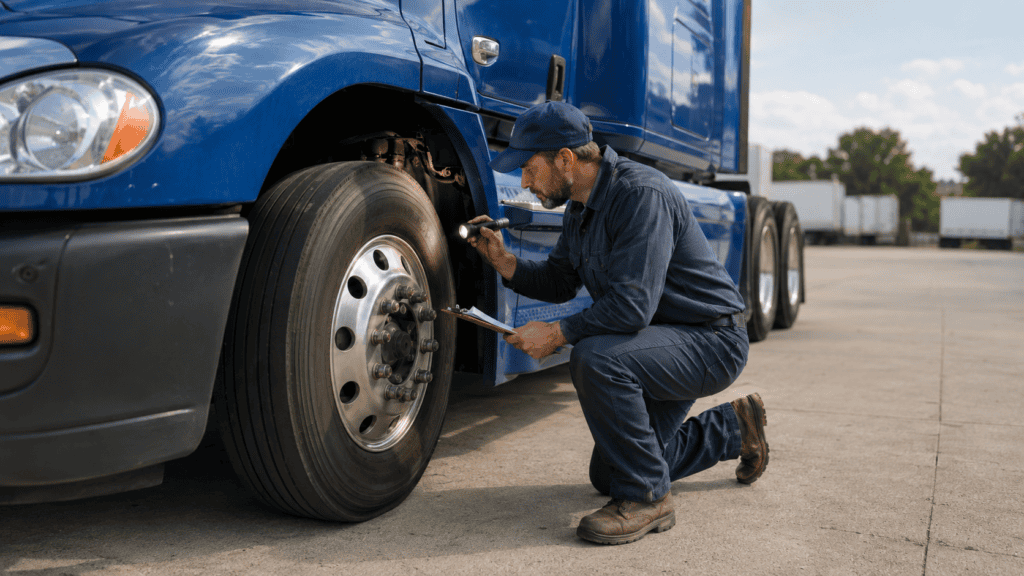
Quick Answer: Yes, you can do your own DOT annual inspection. Under 49 CFR §396.17(d), a motor carrier may perform the required annual inspection on vehicles under its control, and an owner-operator can inspect their own truck. But there is one firm condition: the person performing and certifying the inspection must be a qualified inspector under 49 CFR §396.19. Years of driving or wrenching do not automatically make you qualified in the eyes of the DOT. You also cannot self-inspect if your vehicle is registered in a state that mandates its own approved inspection program. Meet the qualification requirement and keep the records, and self-inspecting is completely legal and often the cheaper, faster option.
It is one of the most common questions owner-operators and small fleets ask: do I really have to pay a shop to inspect my own truck every year, or can I just do it myself? The answer is yes, you can do it yourself, but there is a right way and a wrong way, and getting it wrong can mean fines and out-of-service orders even if your truck is mechanically perfect. This guide walks through exactly when you can do your own DOT annual inspection, what you need to do it legally, the state exception that trips people up, and how to decide whether it is the right move for you.
Can You Legally Perform Your Own DOT Annual Inspection?
Yes. The federal regulation is explicit. Under 49 CFR §396.17(d), a motor carrier may perform the required annual inspection for vehicles under its control. That means a fleet can inspect its own trucks in-house, and an owner-operator can inspect their own equipment. You do not have to take the vehicle to an outside shop or a state station.
There is one condition attached, and it is the whole game: the inspection has to be performed and certified by a qualified inspector as defined in §396.19. That qualified inspector can be you, if you meet the requirements, or one of your own mechanics. The regulation does not care whether the inspector is an employee or the owner. It cares whether they are qualified and whether you can prove it.
The common and costly mistake is assuming that years behind the wheel or years turning wrenches automatically make you a qualified inspector. They do not, at least not by themselves, and not without documentation. An owner-operator who self-certifies an inspection without meeting the §396.19 standard has an invalid inspection on record, which can surface as a violation during an audit or a roadside stop even if the truck itself is in perfect shape.
For what the annual inspection itself involves, see our guide to 49 CFR §396.17 periodic inspection requirements.
What Makes Someone a Qualified Inspector?
Under §396.19(a), a qualified inspector must meet three requirements, and all three have to be true:
1. Understand the inspection criteria. You must understand the standards in 49 CFR Part 393 and Appendix A to Part 396 (formerly Appendix G) and be able to identify defective components.
2. Have mastered the methods and tools. You must be knowledgeable of and have mastered the methods, procedures, tools, and equipment used to perform an inspection.
3. Be capable through experience, training, or both. Under §396.19(a)(3), you qualify one of two ways: by completing a Federal- or State-sponsored training program or holding a qualifying state certificate, or through a combination of training and/or experience totaling at least one year.
That third requirement is where most owner-operators actually land. If you have a year or more of hands-on commercial vehicle maintenance experience, you have the experience side. What you usually do not have is documentation that you were trained on the federal inspection standards specifically, rather than having picked it up on the job. That documentation gap is exactly what an auditor looks for, and it is what a training course fills.
For the full breakdown of the qualification standard, see our guide on who can perform DOT annual inspections and what FMCSA §396.19 requires.
The State Exception That Stops You From Self-Inspecting
Here is the catch that most articles miss, and it is the one that can make self-inspection illegal for you specifically.
Section §396.17(d) says you can self-inspect vehicles that are not subject to an inspection under §396.23(a)(1). And §396.23(a)(1) says that if a commercial motor vehicle is subject to a mandatory state inspection program that FMCSA has approved as equivalent to the federal standard, the carrier must meet the requirement through that state program.
Translated: if your vehicle is registered in a state that runs a mandatory, FMCSA-approved inspection program that applies to your truck, you cannot self-inspect it. You have to use that state’s program. Texas is the clearest example. A commercial vehicle registered in Texas must be inspected through a certified Texas commercial inspection station, not by self-inspection.
Other states are the opposite. Ohio has no mandatory approved program for freight trucks, so Ohio carriers self-inspect under the federal route freely. North Carolina is not on FMCSA’s approved list at all, which leaves the federal self-inspection route fully open. Illinois exempts interstate carriers with a USDOT number from its mandatory program, so those carriers can self-inspect too.
The point is that the answer depends on where your truck is plated and which state’s rules apply. Before you self-inspect, confirm your state doesn’t mandate its own program for your vehicle. We cover which states have approved programs in do state DOT inspection requirements replace the federal annual inspection, and break several down individually in our state guides for Texas, Ohio, North Carolina, Pennsylvania, California, and Illinois.
What You Need to Self-Inspect Legally
If you’re clear to self-inspect, here is exactly what the process requires:
A qualified inspector. You, or your mechanic, meeting the §396.19 standard, with the qualification documented and kept on file.
A complete inspection against Appendix A. Every component category in Appendix A to Part 396, brakes, steering, suspension, tires and wheels, lighting, coupling devices, frame, fuel system, exhaust, and the rest. In a combination vehicle, each unit is inspected separately.
A proper inspection report. Under §396.21, the report must identify the inspector, the motor carrier, the date, the vehicle, the components inspected and the results, and certify the inspection’s accuracy and completeness.
Proof on the vehicle. Either a copy of the inspection report or a sticker/decal on the vehicle showing the inspection date, where the full report is kept, vehicle identification, and certification that it passed. We break the four required items down in what goes on the truck and what stays in the file.
The right recordkeeping. The inspection report is kept for 14 months under §396.21. Your inspector qualification evidence is kept under §396.19(b) for as long as that person performs inspections, plus one year after they stop.
Separate brake qualification if applicable. Every annual inspection covers brakes, and under §396.25 anyone who inspects, services, or repairs brakes needs a separate brake inspector qualification. A CDL air brake endorsement does not satisfy it. See does a CDL air brake endorsement make you a qualified brake inspector and our DOT air brake certification requirements guide.
And between annual inspections, the daily layer is separate again. See DVIR requirements under §396.11 for what has to be reported daily and who certifies the repair.
You Can Also Have a Shop Do It as Your Agent
Self-inspection is not your only option under the federal route. Under §396.17(e), instead of inspecting the vehicle yourself, you can have a commercial garage, fleet leasing company, truck stop, or similar business perform the inspection as your agent, as long as that business maintains appropriate facilities and employs qualified inspectors under §396.19.
This is the “pay a shop” option, and it is perfectly valid. The difference is that with self-inspection you control the schedule, the cost, and the records. With an outside shop you outsource all three. Which makes more sense depends on your situation, which is the next question.
Should You Self-Inspect? When It Makes Sense and When It Doesn’t
Legal doesn’t always mean worth it. Here’s an honest look at both sides.
Self-inspection makes sense when: you run more than a truck or two, you or a mechanic already have the maintenance experience, and you want control over timing and records. The math favors it quickly. Qualifying an inspector is a one-time step, and the qualification doesn’t expire, so after that first year the per-inspection cost of self-inspecting is essentially your own labor versus paying a shop every single year for every single vehicle. For a multi-truck operation running annual inspections plus, in some states, more frequent cycles, that adds up fast.
Outsourcing makes sense when: you run a single truck and don’t want to get qualified, you lack the tools or a place to do a thorough inspection, or your state mandates a certified station anyway. There’s no shame in paying a shop. For some operators it’s the cleaner choice.
The honest middle: most owner-operators and small fleets who already have mechanical experience find that getting qualified and self-inspecting pays for itself inside the first year and gives them tighter control over their own compliance. But it only works if you actually meet the §396.19 standard and keep the records. Self-inspecting without qualification isn’t saving money, it’s creating a liability.
One more argument for doing it yourself: the defects that park trucks are the ones a thorough inspection catches first. In CVSA’s 2026 International Roadcheck, 19% of vehicles inspected were placed out of service, with brake system violations accounting for 24.3% of all vehicle out-of-service violations. See why trucks fail DOT inspections.
How to Get Qualified to Do Your Own Inspections
If you’ve decided self-inspection is the right move, the path is straightforward. You qualify under §396.19, most commonly through the training-and-experience route in §396.19(a)(3)(ii). If you already have a year of commercial vehicle maintenance experience, documented training on the federal inspection standards completes your qualification and gives you the record to put on file.
You likely have the experience. What’s missing is the paperwork.
The §396.19(a)(3)(ii) route is training and/or experience totaling at least a year. If you have been turning wrenches on commercial equipment, that side is covered. What an auditor asks for is documented instruction in the federal inspection standards — and that is the one piece most owner-operators are missing.
Our DOT Annual Inspection Training Course covers every Appendix A component category and produces the three records you keep on file:
- Certificate of completion — documented training under §396.19(a)(3)(ii)(A)
- Inspector qualification form — the §396.19(b) record
- Inspection checklist — for performing and recording your own inspections
100% online, self-paced, lifetime access. The qualification does not expire, so it is a one-time step for every inspection you perform after it.
Qualifying a mechanic or a whole shop? Group registration with volume discounts.
For the step-by-step path, see how to get certified to do DOT inspections.
Frequently Asked Questions
Can I do my own DOT annual inspection?
Yes, under 49 CFR §396.17(d), as long as you are a qualified inspector under §396.19 and your vehicle is not subject to a mandatory state inspection program. An owner-operator can inspect their own truck, and a fleet can inspect its own vehicles in-house.
Do I need to be certified to inspect my own truck?
There is no federal “certification,” but you do need to be qualified under §396.19. That means understanding the Part 393 and Appendix A standards, having mastered the inspection methods, and meeting the training-and/or-experience requirement. Most experienced mechanics complete their qualification with documented training.
Does my experience automatically make me qualified?
Not by itself, and not without documentation. Experience can satisfy part of the §396.19(a)(3)(ii) requirement, but you must also understand the federal inspection criteria and have the qualification documented. Self-certifying without meeting the full standard can result in violations during an audit.
Are there states where I can’t self-inspect?
Yes. If your vehicle is registered in a state with a mandatory, FMCSA-approved inspection program that applies to it, you must use that program instead of self-inspecting. Texas is a clear example for Texas-plated commercial vehicles. Ohio, North Carolina, and interstate carriers in Illinois, by contrast, can self-inspect under the federal route.
What records do I keep if I self-inspect?
The inspection report for 14 months under §396.21, proof of the current inspection on the vehicle, and your inspector qualification evidence under §396.19(b) for as long as you perform inspections plus one year. If you do brake work, keep separate §396.25 brake qualification evidence.
Is self-inspection cheaper than using a shop?
Usually, for anyone running more than one truck or who already has mechanical experience. Qualifying is a one-time step and doesn’t expire, so after the first year self-inspecting is your own labor versus paying a shop per vehicle per year. For a single truck with no mechanical background, outsourcing may be simpler.
Can I do my own DOT annual inspection on a trailer?
Yes, under the same rule. Section §396.17(a) treats each vehicle in a combination separately, so a tractor, semitrailer, full trailer, and converter dolly each require their own annual inspection, their own report, and their own documentation on the vehicle. A qualified inspector under §396.19 can perform all of them.
The Bottom Line
Yes, you can do your own DOT annual inspection. The federal rule allows it, and for many owner-operators and small fleets it’s the cheaper, faster, more controllable option. The one firm requirement is that whoever performs and certifies the inspection is a qualified inspector under §396.19, with the qualification documented and the records kept. And confirm your state doesn’t mandate its own program for your vehicle before you rely on self-inspection.
If you have the experience but not the documented training, that’s the one piece to close, and it’s a straightforward one. Get qualified, keep your records, and you’re inspecting your own equipment on your own schedule, legally.
Josh Lopez has spent more than 10 years in the trucking and freight industry, working across shippers, carriers, brokerage, and reefer LTL. He writes about DOT compliance, FMCSA regulations, and commercial vehicle inspection to help mechanics, owner-operators, and fleet managers stay compliant on the road.