Quick Answer: Brake Safety Week 2026 runs August 23-29, when CVSA-certified inspectors across the U.S., Canada, and Mexico conduct focused commercial vehicle brake inspections. This year’s special focus is the condition of brake drums and air disc brake rotors. Brake violations are consistently the number one reason trucks are placed out of service, so the components most likely to get your vehicle parked are the ones a qualified inspector checks during a 49 CFR §396.17 annual inspection. The best preparation is not last-minute, it is a properly performed annual inspection by an inspector who knows the out-of-service criteria.
Every August, brakes get put under a microscope. Brake Safety Week is CVSA’s annual enforcement and education campaign, and for one week inspectors specifically target the braking systems that cause more out-of-service orders than any other category. This guide covers the 2026 dates and focus, exactly what puts brakes out of service, and how a strong annual inspection program keeps your trucks out of the penalty column, not just during Brake Safety Week but year-round.
When Is Brake Safety Week 2026?
Brake Safety Week 2026 takes place August 23-29. CVSA has confirmed the seven-day window, during which certified inspectors in the United States, Canada, and Mexico conduct routine commercial motor vehicle inspections with a focus on brake systems and components.
The campaign is part of CVSA’s Operation Airbrake program. It is both enforcement and education: inspectors identify and remove unsafe vehicles, and CVSA uses the data to raise awareness about brake maintenance across the industry.
What Is the 2026 Brake Safety Week Focus Area?
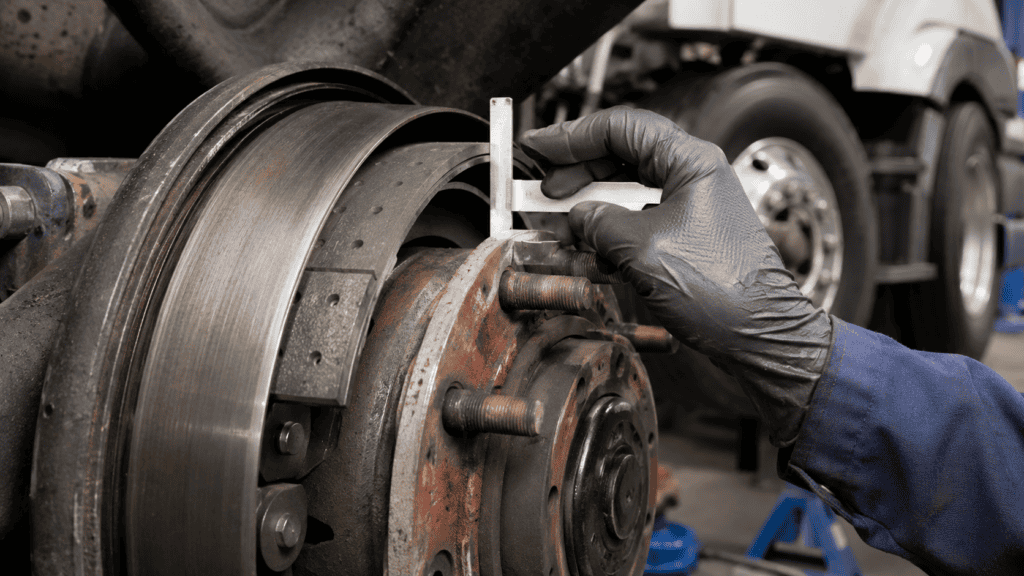
The 2026 focus area is the condition of brake drums and air disc brake rotors. Inspectors will pay special attention to these components and capture data on their condition throughout the week.
The reason is safety, not paperwork. Brake drums and rotors are the friction surfaces that stop the vehicle, and when they crack, break, or wear beyond specification, braking efficiency drops. CVSA has also warned that broken pieces of drums and rotors can become dislodged from a moving vehicle and strike other motorists, which is why this year’s emphasis is on structural condition, not just wear.
The enforcement data shows how these findings are treated once identified. During CVSA’s unannounced Brake Safety Day on April 14, 2026, inspectors documented 43 drum and rotor violations, and 21 of those were out-of-service violations — nearly a 50 percent out-of-service rate on the focus component. The most common findings were broken rotors, rusted rotors, metal-to-metal contact, and broken drums.
If you run a shop or a fleet, drums and rotors belong at the top of your pre-August checklist.
What Does the Federal Standard Actually Require for Drums and Rotors?
This is where most published guidance goes wrong, so it is worth reading the regulation precisely.
49 CFR §393.47(g) states that the thickness of the drums or rotors shall not be less than the limits established by the brake drum or rotor manufacturer.
That is the entire federal requirement on thickness. There is no federal minimum thickness figure for brake drums or rotors. The standard is whatever the component manufacturer specifies — typically cast or stamped into the component itself, or published in the manufacturer’s service literature.
The practical consequence is significant: you cannot verify drum or rotor thickness compliance without knowing that specific manufacturer’s limit. A drum that is legal on one vehicle may be out of spec on another. Any source quoting a single federal thickness number for drums or rotors is citing something that does not exist.
Structural condition is handled separately. Appendix A to Part 396 requires rejection of drums and rotors:
- With any external crack or cracks that open upon brake application. The regulation adds an explicit caution: do not confuse short hairline heat check cracks with flexural cracks.
- With any portion of the drum or rotor missing or in danger of falling away.
That first criterion contains the distinction that separates a competent inspector from a guessing one. Heat checking is not by itself an automatic rejection. Short hairline surface cracks from normal thermal cycling are expected on a working drum. What fails the vehicle is a flexural crack — one that opens when brake force is applied, because it runs through the structure rather than sitting on the friction surface.
Checking this correctly means applying the brakes and observing crack behavior, not glancing at the surface and making a judgment call. A crack that stays closed under application and one that opens under application look similar at rest and mean entirely different things.
Why Brakes Matter More Than Any Other Inspection Category
Brakes are not just another line item. They are the single largest source of out-of-service violations in commercial vehicle enforcement, year after year.
During the 2025 CVSA International Roadcheck, brake system violations accounted for 3,304 out-of-service findings, 24.4% of all vehicle out-of-service violations, and brake-related issues combined made up roughly 41% of the total, the largest category by a wide margin. During Brake Safety Week 2025 specifically, more than 15,000 vehicles were inspected and 15.1% were placed out of service for brake-related violations — up from 13% in 2024. And on CVSA’s unannounced Brake Safety Day in 2026, inspectors conducted 4,021 inspections across 47 jurisdictions and placed 574 vehicles out of service for brake violations, a 14.3% rate.
The pattern is consistent: roughly one in seven inspected vehicles gets parked for brakes during a focused brake event. Those are not obscure mechanical failures. They are the exact defects a qualified inspector catches during a routine annual inspection, months before a roadside inspector ever sees the truck.
What Puts Truck Brakes Out of Service?
Understanding the out-of-service criteria is the whole game. Here are the brake defects most likely to sideline a commercial vehicle, drawn from the federal standards in 49 CFR Part 393 and Appendix A to Part 396.
Brake lining and pad thickness below minimum
Section §393.47(d) sets the operating minimums:
- Steering axle brakes — §393.47(d)(1): not less than 4.8 mm (3/16 inch) at the shoe center for a shoe with a continuous strip of lining; not less than 6.4 mm (1/4 inch) at the shoe center for a shoe with two pads; or worn to the wear indicator if so marked, for air drum brakes. Not less than 3.2 mm (1/8 inch) for air disc brakes, or 1.6 mm (1/16 inch) or less for hydraulic disc, drum, and electric brakes.
- Non-steering axle brakes — §393.47(d)(2): air braked vehicles shall not operate with lining/pad thickness less than 6.4 mm (1/4 inch), or worn to the wear indicator if so marked, measured at the shoe center for drum brakes; or less than 3.2 mm (1/8 inch) for disc brakes. Hydraulic or electric braked vehicles shall not operate with lining/pad thickness less than 1.6 mm (1/16 inch), measured at the shoe center, for disc or drum brakes.
One nuance experienced technicians miss: Appendix A to Part 396 and §393.47 do not state the steering-axle drum requirement identically. Appendix A rejects steering-axle lining with a thickness less than 1/4 inch at the shoe center for drum brakes. Section §393.47(d)(1) distinguishes by shoe type — 3/16 inch for a continuous strip, 1/4 inch for a shoe with two pads. When performing a periodic inspection, Appendix A is the governing minimum inspection standard. Knowing both texts exist, and which applies to the inspection you are conducting, is what makes an inspection record defensible.
Any lining contaminated with oil or grease, or worn to metal-to-metal contact, is a defect regardless of measured thickness.
Brake drums and rotors — the 2026 focus
Covered in full above: thickness below the manufacturer’s limit under §393.47(g), external cracks that open on brake application, and any portion missing or in danger of falling away under Appendix A. Metal-to-metal contact means the lining has worn completely through and the component is no longer braking as designed.
Pushrod stroke out of adjustment
On air brakes, when the pushrod travels beyond the readjustment limit for that chamber size, the brake is out of adjustment. Section §393.47(e) sets the readjustment limits; for actuator types not listed in the tables, stroke must not exceed 80 percent of the rated stroke marked by the manufacturer, or the manufacturer’s marked readjustment limit.
Appendix A specifies how the measurement must be taken: engine off, reservoir pressure of 80 to 90 psi, brakes fully applied. Any brake stroke exceeding the readjustment limit is rejected. Measuring under different conditions produces different numbers and an inspection that will not hold up.
For wedge brakes, §393.47(f) limits movement of the scribe mark on the lining to 1.6 mm (1/16 inch).
Air loss and leaks
An air brake system that loses pressure faster than the allowable rate, audible leaks, and low-air warning devices that do not function all point to a system that cannot be relied on to stop the vehicle.
Damaged or defective components
Worn or damaged S-cams and cam rollers, broken return springs, damaged or bent slack adjusters and pushrods, cracked or loose chambers, and mismatched slack adjuster lengths on the same axle. On hydraulic systems, leaking wheel cylinders, stuck caliper pistons, and frozen adjusters.
The 20-percent rule
Under the North American Standard out-of-service criteria, a vehicle is placed out of service when the number of defective brakes equals 20 percent or more of the service brakes on the vehicle or combination.
This is the rule that actually parks most trucks. It was the single most-cited out-of-service reason during Brake Safety Week 2025, accounting for 1,199 violations, and during the April 2026 Brake Safety Day, 313 vehicles met the threshold.
The arithmetic catches operators off guard. A typical five-axle tractor-trailer has 10 brakes. Two defective brakes is 20 percent, and the vehicle is parked. No single defect has to be dramatic. Two quiet problems on a combination that otherwise drives normally will cross the line together — which is exactly why trucks that “felt fine” get placed out of service.
How the Annual Inspection Connects to Brake Safety Week
Here is the connection most fleets miss: the brake components CVSA inspectors check during Brake Safety Week are the same components a qualified inspector examines during the federal DOT annual inspection required under 49 CFR §396.17.
Brake Safety Week catches defects after the truck is on the road, during a high-visibility enforcement window. A properly conducted annual inspection catches the same defects months earlier, in your own shop, on your own schedule, at a fraction of the cost of an out-of-service order plus emergency repair and lost freight.
The downstream cost extends past the roadside as well. An out-of-service violation is recorded against the carrier’s DOT number, feeds the Vehicle Maintenance BASIC under CSA, and appears on the reports insurance underwriters pull at renewal.
This is why the fleets that sail through Brake Safety Week are not the ones scrambling in mid-August. They are the ones running a real annual inspection program year-round, performed by inspectors who know the out-of-service criteria cold. Brake Safety Week is simply the moment that ongoing diligence becomes visible.
Who Is Qualified to Inspect Brakes?
Brake work carries its own qualification requirement, separate from the general annual inspector qualification. Under 49 CFR §396.25, motor carriers and intermodal equipment providers must ensure that all inspections, maintenance, repairs, or service to the brakes of their commercial motor vehicles are performed in compliance with that section, and must retain evidence of each brake inspector’s qualification.
Section §396.25(e) requires that evidence to be maintained at the carrier’s principal place of business, or at the location where the brake inspector is employed, for the period of employment in that capacity and for one year thereafter.
This trips up a lot of shops, because it is separate from the §396.19 annual inspector qualification. A person performing the full annual inspection generally needs both, since inspecting the brakes triggers §396.25.
Does a CDL air brake endorsement satisfy §396.25?
No — but the regulation contains a recordkeeping carve-out that is widely misread.
FMCSA regulatory guidance answers the direct question plainly: a CDL with an air brake endorsement does not qualify a person as a brake inspector under §396.25.
However, §396.25(e) adds that carriers do not have to maintain evidence of qualifications to inspect air brake systems for such inspections performed by persons who have passed the air brake knowledge and skills test for a Commercial Driver’s License.
The distinction matters. The endorsement does not make someone a qualified brake inspector for purposes of the section generally. It does relieve the carrier of the documentation burden specifically for air brake system inspections performed by a CDL holder who passed that test. Treating those two statements as interchangeable is how shops end up with gaps in their qualification files.
We cover the relationship between the two qualifications in 396.19 vs 396.25: annual inspector vs brake inspector qualification, the endorsement question in does a CDL air brake endorsement make you a qualified brake inspector, and the full brake qualification picture in our DOT air brake certification requirements guide.
What does §396.19 require for the annual inspector?
Under 49 CFR §396.19(a), the motor carrier must ensure that individuals performing annual inspections understand the inspection criteria set forth in Part 393 and Appendix A to Part 396 and can identify defective components; are knowledgeable of and have mastered the methods, procedures, tools and equipment used; and are capable of performing an inspection by reason of experience, training, or both.
That last requirement, §396.19(a)(3), has two routes — not four, despite how it is often described:
- §396.19(a)(3)(i): successful completion of a Federal- or State-sponsored training program, or a certificate from a State or Canadian Province qualifying the individual to perform commercial motor vehicle safety inspections.
- §396.19(a)(3)(ii): a combination of training or experience totaling at least 1 year. That combination may consist of (A) a commercial motor vehicle manufacturer-sponsored training program or similar commercial training program; (B) experience as a mechanic or inspector in a motor carrier or intermodal equipment maintenance program; (C) experience as a mechanic or inspector at a commercial garage, fleet leasing company, or similar facility; or (D) experience as a commercial motor vehicle inspector for a State, Provincial, or Federal government.
Items (A) through (D) are components that count toward the one-year total under route (ii) — they are not four separate standalone pathways. Experience alone can qualify an inspector under (ii)(B), (C), or (D). And there is no federal DOT inspector certification or license issued by any agency: under §396.19(b), qualification is documented and retained by the motor carrier, for the period the individual performs annual inspections and for one year thereafter.
How to Prepare for Brake Safety Week 2026
Prioritize drums and rotors. Since they are the 2026 focus, inspect every drum and rotor before the last week of August. Look through the wheel openings for external cracks and missing pieces, apply the brakes and observe whether any crack opens, and check for scoring, bluing, and metal-to-metal contact. Measure thickness against the manufacturer’s published limit for that component, not a generic figure. Make sure your shop team and any outside maintenance vendors know this is the emphasis.
Measure pushrod stroke on every air-braked axle. Engine off, 80 to 90 psi reservoir pressure, brakes fully applied. Out-of-adjustment brakes are among the most common and most preventable brake OOS findings. Measure, do not eyeball.
Check lining and pad thickness against the correct standard for the axle position, brake type, and shoe configuration. Replace anything near the threshold rather than gambling on it lasting through August.
Test the air system. Verify the system holds pressure within the allowable leak rate, the low-air warning activates, and the automatic and spring brakes function.
Count your defects against the 20-percent threshold. Before anything else, tally defective brakes across every wheel position. Two out of ten parks the vehicle regardless of how minor each individual defect appears.
Run a full annual inspection, not a spot check. The most reliable preparation is a complete §396.17 annual inspection by a qualified inspector. If your annual inspections are current and thorough, Brake Safety Week is a non-event.
Drivers should inspect visible drum and rotor portions during pre-trip and post-trip inspections, looking through available inspection openings — without crawling under an unsecured vehicle.
The Best Preparation Is Year-Round, Not Last-Minute
Brake Safety Week is a concentrated enforcement window, but brake violations get written every day of the year. CVSA’s unannounced Brake Safety Day — held April 14 in 2026 — exists precisely so carriers cannot rely on a single seasonal push.
The fleets with the lowest violation rates are not the ones that cram in August. They are the ones with a consistent preventive maintenance schedule and qualified inspectors performing thorough annual inspections on every vehicle.
For the official campaign details, see the CVSA Operation Airbrake page. For the broader enforcement picture, see our guides to the 2026 CVSA International Roadcheck and DOT compliance enforcement in 2026.
Get Your Team Qualified to Inspect Brakes and Perform Annual Inspections
The most durable way to prepare for Brake Safety Week, and every other enforcement event, is to have qualified inspectors performing thorough annual inspections in-house. When your team is checking the same brake components inspectors check, using the same federal criteria, defects get found and fixed before they become out-of-service orders.
Our DOT Annual Inspection Training Course covers the full inspection process, including the brake systems, drums, rotors, linings, and adjustment criteria that drive the most out-of-service violations. Every enrollment includes three deliverables:
- Certificate of completion — documenting the training component of your inspector’s qualification under 49 CFR §396.19(a)(3)(ii)
- Inspector qualification form — the §396.19(b) documentation your carrier retains on file
- Inspection checklist — the working document for performing and recording annual inspections
The course is fully online and self-paced, so a mechanic can complete it before the August 23 enforcement window opens.
Qualifying more than one mechanic? Group registration with volume discounts is available for shops and fleets. For the brake-specific requirements, see who can perform DOT annual inspections.
Frequently Asked Questions
When is Brake Safety Week 2026?
Brake Safety Week 2026 is August 23-29. CVSA-certified inspectors across the U.S., Canada, and Mexico conduct focused brake inspections throughout the week as part of the Operation Airbrake program.
What is the 2026 Brake Safety Week focus area?
The condition of brake drums and air disc brake rotors. Inspectors will pay special attention to cracks, wear beyond the manufacturer’s limit, and structural damage, and will capture data on drum and rotor condition throughout the week. During the April 2026 Brake Safety Day, 43 drum and rotor violations were documented and 21 of those were out-of-service violations.
What is the federal minimum thickness for a brake drum or rotor?
There is no federal minimum thickness figure. 49 CFR §393.47(g) requires only that drum and rotor thickness not be less than the limits established by the drum or rotor manufacturer. Verifying compliance requires knowing that manufacturer’s specification for the specific component.
Does a cracked brake drum automatically fail an inspection?
Not every crack. Appendix A to Part 396 requires rejection for any external crack or cracks that open upon brake application, and specifically cautions against confusing short hairline heat check cracks with flexural cracks. Heat checking on the friction surface is not by itself an automatic rejection; a crack that opens when brake force is applied is.
What is the 20-percent out-of-service rule?
A vehicle is placed out of service when 20 percent or more of its service brakes are defective, counted across every wheel position. On a typical five-axle tractor-trailer with 10 brakes, two defective brakes crosses the threshold. It was the most-cited out-of-service reason during Brake Safety Week 2025, with 1,199 violations.
Do I need special qualification to inspect brakes?
Yes. Under 49 CFR §396.25, motor carriers must ensure brake inspections, maintenance, service, and repairs are performed by qualified brake inspectors, and must retain evidence of qualification. This is separate from the §396.19 annual inspector qualification. FMCSA guidance states that a CDL air brake endorsement does not qualify a person as a brake inspector under §396.25 — though §396.25(e) does relieve carriers of maintaining qualification evidence for air brake system inspections performed by someone who passed the CDL air brake knowledge and skills test.
How should brake pushrod stroke be measured?
Appendix A to Part 396 specifies measurement with the engine off, reservoir pressure between 80 and 90 psi, and brakes fully applied. Any stroke exceeding the readjustment limit is rejected. For actuator types not listed in the §393.47(e) tables, stroke must not exceed 80 percent of the rated stroke marked by the manufacturer, or the manufacturer’s marked readjustment limit.
How should I prepare for Brake Safety Week?
Prioritize drums and rotors since they are the 2026 focus, measure pushrod stroke on every air-braked axle under the correct conditions, check lining thickness against the standard for that axle position and brake type, test the air system, count defective brakes against the 20-percent threshold, and ideally run a complete §396.17 annual inspection with a qualified inspector rather than a last-minute spot check.
The Bottom Line
Brake Safety Week 2026 runs August 23-29, with a focus on brake drums and air disc brake rotors. Brakes are the number one out-of-service category in commercial vehicle enforcement, and the defects that get trucks parked during Brake Safety Week are the same ones a qualified inspector catches during a routine annual inspection.
The fleets that pass cleanly are the ones running strong year-round inspection programs with qualified inspectors, not the ones scrambling in August. If your inspectors lack documented qualification under §396.19 and §396.25, or your annual inspection program is thin, the weeks before Brake Safety Week are the time to fix it.
Josh Lopez has spent more than 10 years in the trucking and freight industry, working across shippers, carriers, brokerage, and reefer LTL. He writes about DOT compliance, FMCSA regulations, and commercial vehicle inspection to help mechanics, owner-operators, and fleet managers stay compliant on the road. Every regulatory citation on this site is verified against the current eCFR text before publication.