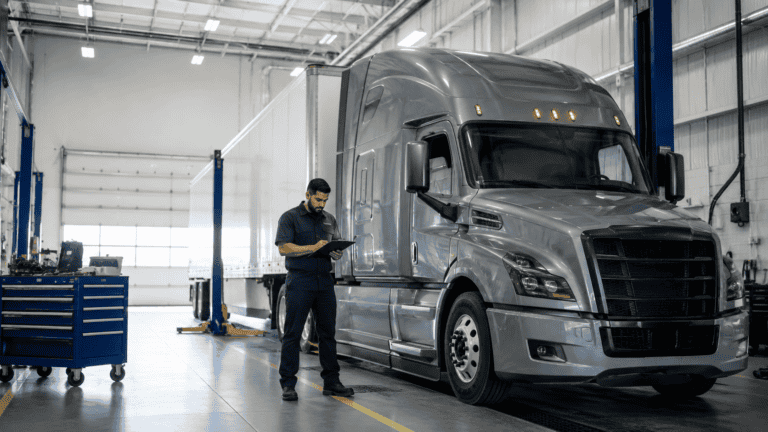
Quick Answer: Florida does not run its own state commercial vehicle inspection program. Instead, Florida law adopts the Federal Motor Carrier Safety Regulations directly, including Part 396. That means the Florida DOT annual inspection is the federal annual inspection under 49 CFR §396.17, performed by an inspector qualified under 49 CFR §396.19. Carriers can qualify their own in-house inspector or use a third party. One Florida-specific detail: the weight threshold differs between interstate and intrastate operations — interstate commercial vehicles are covered at 10,001 pounds and above, while Florida applies a 26,001 pound threshold to intrastate operations.
This makes Florida one of the more straightforward states for inspection compliance, because there is no separate state program layered on top of the federal rule. But it also means the responsibility sits squarely with the carrier: there is no state inspection station to hand the job to. You need a qualified inspector. Here is exactly how it works.
Does Florida Require a DOT Annual Inspection?
Yes. Every commercial motor vehicle operating in Florida must pass an annual inspection, but the requirement comes from federal law rather than a separate Florida program. Sections 316.302 and 316.70 of the Florida Statutes adopt the Federal Motor Carrier Safety Regulations found in Title 49 of the Code of Federal Regulations, including Part 396, which contains the inspection, repair, and maintenance rules.
So when a Florida carrier asks whether they need a DOT annual inspection, the answer is yes, under 49 CFR §396.17, the federal periodic inspection requirement. Florida enforces the federal standard rather than substituting its own. For what that requirement involves in detail, see our guide to 49 CFR §396.17.
Does Florida Have Its Own State Inspection Program?
No. Unlike states such as Pennsylvania, which runs mandatory inspections at official state stations, or California, which uses a terminal-based program, Florida has no separate state periodic inspection program for commercial vehicles. Florida adopts the federal rules and enforces them.
This is a meaningful practical difference, and it works in your favor. Under 49 CFR §396.23(a)(1), a vehicle subject to an FMCSA-approved mandatory state program must meet the federal requirement through that program — which closes off self-inspection for Texas-plated trucks and Pennsylvania-registered power units. Because Florida has no such program, that constraint does not apply, and §396.17(d), which permits a motor carrier to perform its own annual inspection, is fully available.
The federal rule allows the motor carrier to have the annual inspection performed by its own qualified employee under §396.17(d), or by a commercial garage, fleet leasing company, or similar business acting as its agent under §396.17(e). Since Florida does not have a state program, Florida carriers rely on those two options, which makes having a qualified inspector genuinely valuable.
For the national picture of which states run approved programs, see do state DOT inspection requirements replace the federal annual inspection.
What Are the Weight Thresholds in Florida?
This is where Florida carriers most often get tripped up, because interstate and intrastate operations are treated differently.
| Operation | Threshold | Also covered regardless of weight |
|---|---|---|
| Interstate | 10,001 lbs GVWR or GCWR and above | Placarded hazmat, larger passenger-carrying vehicles |
| Intrastate (Florida only) | 26,001 lbs | — |
For interstate commerce, the federal definition applies: a commercial motor vehicle with a gross vehicle weight rating or gross combination weight rating of 10,001 pounds or more is subject to the annual inspection requirement, along with vehicles carrying placarded hazardous materials and larger passenger-carrying vehicles.
For intrastate commerce — operations that stay entirely within Florida — Florida applies a higher threshold of 26,001 pounds. So a vehicle running purely inside Florida under 26,001 pounds may not be subject to the same requirement that would apply if it crossed a state line. If your operation runs interstate at all, the 10,001 pound federal threshold governs.
That distinction catches a lot of Florida service businesses — landscaping, HVAC, construction, delivery — running trucks between 10,001 and 26,000 pounds. Stay inside the state and the annual inspection may not reach you. Take one load across the Georgia or Alabama line and it does.
Who Enforces Commercial Vehicle Safety in Florida?
The Florida Highway Patrol’s Commercial Vehicle Enforcement unit handles commercial vehicle safety enforcement, conducting inspections at weigh stations and on state highways along Florida’s major freight corridors, including I-95, I-75, I-10, and I-4. These are roadside enforcement inspections, which are separate from the annual inspection you are responsible for scheduling and documenting.
These officers are specialists. According to the Florida Department of Highway Safety and Motor Vehicles, CVE Troopers complete approximately 500 additional hours of specialized commercial motor vehicle training beyond their standard trooper certification.
A current annual inspection is one of the things enforcement checks, and not having one is a straightforward violation. During CVSA’s 2026 International Roadcheck, inspectors conducted 54,575 inspections and placed 10,350 vehicles out of service, a rate of 19%, with brake system violations accounting for 24.3% of all vehicle out-of-service violations. See why trucks fail DOT inspections, and for how a roadside stop differs from your scheduled annual inspection, DOT annual inspection vs roadside inspection.
Who Can Perform a DOT Annual Inspection in Florida?
A person qualified under 49 CFR §396.19. Under that rule, the inspector must understand the inspection criteria in Part 393 and Appendix A to Part 396, have mastered the methods, procedures, tools, and equipment used in an inspection, and be able to identify defective components. Qualification comes through one of two routes under §396.19(a)(3): a Federal- or State-sponsored training program or qualifying state certificate, or a combination of training and/or experience totaling at least one year.
Because Florida has no state inspection station network to fall back on, this qualification is the whole game for Florida carriers. You either qualify your own inspector, or you pay a third party every time. There is no government-issued license or federal certificate for this. The motor carrier keeps evidence of the inspector’s qualification on file, for the period the person performs inspections plus one year afterward.
See who can perform DOT annual inspections, our guide to FMCSA §396.19, and for owner-operators, can I do my own DOT annual inspection.
Brakes Require a Second, Separate Qualification
Every annual inspection includes the brake system, and brakes carry their own qualification requirement under 49 CFR §396.25. It is not part of §396.19. It is a separate rule applying to anyone who inspects, maintains, services, or repairs brakes on a commercial vehicle, with its own evidence and its own retention period.
If you are a Florida carrier bringing inspections in-house, this is the piece most operations miss. Your inspector needs documented qualification under both §396.19 and §396.25. A CDL air brake endorsement does not satisfy §396.25 — FMCSA has stated that directly. See does a CDL air brake endorsement make you a qualified brake inspector, 396.19 vs 396.25, and our DOT air brake certification requirements guide.
What Records Does a Florida Carrier Need to Keep?
Under 49 CFR §396.21, the periodic inspection report must be retained for 14 months, with proof of the current inspection on the vehicle — either the report itself or a compliant decal. Separately, evidence of the inspector’s §396.19 qualification is kept on file for as long as that person performs inspections and for one year after.
| Record | Regulation | Retention |
|---|---|---|
| Annual inspection report | §396.21(b)(1) | 14 months |
| Inspector qualification evidence | §396.19(b) | Service + 1 year |
| Brake inspector qualification | §396.25(e) | Employment + 1 year |
| Driver vehicle inspection report | §396.11(a)(4) | 3 months |
Because Florida has no state program, the §396.19(b) exception for inspections performed under a State periodic inspection program does not apply to you. Florida carriers keep the inspector qualification record.
During an audit or a roadside inspection, these are exactly the documents that get requested. The most common failure is not that the inspection was not done, but that the carrier cannot produce the paperwork proving the inspection was performed by a qualified person. See what that qualification record should contain, what goes on the truck and what stays in the file, and DVIR requirements under §396.11.
How Do I Get Qualified to Perform DOT Inspections in Florida?
You qualify under the federal standard, 49 CFR §396.19, because that is the standard Florida enforces. The training pathway is the most direct route: complete a training program that covers the inspection criteria in Part 393 and Appendix A, and keep the documentation on file as evidence of your qualification.
Most working mechanics already have the experience side of §396.19(a)(3)(ii). What is usually missing is documented training in the federal standards rather than knowledge picked up on the job — and that is exactly what an auditor asks to see.
No state station means no one else to hand it to.
Florida has no inspection program to route your trucks through. You either qualify a mechanic once, or you pay a third party per vehicle, every year, indefinitely. The qualification does not expire.
Our DOT Annual Inspection Training Course trains to the federal §396.19 standard — the standard Florida adopts and enforces — covering 49 CFR Part 393 and Appendix A to Part 396. Every enrollment produces three records for your file:
- Certificate of completion — documented training under §396.19(a)(3)(ii)(A)
- Inspector qualification form — the §396.19(b) record your carrier retains
- Inspection checklist — for performing and recording annual inspections
Several mechanics or multiple yards? Group registration with volume discounts.
For the step-by-step path, see how to get certified to do DOT inspections.
Operating in more than one state? See our state guides for Pennsylvania, California, Texas, North Carolina, Illinois, and Ohio.
Florida DOT Annual Inspection Frequently Asked Questions
Does Florida require a DOT annual inspection?
Yes. Florida law adopts the Federal Motor Carrier Safety Regulations, including Part 396, so the federal annual inspection under 49 CFR §396.17 applies to commercial vehicles operating in Florida. Sections 316.302 and 316.70 of the Florida Statutes adopt the federal rules directly.
Does Florida have its own state inspection program?
No. Florida has no separate state periodic inspection program for commercial vehicles. It adopts and enforces the federal standard, so carriers use a qualified in-house inspector under §396.17(d) or a commercial garage acting as their agent under §396.17(e).
Can I self-inspect my trucks in Florida?
Yes. Because Florida runs no FMCSA-approved mandatory inspection program, the constraint in §396.23(a)(1) does not apply, and §396.17(d) permits a motor carrier to perform its own annual inspection using an inspector qualified under §396.19. This is different from Texas or Pennsylvania, where state-registered commercial vehicles must go through the state program.
What is the weight threshold in Florida?
Interstate commercial vehicles are covered at 10,001 pounds GVWR or GCWR and above under the federal rule, along with placarded hazmat vehicles and larger passenger-carrying vehicles. Florida applies a 26,001 pound threshold to intrastate operations. If your operation runs interstate at all, the 10,001 pound federal threshold governs.
Who can perform a DOT annual inspection in Florida?
A person qualified under 49 CFR §396.19. That can be a carrier’s own in-house inspector, or an owner-operator who qualifies themselves. There is no state inspector license in Florida, and no federal agency issues a DOT inspector certification.
Do I need a separate qualification to inspect brakes in Florida?
Yes. Under 49 CFR §396.25, anyone who inspects, maintains, services, or repairs brakes on a commercial vehicle needs documented brake inspector qualification in addition to §396.19, and the carrier keeps that evidence on file. A CDL air brake endorsement does not satisfy it.
How long must Florida carriers keep inspection records?
The periodic inspection report must be kept for 14 months under 49 CFR §396.21, with proof of the current inspection on the vehicle. Inspector qualification records are kept for the period of service plus one year. Because Florida has no state program, the §396.19(b) exception for state-program inspections does not apply — Florida carriers keep the qualification record.
Who enforces commercial vehicle inspections in Florida?
The Florida Highway Patrol’s Commercial Vehicle Enforcement unit, at weigh stations and on state highways along corridors including I-95, I-75, I-10, and I-4. According to the Florida Department of Highway Safety and Motor Vehicles, CVE Troopers complete approximately 500 additional hours of specialized commercial motor vehicle training beyond standard trooper certification.
Does your course qualify me to inspect in Florida?
The course trains you to the federal 49 CFR §396.19 standard, which is the qualification standard Florida adopts and enforces, and produces the certificate and qualification form you keep on file. Combined with your commercial vehicle maintenance experience, that satisfies the federal qualification requirement.
About the author: Josh Lopez has spent more than 10 years in the trucking and freight industry, working across shippers, carriers, brokerage, and reefer LTL. He writes about DOT compliance, FMCSA regulations, and commercial vehicle inspection to help mechanics, owner-operators, and fleet managers understand the rules that govern their operations and stay compliant on the road.