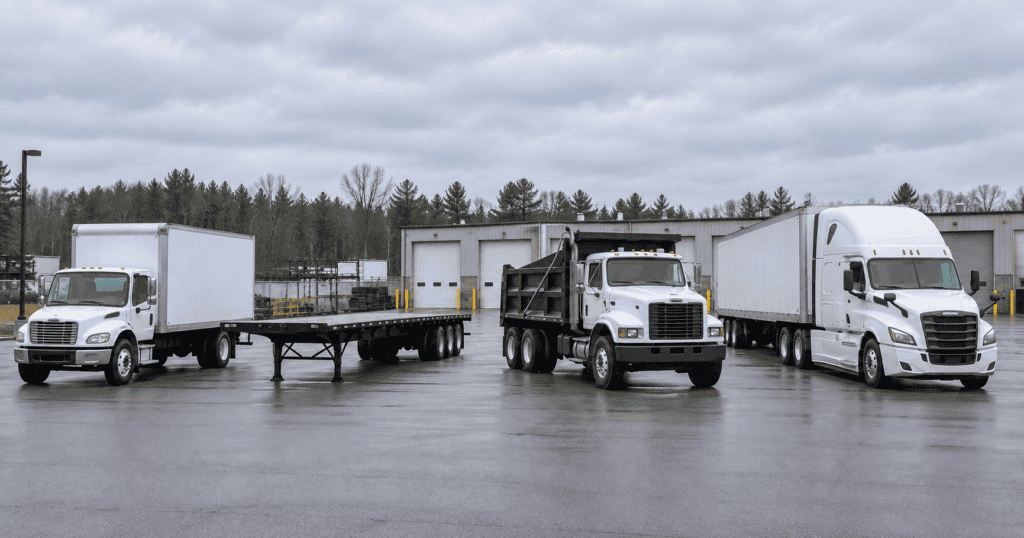
- It has a gross vehicle weight rating or gross combination weight rating — or actual weight — of 10,001 pounds or more, whichever is greater. This includes trailers.
- It is designed or used to carry more than 8 passengers (including the driver) for compensation.
- It is designed or used to carry more than 15 passengers (including the driver), not for compensation.
- It transports hazardous materials in a quantity requiring placards — at any weight.
What Is the Federal Definition of a Commercial Motor Vehicle?
49 CFR §390.5 defines a commercial motor vehicle as any self-propelled or towed motor vehicle used on a highway in interstate commerce to transport passengers or property when the vehicle:- Has a gross vehicle weight rating or gross combination weight rating, or gross vehicle weight or gross combination weight, of 4,536 kg (10,001 pounds) or more, whichever is greater; or
- Is designed or used to transport more than 8 passengers (including the driver) for compensation; or
- Is designed or used to transport more than 15 passengers, including the driver, and is not used to transport passengers for compensation; or
- Is used in transporting material found by the Secretary of Transportation to be hazardous under 49 U.S.C. 5103 and transported in a quantity requiring placarding.
10,001 vs 26,001: The Most Common Mistake
This single confusion causes more missed inspections than anything else, and it comes from mixing two separate regulations.| Threshold | Regulation | What it triggers |
|---|---|---|
| 10,001 lbs | 49 CFR §390.5 | Commercial motor vehicle — FMCSR safety rules including the §396.17 annual inspection |
| 26,001 lbs | 49 CFR §383.5 | Commercial driver’s license requirement |
Does Each Trailer Need Its Own Annual Inspection?
Yes, and §396.17(a) says so with an explicit example. The regulation states that the term commercial motor vehicle includes each vehicle in a combination vehicle. For a tractor semitrailer, full trailer combination, the tractor, the semitrailer, and the full trailer — including the converter dolly if so equipped — must each be inspected. The practical consequence is a vehicle count most carriers get wrong:- Tractor + semitrailer = 2 inspections, 2 reports
- Tractor + semitrailer + dolly + full trailer = 4 inspections, 4 reports
- Three trucks pulling five trailers = 8 inspections, not 3
Does My Vehicle Need a DOT Annual Inspection?
The specific types people ask about most, and why each lands where it does.| Vehicle | In scope? | Why |
|---|---|---|
| Tractor-trailer | Yes | Well over 10,001 lbs — and each unit separately |
| Box truck / straight truck | Yes if GVWR 10,001+ | Most medium-duty box trucks are 12,500–26,000 lbs. No CDL needed, inspection still required |
| Dump truck | Yes | Typically 26,000–60,000 lbs GVWR |
| Flatbed trailer | Yes, separately | A towed vehicle is a CMV in its own right under §390.5 |
| Tow truck / wrecker | Yes if 10,001+ | Most medium and heavy wreckers clear it easily |
| Pickup towing a trailer | Often yes | Judged on gross combination weight rating — a 9,900 lb pickup plus a 7,000 lb trailer is a 16,900 lb combination |
| Concrete mixer / roll-off | Yes | Well above 10,001 lbs; roll-off containers travel on the chassis, which is the vehicle |
| Car hauler / livestock / tanker trailer | Yes, separately | Trailer type is irrelevant — a towed vehicle over the threshold is its own CMV |
| Landscape / equipment trailer | Check the combination | Often under 10,001 lbs alone, but the truck-plus-trailer GCWR usually is not |
| Service / utility truck | Yes if 10,001+ | Bucket trucks, crane trucks, and mechanic rigs usually exceed it |
| Passenger van, for hire | Yes at 9+ people | “More than 8 including the driver” for compensation — weight is irrelevant |
| Passenger van, not for hire | Yes at 16+ people | “More than 15 including the driver” — a 15-passenger van is below the line |
| Any vehicle with hazmat placards | Yes, any weight | Placarded quantity triggers CMV status regardless of size |
| Pickup under 10,001, no trailer | No | Below every trigger — unless placarded or carrying passengers for hire |
What Counts as Interstate Commerce?
Broader than “I cross state lines.” Interstate commerce includes trade, traffic, or transportation that moves between states — but it also captures transportation entirely within one state when it is part of a larger movement that began or will end in another state or country. So a local haul from a port to a warehouse, on freight that arrived from overseas or is bound out of state, is interstate commerce even though the truck never leaves the county. And intrastate-only operations usually are not off the hook. Most states have adopted the Federal Motor Carrier Safety Regulations for intrastate carriers, sometimes at different weight thresholds. North Carolina applies the inspection rules at a GVWR over 10,000 pounds. Georgia adopts the FMCSRs under O.C.G.A. § 40-1-8. Washington reaches commercial motor vehicles at 10,001 pounds in interstate or intrastate commerce under RCW 46.32.005. The practical answer: if you operate commercially at 10,001 pounds or more, assume you are in scope and verify the specifics for your state. See do state DOT inspection requirements replace the federal annual inspection, and our guides for Texas, California, Georgia, North Carolina, Florida, Washington, Pennsylvania, Illinois, and Ohio.What Is Actually Exempt?
Section §390.3(f) lists operations to which the FMCSRs in Parts 390 through 399 do not apply. The relevant ones:- School bus operations as defined in §390.5, except for §§391.15(e) and (f), 392.15, 392.80, and 392.82.
- Transportation performed by the Federal government, a State, or any political subdivision of a State, or an agency established under a Congressionally approved interstate compact.
- Occasional transportation of personal property by individuals not for compensation and not in furtherance of a commercial enterprise.
- Transportation of human corpses or sick and injured persons.
- Fire trucks and rescue vehicles while involved in emergency and related operations.
- Vehicles designed or used to transport between 9 and 15 passengers (including the driver), not for direct compensation, provided the vehicle does not otherwise meet the CMV definition — with limited exceptions including §§391.15(e) and (f), 392.80, and 392.82.
How Often, and What Does the Inspection Cover?
Under §396.17, a qualifying vehicle must pass a periodic inspection at least once every 12 months, covering at minimum the components in Appendix A to Part 396 — brake systems, steering, suspension, frame, tires, wheels and rims, lighting devices, coupling devices, fuel system, exhaust, and windshield glazing and wipers. For vehicles inspected under an FMCSA-approved state program, §396.17(f) sets the clock precisely: the inspection counts for 12 months commencing from the last day of the month in which it was performed. An inspection on March 3 runs through March 31 of the following year. Documentation of the inspection must be on the vehicle — either the §396.21(a) report or a decal carrying the four items §396.17(c)(2) requires. The report itself is retained 14 months under §396.21. See what goes on the truck and what stays in the file. The annual inspection is separate from the daily driver vehicle inspection report under §396.11 and from roadside enforcement. See DVIR requirements under §396.11 and DOT annual inspection vs roadside inspection.If You’re In Scope, Who Can Perform the Inspection?
A person qualified under 49 CFR §396.19. There is no federal DOT inspector certification or license — no agency issues one. The motor carrier qualifies its own inspectors and retains the evidence on file. Under §396.17(d) a carrier may perform its own annual inspections, and under §396.17(e) it may use a commercial garage, fleet leasing company, or similar business as its agent, provided that business employs qualified inspectors. Either way the carrier holds the qualification record. The §396.19(a)(3) standard has two routes: a Federal- or State-sponsored training program or a qualifying state certificate, or a combination of training and/or experience totaling at least one year. Most working mechanics already have the experience half — what is usually missing is documented training in the federal standards. See who can perform DOT annual inspections, our guide to FMCSA §396.19, and can I do my own DOT annual inspection.What Happens If You’re In Scope and Don’t Know It
Operating without a current annual inspection is among the most commonly cited vehicle maintenance violations. Section §396.17(h) subjects the motor carrier to the penalty provisions of 49 U.S.C. 521(b), and a vehicle without documentation can be placed out of service at roadside — which strands the truck and the load. It also feeds the Vehicle Maintenance categories in CSA, affecting your safety profile, insurance renewals, and the reports brokers pull before assigning freight. For a new carrier the stakes are sharper still. Under §385.321(b), using a commercial motor vehicle that has not been periodically inspected is one of sixteen violations that cause automatic failure of the new entrant safety audit, triggered when 51% or more of examined records show it. See the FMCSA new entrant safety audit. And the defects that generate out-of-service orders are the ones a proper annual inspection catches first. In CVSA’s 2026 International Roadcheck, inspectors placed 10,350 of 54,575 vehicles out of service — 19% — with brake system violations alone accounting for 24.3% of all vehicle out-of-service violations. See why trucks fail DOT inspections.In scope? Then you need a qualified inspector — and it can be you.
Under §396.17(d) a motor carrier can perform its own annual inspections. The only requirement is a person qualified under §396.19, and that qualification does not expire. For a fleet counting every trailer as a separate vehicle, doing it in-house is usually the difference between one training cost and a per-vehicle fee every year.
Our DOT Annual Inspection Training Course covers 49 CFR Part 393 and Appendix A to Part 396 — the criteria §396.19(a)(1) requires an inspector to understand — and produces three records for your file:
- Certificate of completion — documented training under §396.19(a)(3)(ii)(A)
- Inspector qualification form — the §396.19(b) record your carrier retains
- Inspection checklist — for performing and recording annual inspections
100% online and self-paced. Lifetime access.
Qualifying a whole shop? Group registration with volume discounts.
Frequently Asked Questions
What vehicles require a DOT annual inspection?
Any vehicle meeting the commercial motor vehicle definition in 49 CFR §390.5 and operating in interstate commerce: a gross vehicle weight rating, gross combination weight rating, gross vehicle weight, or gross combination weight of 10,001 pounds or more, whichever is greater; or designed or used to carry more than 8 passengers including the driver for compensation; or more than 15 passengers including the driver not for compensation; or transporting placarded hazardous materials. Meeting any one criterion is enough.
What vehicles require a DOT inspection?
The same test. A vehicle needs a commercial vehicle inspection under federal rules when it meets the 49 CFR §390.5 definition: 10,001 pounds or more by gross vehicle weight rating, gross combination weight rating, gross vehicle weight, or gross combination weight, whichever is greater; or more than 8 passengers including the driver for compensation; or more than 15 passengers including the driver not for compensation; or placarded hazardous materials. Whether it is called a DOT inspection, an annual DOT inspection, or a periodic inspection, the requirement is 49 CFR §396.17.
Is the DOT inspection threshold 10,001 or 26,001 pounds?
10,001 pounds. The commercial motor vehicle definition in 49 CFR §390.5 starts there, and that is what triggers the annual inspection requirement under §396.17. The 26,001-pound figure is the commercial driver’s license threshold in 49 CFR §383.5, a separate regulation. A vehicle can require a DOT annual inspection while its driver needs no CDL.
Does my box truck need a DOT annual inspection?
If its GVWR is 10,001 pounds or more and it operates in interstate commerce, yes. Most medium-duty box trucks fall between 12,500 and 26,000 pounds, which places them inside the annual inspection requirement even though no CDL is needed to drive them.
Do trailers need their own DOT inspection?
Yes. Section §396.17(a) states that the term commercial motor vehicle includes each vehicle in a combination vehicle, giving the example of a tractor semitrailer full trailer combination in which the tractor, semitrailer, and full trailer, including the converter dolly if so equipped, must each be inspected. Each unit needs its own inspection, its own report, and its own documentation on the vehicle.
Does a pickup truck pulling a trailer need a DOT inspection?
Often yes, because §390.5 tests gross combination weight rating as well as the rating of the power unit alone. A pickup rated at 9,900 pounds towing a trailer rated at 7,000 pounds is a 16,900-pound combination, well above the 10,001-pound threshold. Contractors and service businesses frequently operate commercial motor vehicles this way without realizing it.
How many passengers before a vehicle needs a DOT inspection?
More than 8 including the driver if passengers are carried for compensation, so 9 or more. More than 15 including the driver if not for compensation, so 16 or more. A standard 15-passenger van operated not for hire falls below that second threshold on the passenger criterion, though it may still qualify on weight.
Do hazmat vehicles need a DOT inspection regardless of weight?
Yes. Under §390.5, transporting material found by the Secretary of Transportation to be hazardous under 49 U.S.C. 5103 in a quantity requiring placarding makes a vehicle a commercial motor vehicle regardless of its weight rating. Placards alone put the vehicle in scope.
What vehicles are exempt from the FMCSRs?
Section §390.3(f) excepts school bus operations, transportation performed by the Federal government or a State or political subdivision, occasional transportation of personal property by individuals not for compensation and not in furtherance of a commercial enterprise, transportation of human corpses or sick and injured persons, fire trucks and rescue vehicles during emergency and related operations, and vehicles carrying between 9 and 15 passengers not for direct compensation that do not otherwise meet the CMV definition. Certain provisions still apply to several of these categories.
Does an intrastate-only carrier need a DOT annual inspection?
Usually yes. The federal definition reaches interstate commerce, but most states have adopted the Federal Motor Carrier Safety Regulations for intrastate carriers, sometimes at different weight thresholds. Washington reaches commercial motor vehicles in interstate or intrastate commerce at 10,001 pounds under RCW 46.32.005; North Carolina applies the Part 396 inspection rules to intrastate carriers above 10,000 pounds GVWR. Check your own state.
How often is the DOT annual inspection required?
At least once every 12 months under 49 CFR §396.17, against the criteria in Appendix A to Part 396. For inspections under an FMCSA-approved state program, §396.17(f) provides that the vehicle meets the requirement for 12 months commencing from the last day of the month in which the inspection was performed.
What happens if a vehicle that needs an inspection doesn’t have one?
Section §396.17(h) subjects the motor carrier to the penalty provisions of 49 U.S.C. 521(b), and a vehicle without documentation of a current inspection can be placed out of service at roadside. The violation also feeds the Vehicle Maintenance categories in CSA. For new carriers, using a commercial motor vehicle that has not been periodically inspected is one of sixteen violations causing automatic failure of the new entrant safety audit under §385.321(b).
The Bottom Line
The test is simple and the number is 10,001 pounds. If your vehicle has a gross vehicle or combination weight rating at or above that, carries 9 or more people for compensation, carries 16 or more people at all, or moves placarded hazmat, it needs a DOT annual inspection every 12 months. Two things catch people out. The CDL threshold is 26,001 pounds and has nothing to do with this — plenty of vehicles need inspections while their drivers need no CDL. And every trailer counts as its own vehicle, so your real inspection count is usually higher than your truck count. If you are in scope, the next question is who performs it. Under §396.17(d) that can be your own qualified mechanic, which for most fleets is the cheaper answer by a wide margin.More than one mechanic? Group registration with volume discounts is available for shops and fleets.