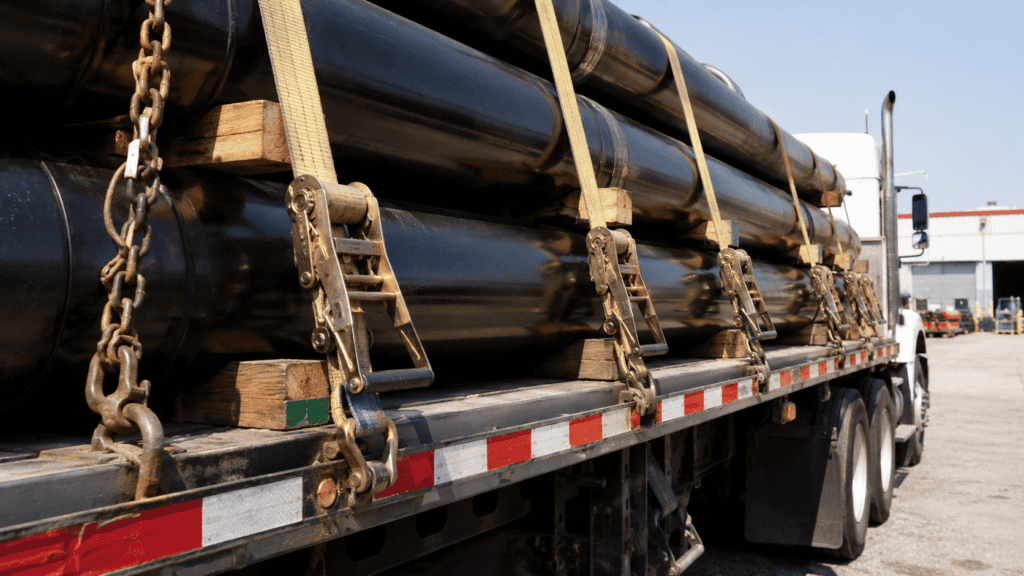
Quick Answer: DOT cargo securement rules are found in 49 CFR Part 393, Subpart I (Sections 393.100 through 393.136), and they apply to virtually all commercial motor vehicles operating in interstate commerce. The core rule: the aggregate working load limit of all your tiedowns must equal at least 50 percent of the cargo’s weight, and your securement system must be able to withstand 0.8g of force forward, 0.5g rearward, and 0.5g laterally. There are also minimum tiedown counts based on cargo length and weight, plus specific rules for commodities like logs, lumber, and metal coils. Cargo securement was the 2026 CVSA International Roadcheck vehicle focus, and it produced 1,724 out-of-service violations — 12.4 percent of the vehicle total, ranking fourth overall.
Cargo that shifts or falls off a truck causes crashes, injuries, and expensive violations. That’s why the federal cargo securement rules are strict, specific, and heavily enforced. This guide breaks down what the rules actually require, the working-load-limit math that trips people up, the inspection points, and how cargo securement ties into the DOT annual inspection your vehicle already needs.
What Are the DOT Cargo Securement Rules?
The rules live in 49 CFR Part 393, Subpart I, titled “Protection Against Shifting and Falling Cargo.” They cover Sections 393.100 through 393.136 and apply to all commercial motor vehicles operating in interstate commerce, generally those with a gross vehicle weight rating of 10,001 pounds or more.
At their core, the rules require that cargo be firmly immobilized or secured on or within a vehicle using structures of adequate strength, dunnage, shoring bars, tiedowns, or a combination of these. The load cannot be able to shift, tip, or fall during normal driving, including hard braking, acceleration, and turns.
The regulation splits into two parts: general requirements that apply to all cargo (§§393.100 through 393.114), and commodity-specific rules for particular load types like logs, lumber, metal coils, and vehicles (§§393.116 through 393.136). When a commodity-specific rule exists, it takes precedence over the general rule.
The 50 Percent Rule: Aggregate Working Load Limit
This is the single most important number in cargo securement, and the one that generates the most violations.
Under §393.106(d), the aggregate working load limit (WLL) of all the tiedowns securing an article of cargo must be at least one-half (50 percent) of the weight of that article. So a 10,000-pound load requires tiedowns with a combined working load limit of at least 5,000 pounds.
Working load limit is the manufacturer-marked safe capacity of a tiedown, and it’s not the same as breaking strength. WLL is what counts for compliance. Every strap, chain, and binder has a marked WLL, and if it’s not marked or is illegible, it can’t be counted.
How Tiedown Working Load Limits Are Counted
Here’s the part that trips up even experienced drivers: how much a tiedown “counts” toward the aggregate depends on how it’s routed.
| Routing | Counts toward aggregate WLL |
|---|---|
| Anchor point on vehicle → attachment point on cargo | 50% of marked WLL |
| Through, over, or around cargo → back to an anchor on the same side | 50% of marked WLL |
| Anchor on one side → over or through cargo → anchor on the opposite side | 100% of marked WLL |
You calculate the aggregate WLL after applying these factors, then compare it to the 50-percent-of-cargo-weight requirement. Getting the routing wrong is how a load that looks well-secured still fails an inspection.
Worked example. A 12,000-pound article needs an aggregate WLL of at least 6,000 pounds. Four straps marked 3,000 lb WLL each, all run from a vehicle anchor to an attachment point on the cargo, count at 50 percent: 4 × 1,500 = 6,000 lb. That just clears it. Run those same four straps side-to-side over the load instead and they count at 100 percent: 4 × 3,000 = 12,000 lb, double the requirement. Same equipment, different routing, completely different compliance position.
How Many Tiedowns Do You Need?
Beyond the working load limit math, §393.110 sets minimum tiedown counts based on the cargo’s dimensions and weight:
| Cargo | Minimum tiedowns |
|---|---|
| 5 ft or less and 1,100 lbs or less | 1 |
| Over 5 ft but under 10 ft, or over 1,100 lbs | 2 |
| Over 10 ft | 2 for the first 10 ft, plus 1 for each additional 10 ft or fraction |
Remember, these are minimums. You must satisfy both the minimum count and the 50-percent aggregate working load limit, whichever demands more tiedowns.
The Performance Standard: What Your System Must Withstand
Under §393.102, the securement system doesn’t just have to look tight, it has to be capable of withstanding specific forces. The system must be able to resist a minimum of 0.8g of deceleration force in the forward direction, 0.5g in the rearward direction, and 0.5g laterally (side to side).
In plain terms, the load must stay put under hard braking (forward), acceleration or backing (rearward), and hard cornering (lateral). This performance standard is why proper working load limits and tiedown counts matter, they’re what deliver the force resistance the rule requires.
Special Rule for Heavy Equipment and Vehicles
Heavy machinery and equipment weighing 10,000 pounds or more has its own requirement under §393.130. It must be secured by tiedowns attached to the vehicle’s structure, frame-to-frame, at the mounting points or another structural part of the equipment.
Tiedowns attached to lift arms, buckets, blades, or other accessory or movable parts are a violation, no matter how tight they appear, because those parts can move or fail. This catches a lot of operators hauling excavators, loaders, and similar equipment.
The Inspection Requirement Drivers Miss
Cargo securement isn’t a one-and-done at the loading dock. Under §393.106, the driver must inspect the cargo and securement within the first 50 miles after beginning a trip and re-secure as necessary. The load must also be re-examined at each change of duty status, after every 3 hours or 150 miles, whichever comes first.
Skipping the 50-mile check is a citable violation even if nothing shifted, straps and chains loosen as a load settles, which is exactly why the rule exists.
Note that this is a separate obligation from the daily driver vehicle inspection report under §396.11 and the pre-trip duty under §396.13. See DVIR requirements under §396.11 for how the daily layer works.
What the 2026 Enforcement Data Showed
Cargo securement was the vehicle focus area of the 2026 CVSA International Roadcheck, and the results tell you how seriously it was taken.
Across 54,575 inspections conducted May 12 through 14, inspectors placed 10,350 vehicles out of service — a 19 percent out-of-service rate. Cargo securement produced 1,724 out-of-service violations, 12.4 percent of all vehicle out-of-service violations, ranking fourth overall.
For context, brake system violations led at 3,379, or 24.3 percent. Cargo securement sits behind brakes and tires but ahead of most other categories, and it is the one most directly under a driver’s control at the moment of loading.
Inspectors looked for freight that was inadequately restrained, immobilized, locked, secured, tied down, packed, or monitored — evaluating whether loads were properly blocked and braced, whether tiedowns and anchor points were in good condition and sufficient number, whether tailboards and end gates were secured, and whether there were visible signs cargo could shift or fall in transit.
See why trucks fail DOT inspections for the full breakdown, and our guides to the 2026 CVSA International Roadcheck and CVSA Level IV inspections.
Why Cargo Securement Violations Are So Costly
Cargo securement is not a minor paperwork issue. Violations score under the Cargo-Related category in CSA, can trigger an out-of-service order that strands the truck and its freight, and carry substantial fines. It’s one of the most common categories of roadside violation.
Worth noting: FMCSA overhauled its Safety Measurement System in February 2026, consolidating roughly 950 violation codes into 116 groups and renaming the BASICs as compliance categories. Fewer, broader categories mean each individual violation carries more weight. See DOT compliance enforcement in 2026 for what changed.
How Cargo Securement Connects to Your DOT Annual Inspection
Here’s the connection fleets should understand: cargo securement isn’t just checked at the roadside. The condition of your securement devices is part of the vehicle’s overall compliance picture, and the securement anchor points, structures, and hardware are inspected as part of a thorough vehicle inspection.
The DOT annual inspection required under 49 CFR §396.17 examines the vehicle against the standards in Appendix A to Part 396, and a qualified inspector who understands the full federal framework, including how cargo securement hardware and vehicle structures must perform, is far better positioned to keep your equipment compliant and roadworthy. The same diligence that passes an annual inspection is the diligence that keeps you out of trouble at a roadside cargo check.
That inspection must be performed by someone qualified under 49 CFR §396.19, and the carrier keeps evidence of that qualification on file. See who can perform DOT annual inspections.
Train Your Team to Inspect and Stay Compliant
Whether it’s cargo securement at the roadside or the annual inspection at your shop, the common thread is the same: compliance depends on trained people who know the federal standards and catch problems before enforcement does. A driver or mechanic who understands how the rules actually work, from working load limits to inspection criteria, is your best protection against violations, out-of-service orders, and the costs that come with them.
Cargo securement was fourth. Brakes were first. Both are Appendix A items.
The categories that park trucks are the same ones a qualified inspector examines during the annual inspection — in your own shop, on your own schedule, before a roadside officer finds them.
Our DOT Annual Inspection Training Course trains your mechanic or owner-operator to the full federal standard under 49 CFR Part 393 and Appendix A to Part 396, and produces three records for your file:
- Certificate of completion — documented training under §396.19(a)(3)(ii)(A)
- Inspector qualification form — the §396.19(b) record your carrier retains
- Inspection checklist — for performing and recording annual inspections
100% online, self-paced — done in an afternoon. The qualification does not expire.
Training more than one person? Group registration with volume discounts.
For the step-by-step path to qualifying, see how to get certified to do DOT inspections, and if you run your own equipment, can I do my own DOT annual inspection.
Frequently Asked Questions
What are the DOT cargo securement rules?
They’re found in 49 CFR Part 393, Subpart I (Sections 393.100-393.136) and apply to commercial motor vehicles in interstate commerce, generally 10,001 lbs or more. The core requirement is that the aggregate working load limit of all tiedowns be at least 50 percent of the cargo’s weight, and that the system withstand 0.8g forward, 0.5g rearward, and 0.5g lateral forces.
What is the 50 percent rule for tiedowns?
Under §393.106(d), the combined working load limit of all tiedowns securing an article must equal at least half the article’s weight. A 10,000-pound load needs tiedowns with a combined working load limit of at least 5,000 pounds.
Does a tiedown always count at its full working load limit?
No. A tiedown running from a vehicle anchor point to an attachment point on the cargo, or one that passes through or over the cargo and returns to an anchor on the same side, counts at 50 percent of its marked working load limit. Only a tiedown running from an anchor on one side, over or through the cargo, to an anchor on the opposite side counts at the full 100 percent.
How many tiedowns do I need?
Under §393.110, cargo 5 ft or less and 1,100 lbs or less needs at least one tiedown; cargo over 5 ft or over 1,100 lbs needs at least two; cargo over 10 ft needs two for the first 10 ft plus one for each additional 10 ft. You must also meet the 50 percent aggregate working load limit, whichever requires more.
How do I secure heavy equipment like an excavator?
Under §393.130, equipment weighing 10,000 lbs or more must be secured frame-to-frame, with tiedowns attached to the vehicle structure and to structural mounting points on the equipment. Attaching tiedowns to buckets, blades, or lift arms is a violation regardless of tightness.
How often must I inspect my cargo securement?
Within the first 50 miles of a trip, then at every change of duty status or after 3 hours or 150 miles, whichever comes first. Skipping the 50-mile check is citable even if nothing shifted.
What happens if I fail a cargo securement inspection?
Cargo securement violations score under the Cargo-Related category in CSA, can result in an out-of-service order that strands the truck and its freight, and carry significant fines. It is one of the most common roadside violation categories.
How many cargo securement violations were found in the 2026 Roadcheck?
Cargo securement was the 2026 vehicle focus area and produced 1,724 out-of-service violations, 12.4 percent of all vehicle out-of-service violations, ranking fourth overall. Across the event, inspectors conducted 54,575 inspections and placed 10,350 vehicles out of service, a 19 percent rate, with brake system violations leading at 24.3 percent.
Do cargo securement rules apply to enclosed van trailers?
Yes. The rules in Subpart I apply to all commercial motor vehicles in interstate commerce, not just flatbeds. Cargo inside a van trailer must still be firmly immobilized or secured using structures of adequate strength, dunnage, shoring bars, tiedowns, or a combination, so that it cannot shift or fall during normal driving.
The Bottom Line
DOT cargo securement rules under 49 CFR Part 393, Subpart I come down to a few essentials: aggregate tiedown working load limit of at least 50 percent of cargo weight, the right minimum number of tiedowns, a system that withstands 0.8g forward and 0.5g in the other directions, frame-to-frame securement for heavy equipment, and the 50-mile inspection check. Get those right and you’ll pass the roadside checks that put so many trucks out of service.
And remember that cargo securement is one piece of a larger compliance picture. The trained judgment that keeps your load secure is the same trained judgment that passes your annual inspection, so investing in qualified, knowledgeable inspectors pays off at the loading dock, at the roadside, and in your shop.
Josh Lopez has spent more than 10 years in the trucking and freight industry, working across shippers, carriers, brokerage, and reefer LTL. He writes about DOT compliance, FMCSA regulations, and commercial vehicle inspection to help mechanics, owner-operators, and fleet managers stay compliant on the road.