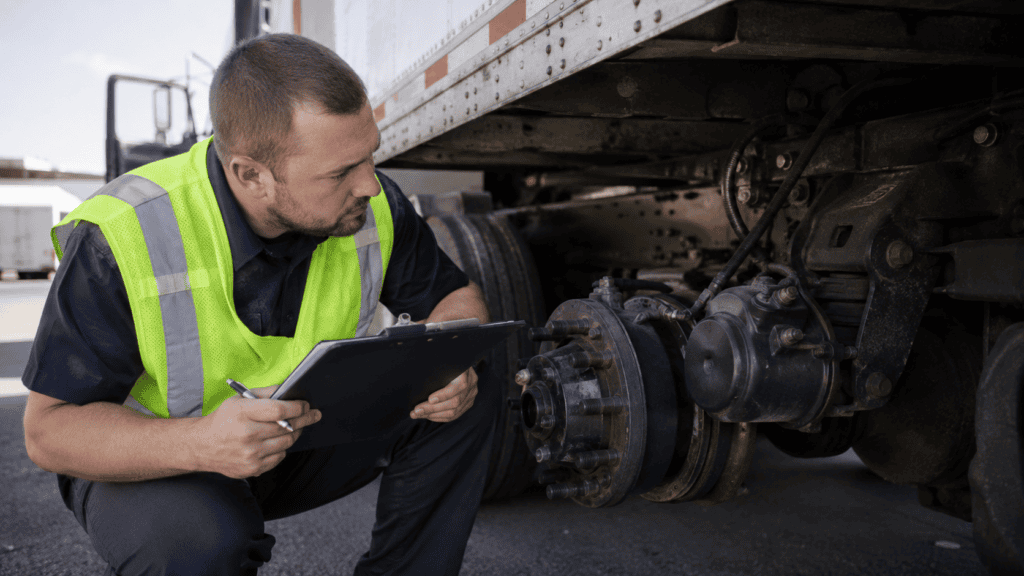
Quick Answer: A CVSA Level IV inspection is a special, one-time examination that targets a single specific component or system on a commercial vehicle, rather than the whole vehicle. It’s most often used during focused enforcement campaigns like Brake Safety Week, or as part of a research study or a post-crash investigation. The critical thing to understand: any commercial vehicle can be selected for a Level IV inspection at any time, even one that just passed a full Level I inspection and is displaying a valid CVSA decal. A decal does not exempt you. The only real protection is a vehicle that’s actually compliant, inspected by a qualified inspector who knows what puts a truck out of service.
Most drivers and fleets know about the big roadside inspection, the full Level I. Far fewer understand the Level IV “special” inspection, which is exactly the type that catches vehicles off guard during events like Brake Safety Week. This guide explains what a Level IV inspection actually is, when it happens, why your CVSA decal won’t save you, and how to make sure your trucks pass.
What Is a CVSA Level IV Inspection?
A Level IV inspection is a special, targeted, one-time examination of a specific part, system, or component on a commercial vehicle. Unlike a Level I inspection, which is a comprehensive head-to-toe check of the driver and the entire vehicle, a Level IV inspection zeroes in on one thing.
According to the Commercial Vehicle Safety Alliance, these inspections are normally conducted in support of a study, or to verify or refute a suspected safety trend. In other words, enforcement agencies use Level IV inspections to gather focused data on a particular problem area, like brakes, tires, or a specific violation type they’re tracking across the industry.
The scope varies widely. A Level IV inspection could be a deep look at just the brake system, just the tires, or any single component the campaign is targeting. It’s narrow and specific by design.
When Does a Level IV Inspection Happen?
Level IV inspections show up in a few specific situations:
Focused enforcement campaigns. This is the big one. CVSA’s Brake Safety Week and Brake Safety Day are conducted as Level IV special inspections dedicated to brake components. During these events, inspectors across the U.S., Canada, and Mexico pull commercial vehicles specifically to examine the targeted system and collect data.
Research and trend studies. When CVSA or an enforcement agency wants to measure how common a particular defect is, they run Level IV inspections to gather statistics on that one component.
Post-crash investigations. A Level IV inspection can be used for a post-crash or post-collision examination when a full post-crash inspection isn’t required and a standard Level I, II, or III can’t be completed. In those cases, the accessible components are inspected to Level IV standards.
The point is that Level IV inspections are often part of an unannounced, targeted push, not a routine roadside stop. You don’t get a warning that a Level IV campaign is happening in your area.
The scale is real. During Brake Safety Week 2025, more than 15,000 commercial vehicles were inspected and 15.1% were placed out of service for brake-related violations. During CVSA’s unannounced Brake Safety Day on April 14, 2026, inspectors conducted 4,021 inspections across 47 jurisdictions and placed 574 vehicles out of service, a 14.3% rate.
Why Your CVSA Decal Won’t Save You
Here’s the part that catches fleets off guard, and it’s the single most important thing to understand about Level IV inspections.
Any commercial vehicle can be selected for a Level IV special inspection, even if it recently passed a full Level I inspection and is displaying a valid CVSA decal. The decal, which you earn by passing a Level I or Level V inspection, does not exempt you from a Level IV.
Think about what that means during Brake Safety Week. A truck that passed a comprehensive inspection last month and has a current decal on the windshield can still be pulled and have its brakes examined. If the brakes have gone out of adjustment since that decal was issued, the truck goes out of service, decal or not.
This is why “we just passed an inspection” is not a compliance strategy. The decal reduces your odds of being stopped for a routine reinspection, but it provides zero protection against a targeted Level IV campaign. The only thing that protects you is a vehicle that is genuinely, currently compliant.
How the Inspection Levels Compare
| Level | Scope | Decal issued? |
|---|---|---|
| Level I | Driver credentials plus complete vehicle, including under-vehicle | Yes |
| Level II | Walk-around driver and vehicle, no under-vehicle | No |
| Level III | Driver and credentials only | No |
| Level IV | One specific component, one time | No |
| Level V | Full vehicle only, no driver present | Yes |
| Level VI | Enhanced inspection for radioactive shipments | Special decal |
Level I is the comprehensive standard: driver credentials plus a complete vehicle inspection including under-vehicle components. It’s the benchmark and the default at CVSA International Roadcheck. During the 2026 Roadcheck, 54,575 inspections produced a 19% vehicle out-of-service rate.
Level V is a full vehicle-only inspection (everything in Level I minus the driver), often used as the annual DOT inspection at a terminal or shop.
Note that a CVSA decal is only issued after a Level I or Level V inspection with no critical violations, and it remains valid for up to three consecutive months. Level IV inspections don’t issue decals — they’re about targeted enforcement and data, not certification.
For how the roadside levels differ from the scheduled annual inspection you control, see DOT annual inspection vs roadside inspection.
How Do You Pass a Level IV Inspection?
Since a Level IV inspection targets a specific component, passing comes down to that component actually being compliant, on any given day, without warning. And because brakes are the most common Level IV focus, the practical answer for most fleets is: keep your brakes and every other inspection item in continuous compliance, not just compliant on the day you happened to get a decal.
The defects that fail a Level IV brake inspection are the same ones that show up in any thorough inspection: brake linings worn below the §393.47(d) minimums, pushrod stroke out of adjustment, cracked drums and rotors, air leaks, and defective components. Under the 20 percent out-of-service rule, a vehicle is placed out of service when 20 percent or more of its service brakes are defective — two brakes on a ten-brake tractor-trailer crosses the threshold.
Two measurement details worth knowing, because they are where inspections are won or lost:
- Pushrod stroke is measured with the engine off, reservoir pressure at 80 to 90 psi, and brakes fully applied. Measuring under different conditions produces different numbers.
- Drums and rotors have no federal minimum thickness figure. Section §393.47(g) defers to the manufacturer’s limit. Appendix A rejects a drum or rotor with any external crack that opens upon brake application, and explicitly cautions against confusing that with normal heat check cracks.
The only reliable way to be ready for an unannounced Level IV inspection is a real, ongoing inspection program run by a qualified inspector who knows exactly what the out-of-service criteria are and catches these defects before enforcement does. See why trucks fail DOT inspections and, for the difference between the annual inspection standard and the out-of-service threshold, legal, out-of-service, or failed inspection.
Who Should Be Doing Your Inspections?
Someone qualified under 49 CFR §396.19. There is no federal DOT inspector certification — the motor carrier qualifies its own inspectors and retains the evidence on file. Under §396.17(d) a carrier may perform its own annual inspections, or under §396.17(e) use a commercial garage as its agent.
And because brakes are the most common Level IV target, note that brake work carries a second qualification under §396.25, separate from §396.19. A CDL air brake endorsement does not by itself satisfy it. See 396.19 vs 396.25 and who can perform DOT annual inspections.
Be Ready Before Enforcement Finds You
Here’s the bottom line for fleets and owner-operators: you cannot predict when a Level IV campaign will hit your area, and your CVSA decal won’t protect you when it does. The only thing that keeps your trucks on the road is having them genuinely compliant every single day, which means having a qualified inspector on your team who catches defects before an enforcement officer does.
A decal proves you passed once. Compliance has to be continuous.
Level IV inspections are unannounced and target one component. The only preparation that works is an inspection program that catches defects on your schedule instead of theirs.
Our DOT Annual Inspection Training Course trains your mechanic or owner-operator to the federal §396.19 standard, covering brakes, drums, rotors, linings, adjustment limits, and every other component that gets trucks placed out of service. Every enrollment includes three records:
- Certificate of completion — documented training under §396.19(a)(3)(ii)(A)
- Inspector qualification form — the §396.19(b) record your carrier retains
- Inspection checklist — for performing and recording annual inspections
100% online, self-paced — your mechanic can complete it in an afternoon.
Qualifying more than one mechanic? Group registration with volume discounts.
To understand the brake-specific qualification, see our guides on DOT air brake certification requirements and Brake Safety Week 2026. For the step-by-step path to qualifying, see how to get certified to do DOT inspections, and if you’re an owner-operator, can I do my own DOT annual inspection.
Frequently Asked Questions
What is a CVSA Level IV inspection?
A special, one-time examination targeting a single specific component or system on a commercial vehicle, rather than the whole vehicle. It’s typically conducted as part of a research study, a focused enforcement campaign like Brake Safety Week, or a post-crash investigation.
Does a CVSA decal exempt me from a Level IV inspection?
No. Any commercial vehicle can be selected for a Level IV inspection even if it recently passed a Level I inspection and is displaying a valid CVSA decal. The decal does not protect you from a targeted Level IV campaign.
Is Brake Safety Week a Level IV inspection?
Yes. CVSA’s Brake Safety Week and Brake Safety Day are conducted as Level IV special inspections focused on brake components. That’s why a current decal won’t exempt your vehicle during the event.
How is a Level IV inspection different from a Level I?
A Level I inspection is a comprehensive head-to-toe check of the driver and entire vehicle, including under-vehicle components, and can result in a CVSA decal. A Level IV inspection targets one specific component, is usually part of a campaign or study, and does not issue a decal.
Which inspection levels issue a CVSA decal?
Only Level I and Level V, and only when no critical violations are found. The decal remains valid for up to three consecutive months, during which a vehicle displaying it is generally not selected for another Level I. Levels II, III, and IV do not issue decals.
How do I pass a Level IV inspection?
Keep the targeted component, most often the brakes, in continuous compliance. Since Level IV inspections are unannounced, the only reliable preparation is an ongoing inspection program run by a qualified inspector who catches out-of-service defects before enforcement does.
Can I be inspected right after passing another inspection?
Yes. A Level IV special inspection can select any commercial vehicle regardless of a recent Level I pass or an active decal. Compliance has to be continuous, not just current on the day a decal was issued.
What is the 20 percent out-of-service brake rule?
Under CVSA’s North American Standard Out-of-Service Criteria, a vehicle is placed out of service when 20 percent or more of its service brakes have a defect, counted across every wheel position. On a five-axle tractor-trailer with ten brakes, two defective brakes crosses the threshold. It was the most-cited out-of-service reason during Brake Safety Week 2025, with 1,199 violations.
Who is qualified to inspect my vehicle before a Level IV campaign?
Someone qualified under 49 CFR §396.19, which can be your own in-house mechanic under §396.17(d) or a commercial garage acting as your agent under §396.17(e). If they perform brake work, they also need separate qualification under §396.25. No federal agency issues a DOT inspector certification; the motor carrier documents the qualification and keeps the evidence on file.
The Bottom Line
A CVSA Level IV inspection is a targeted, one-time check of a single component, most often the brakes, and it’s the type of inspection used during Brake Safety Week and similar campaigns. The hard truth is that it can happen any day, without warning, and your CVSA decal won’t exempt you. The only real protection is a vehicle that’s genuinely compliant every day of the year.
That means having a qualified inspector on your team who knows the out-of-service criteria and catches problems before enforcement does. If your fleet doesn’t have one, the weeks before the next enforcement campaign are the time to fix that, because the next Level IV inspection won’t send you a warning.
Training a whole shop? Group registration with volume discounts is available.
Josh Lopez has spent more than 10 years in the trucking and freight industry, working across shippers, carriers, brokerage, and reefer LTL. He writes about DOT compliance, FMCSA regulations, and commercial vehicle inspection to help mechanics, owner-operators, and fleet managers stay compliant on the road.