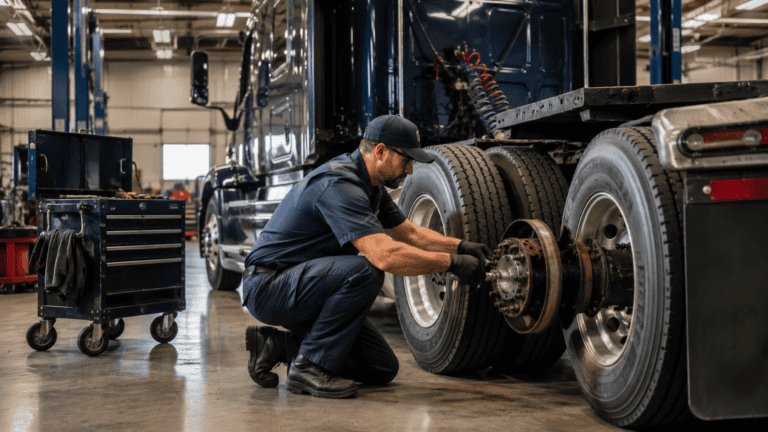
Quick Answer: 49 CFR §396.19 and 49 CFR §396.25 are two separate qualification standards. Section §396.19 qualifies a person to perform the DOT annual (periodic) inspection. Section §396.25 qualifies a person to inspect, service, or repair the brakes on a commercial vehicle. Being qualified under one does not automatically qualify you under the other, and a full annual inspection that includes the brakes generally requires meeting both.
This is one of the most misunderstood areas in DOT compliance, and it shows up constantly in real questions: do I need a separate brake qualification, does my annual inspector qualification cover brakes, who fills out the brake qualification form. The short version is that brakes are treated separately under the regulations because they are so critical to safety. Here is exactly how the two qualifications relate, and when you need each.
What Is the §396.19 Qualification?
49 CFR §396.19 sets the qualification standard for the person who performs the DOT annual, or periodic, inspection under 49 CFR §396.17. To qualify, the inspector must understand the inspection criteria in Part 393 and Appendix A to Part 396, have mastered the methods and tools used in an inspection, and be capable under one of the two routes in §396.19(a)(3): a Federal- or State-sponsored training program or a qualifying state certificate, or a combination of training and/or experience totaling at least one year. There is no government-issued license; the motor carrier keeps evidence of the qualification on file.
This is the qualification most people mean when they talk about becoming a DOT inspector. It covers the full annual inspection across all of the vehicle’s systems. For the full breakdown, see our guide to FMCSA §396.19 and who can perform DOT annual inspections.
What Is the §396.25 Qualification?
49 CFR §396.25 sets a separate qualification standard specifically for brake inspectors. Under this rule, any person responsible for inspecting, maintaining, servicing, or repairing the brakes on a commercial vehicle must meet the brake inspector qualification.
Section §396.25(d) requires three things, and all three have to be true. The person must:
- Understand the brake service or inspection task to be accomplished and be able to perform that task;
- Be knowledgeable of and have mastered the methods, procedures, tools, and equipment used when performing an assigned brake service or inspection task; and
- Be capable of performing the assigned brake service or inspection by reason of experience, training, or both.
That third condition, §396.25(d)(3), has two routes:
Route 1 — §396.25(d)(3)(i): Successful completion of an apprenticeship program sponsored by a State, a Canadian Province, a Federal agency, or a labor union; or a training program approved by a State, Provincial, or Federal agency; or a certificate from a State or Canadian Province that qualifies the person to perform the assigned brake service or inspection task, including passage of Commercial Driver’s License air brake tests in the case of a brake inspection.
Route 2 — §396.25(d)(3)(ii): Brake-related training or experience, or a combination, totaling at least one year.
The reason brakes get their own standard is straightforward. Brake violations are consistently the most common and most serious problems found during roadside inspections. In CVSA’s 2026 International Roadcheck, brake system violations accounted for 3,379 out-of-service violations — 24.3% of all vehicle out-of-service violations and the largest single category. During Brake Safety Week 2025, more than 15,000 vehicles were inspected and 15.1% were placed out of service for brake-related violations. See why trucks fail DOT inspections.
You will often see this called “air brake certification” or “commercial brake certification,” but technically no certificate is issued. It is the §396.25 brake inspector qualification, documented and kept on file by the carrier. The search term and the regulation are describing the same thing.
Does the §396.19 Annual Qualification Cover Brakes?
Not automatically, and this is the key point. Being qualified under §396.19 to perform the annual inspection does not by itself make you qualified under §396.25 to inspect and service brakes. They are separate standards with separate requirements. The annual inspection includes checking the brakes, so in practice, a person performing the complete annual inspection generally needs to satisfy both §396.19 for the overall inspection and §396.25 for the brake portion.
Many carriers do not realize this. They qualify a mechanic for the annual inspection and assume that covers everything, when the brake work actually requires meeting the additional §396.25 standard. That gap is a common compliance finding during audits, and it matters because brake adjustment and brake system violations consistently rank among the most-cited vehicle maintenance violations year after year in FMCSA roadside inspection data.
So Do You Need Both Qualifications?
In most real-world cases, yes, if the same person is performing the full annual inspection including brakes. The annual inspection is not complete without inspecting the brake system, and inspecting the brakes triggers the §396.25 requirement. So the practical answer for a mechanic or owner-operator who wants to perform complete in-house annual inspections is that you should be prepared to meet both standards.
There are situations where they separate. A shop might have one person qualified under §396.19 handling the overall inspection and a different, brake-qualified person handling brake service. Or a carrier might send brake work to a qualified brake specialist. But if you are the one signing off on a full annual inspection, you are touching the brakes, and that means both standards apply to you.
One useful flexibility: FMCSA guidance confirms that §396.25 qualification is task-specific. A motor carrier may qualify someone to perform a limited set of brake tasks — inspecting and adjusting brakes, for instance — without qualifying them to repair or replace brake components. You do not have to qualify every mechanic for every brake task.
Does a CDL Air Brake Endorsement Qualify You for Brakes?
This is where almost every source, including most compliance blogs, gets it half right. The complete answer requires reading §396.25(d) as a whole.
What the regulation text says: §396.25(d)(3)(i) expressly includes passage of Commercial Driver’s License air brake tests as satisfying that subparagraph in the case of a brake inspection. So the CDL air brake test does satisfy the third condition, for inspection specifically.
What FMCSA guidance says: asked directly whether a CDL with an air brake endorsement qualifies a person as a brake inspector under §396.25, FMCSA answered no.
Both are correct, and here is why they fit together. Section §396.25(d) requires all three conditions, joined by “and.” Passing the CDL air brake test satisfies condition (3) for a brake inspection. It does not establish condition (1), that the person understands the task and can perform it, or condition (2), that they have mastered the methods, procedures, tools, and equipment. Those remain the carrier’s determination. The test result is one component of qualification, not the qualification itself.
Two further limits are worth naming. The regulation’s parenthetical applies to a brake inspection — not to brake maintenance, service, or repair. And it does nothing at all for §396.19, so it does not qualify anyone to perform the full annual inspection.
There is also a recordkeeping provision people confuse with qualification. Section §396.25(e) provides that carriers do not have to maintain evidence of qualifications to inspect air brake systems for such inspections performed by persons who have passed the air brake knowledge and skills test for a Commercial Driver’s License. That is a documentation waiver for a narrow category of work. It is not a statement that the person is fully qualified.
We cover the endorsement question in depth, including why there is technically no such thing as an “air brake endorsement,” in does a CDL air brake endorsement make you a qualified brake inspector.
Who Fills Out the Brake Inspector Qualification Form?
Like the annual inspector qualification, the brake inspector qualification is documented and kept on file by the motor carrier. There is a qualification statement that records the inspector’s name, which qualification route they meet, and the supporting evidence — a training certificate, or the years and type of experience. The inspector certifies the information, and the carrier retains it.
Under §396.25(e), the carrier must keep this evidence at its principal place of business or at the location where the brake inspector is employed, for the period of employment in that capacity and for one year afterward. FMCSA publishes an optional sample Brake Inspector Qualifications form through its Safety Planner, but no specific format is mandated.
For the full walkthrough, see who fills out the §396.25 brake inspector qualification form and our FMCSA inspector qualifications form guide for the §396.19 side.
How the Two Standards Compare
| §396.19 | §396.25 | |
|---|---|---|
| Covers | The full annual inspection | Brake inspection, maintenance, service, repair |
| Standard | Part 393 and Appendix A criteria | The assigned brake task |
| Routes | Two, under §396.19(a)(3) | Two, under §396.25(d)(3) |
| Task-specific? | No — covers the whole inspection | Yes — can be limited to specific brake tasks |
| CDL air brake test | Does nothing | Satisfies (d)(3)(i) for inspection only |
| Retention | §396.19(b) — service + 1 year | §396.25(e) — employment + 1 year |
How Do You Qualify for Both?
The cleanest path for someone who wants to perform complete annual inspections is to meet the §396.19 standard through a training program, and to meet the §396.25 brake standard through the appropriate brake route — training, experience, or the CDL air brake test for air brake inspection specifically.
One course, both standards addressed.
Our DOT Annual Inspection Training Course trains to the federal §396.19 standard, covering the full inspection criteria in Part 393 and Appendix A to Part 396 — including how the brake components are assessed as part of the annual inspection, which is the knowledge base behind §396.25 conditions (1) and (2).
Every enrollment produces three records for your file:
- Certificate of completion — documented training under §396.19(a)(3)(ii)(A)
- Inspector qualification form — the §396.19(b) record your carrier retains
- Inspection checklist — for performing and recording annual inspections
100% online and self-paced. The §396.25 brake record is documented separately by the carrier, using the same evidence plus the brake route that applies to that person.
Qualifying a shop? Group registration with volume discounts.
For the brake-specific §396.25 qualification in full, see our guide to DOT air brake certification requirements. If you are an owner-operator working out whether to bring inspections in-house at all, start with can I do my own DOT annual inspection.
§396.19 vs §396.25: Frequently Asked Questions
What is the difference between 396.19 and 396.25?
Section §396.19 qualifies a person to perform the DOT annual inspection. Section §396.25 qualifies a person to inspect, service, or repair brakes. They are separate standards with separate evidence and separate retention rules, and being qualified under one does not qualify you under the other.
Does my 396.19 annual inspector qualification cover brakes?
No, not automatically. The annual inspection includes brakes, so a person performing the full inspection generally needs to meet both §396.19 and the §396.25 brake standard. Qualifying a mechanic for the annual inspection and assuming it covers brake work is a common audit finding.
Do I need both qualifications?
Usually yes, if the same person performs the complete annual inspection including the brake portion. They can be split between two qualified people, but inspecting brakes triggers §396.25.
Does a CDL air brake endorsement qualify me to inspect brakes?
Partly, and the nuance matters. Section §396.25(d)(3)(i) expressly includes passage of Commercial Driver’s License air brake tests as satisfying that subparagraph in the case of a brake inspection. But §396.25(d) requires all three of its conditions, and the test does not establish that the person understands the task or has mastered the methods and tools. That is why FMCSA guidance answers no to whether the endorsement qualifies someone as a brake inspector. It also does not reach brake service or repair, and it does nothing for §396.19.
Can a brake inspector be qualified for only some brake tasks?
Yes. FMCSA guidance confirms that a motor carrier may qualify an employee under §396.25 to perform a limited number of brake tasks, such as inspecting and adjusting brakes, without qualifying them to repair or replace brake components. Qualification attaches to the assigned task.
Who keeps the brake inspector qualification records?
The motor carrier, under §396.25(e), at its principal place of business or at the location where the brake inspector is employed, for the period of employment in that capacity plus one year. The exception is air brake system inspections performed by someone who passed the CDL air brake knowledge and skills test, where the carrier is not required to maintain the qualification evidence.
Is “air brake certification” the same as the 396.25 qualification?
Yes. People search for “air brake certification” or “commercial brake certification,” but there is no formal certificate and no agency issues one. It refers to meeting the 49 CFR §396.25 brake inspector qualification, which the carrier documents and keeps on file.
How many routes are there under 396.25?
Two, under §396.25(d)(3). Route (i) is a sponsored apprenticeship, an agency-approved training program, or a qualifying state or Canadian Province certificate, which expressly includes passage of the CDL air brake tests in the case of a brake inspection. Route (ii) is brake-related training or experience, or a combination, totaling at least one year. Both sit on top of the two other conditions in §396.25(d).
Does your course qualify me for both?
The course trains to the §396.19 annual inspector standard and covers how brake components are assessed within the annual inspection, which is the knowledge base behind the §396.25 conditions. The §396.25 brake record is documented separately by the carrier, using that evidence plus the brake route that applies to the individual.
About the author: Josh Lopez has spent more than 10 years in the trucking and freight industry, working across shippers, carriers, brokerage, and reefer LTL. He writes about DOT compliance, FMCSA regulations, and commercial vehicle inspection to help mechanics, owner-operators, and fleet managers understand the rules that govern their operations and stay compliant on the road.