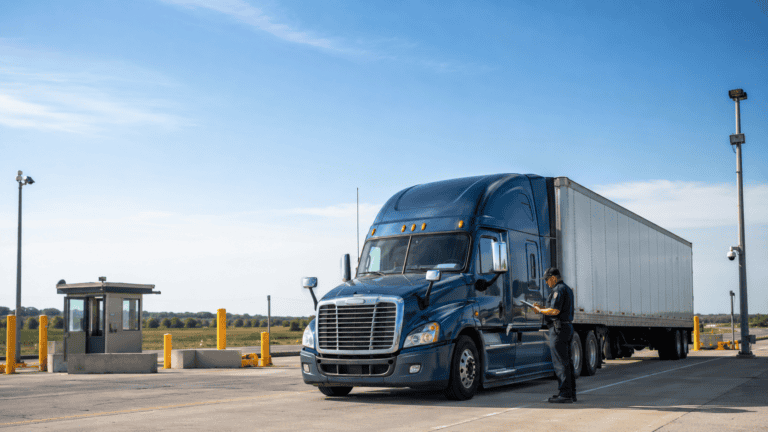
Quick Answer: The DOT annual inspection and a roadside inspection are two different things. The annual inspection (periodic inspection) is a scheduled, once-a-year inspection required under 49 CFR §396.17, performed by an inspector qualified under 49 CFR §396.19 and documented by the carrier. A roadside inspection is an unscheduled enforcement check performed by a certified officer using the CVSA inspection levels. Passing a roadside inspection does not satisfy your annual inspection requirement — you still need both.
This is one of the most common points of confusion in commercial vehicle compliance. People assume that if a truck passed a thorough roadside inspection, it must be covered for the year. It is not. The two inspections come from different parts of the regulation, are performed by different people, and satisfy different requirements. Here is how the DOT annual inspection vs roadside inspection question actually breaks down, and why you need to keep them straight.
DOT Annual Inspection vs Roadside Inspection at a Glance
| Annual (periodic) inspection | Roadside inspection | |
|---|---|---|
| Regulation | 49 CFR §396.17 | CVSA North American Standard levels |
| Scheduled? | Yes — you schedule it | No — unannounced |
| Who performs it | Inspector qualified under §396.19 — can be your own mechanic | CVSA-certified enforcement officer |
| Frequency | At least every 12 months | Whenever you are selected |
| Standard applied | Appendix A to Part 396 | CVSA out-of-service criteria |
| Record | Report retained 14 months, §396.21(b)(1) | Feeds the carrier’s CSA score |
| Satisfies the other? | No — you can still be inspected | No — with narrow exceptions |
What Is the DOT Annual Inspection?
The annual inspection, formally the periodic inspection, is required under 49 CFR §396.17. Every commercial motor vehicle operating in interstate commerce must pass one at least once every 12 months. It is a scheduled, top-to-bottom safety inspection covering brakes, steering, suspension, tires, lighting, coupling devices, the frame, exhaust, fuel systems, and the other components in the federal minimum standards (Appendix A to Part 396).
The key features: it is planned (you schedule it), it is performed by a qualified inspector under 49 CFR §396.19, and the motor carrier keeps the inspection report on file for 14 months. A carrier can have its own in-house qualified inspector perform it under §396.17(d), use a commercial garage as its agent under §396.17(e), or use a qualifying state program under §396.17(f). It is a compliance record you maintain, not something an officer does to you on the highway.
For the requirement in full, see our guide to 49 CFR §396.17. For what has to ride on the vehicle afterward, see what goes on the truck and what stays in the file.
What Is a Roadside Inspection?
A roadside inspection is an unscheduled enforcement inspection performed by a CVSA-certified officer, usually at a weigh station or during a roadside stop. It follows the North American Standard Inspection Program developed by the Commercial Vehicle Safety Alliance (CVSA) in coordination with FMCSA, and it uses a system of inspection levels that determine how deep the inspection goes.
Unlike the annual inspection, you do not schedule a roadside inspection and you do not perform it yourself. An enforcement officer initiates it, and the results feed directly into your carrier’s safety record. If the officer finds critical violations, the vehicle or driver can be placed out of service on the spot.
Roadside enforcement is widespread. During the 2026 International Roadcheck, inspectors performed 54,575 inspections over 72 hours and placed 10,350 vehicles out of service — 19% — along with 3,184 drivers at 5.8%. Brake system violations alone accounted for 24.3% of all vehicle out-of-service violations. See why trucks fail DOT inspections for the full breakdown of what actually parks a truck.
What Are the CVSA Roadside Inspection Levels?
Roadside inspections are categorized into levels. The ones you are most likely to encounter:
Level I is the most thorough — a full inspection of both the driver and the vehicle, including going under the vehicle to check brakes, suspension, and frame. It takes roughly 45 to 60 minutes. A clean Level I can earn a CVSA decal that helps the vehicle avoid re-inspection for up to about three months.
Level II is a walk-around driver and vehicle inspection that covers similar items but does not include going under the vehicle. It is quicker, around 20 to 30 minutes. Level I and Level II together account for over 90% of all roadside inspections, so these are the two you are by far most likely to encounter.
Level III focuses on the driver and credentials — license, medical certificate, hours of service, and paperwork — rather than the vehicle.
Level IV is a special one-item inspection, often tied to a study or a focused enforcement campaign like Brake Safety Week. See what is a CVSA Level IV inspection.
Level V is a vehicle-only inspection with no driver present, often done at a terminal or maintenance yard.
Level VI applies to certain radioactive material shipments, and Level VII covers jurisdictional programs like school buses, taxis, and shuttles.
Does Passing a Roadside Inspection Count as Your Annual Inspection?
Generally, no, and this is the most important point to understand. A violation-free CVSA Level I roadside inspection does not by itself satisfy the annual periodic inspection requirement under 49 CFR §396.17. Even though a Level I is extremely thorough, it is not automatically a substitute for the scheduled annual inspection. They are separate obligations.
There is one nuance worth knowing. A Level V vehicle-only inspection, because it covers the full vehicle against the same standards, can serve as a valid annual inspection when it is properly documented. And under §396.17(f), inspections performed under a qualifying state program count as periodic-equivalent — whether that applies to you depends on your state, covered in do state DOT inspection requirements replace the federal annual inspection.
But a routine roadside Level I that an officer performs during a traffic stop does not replace the annual inspection you are responsible for scheduling and documenting. If you rely on a roadside pass instead of maintaining your annual inspection, you can still be cited for not having a current periodic inspection.
Different Standards, Different Numbers
There is a subtler difference that catches experienced mechanics: the two inspections do not always measure against the same threshold.
The annual inspection is a pass-or-fail assessment against Appendix A to Part 396. A roadside officer decides whether to park the truck using the CVSA North American Standard Out-of-Service Criteria. And Part 393 sets a third standard — the minimum condition for lawful operation.
Those are three different numbers on some components. A steer tire at 3/32 of an inch is a violation of §393.75(b), which requires 4/32, but it is not below the CVSA out-of-service threshold, so the truck gets a citation and keeps rolling. We separate all three in legal, out-of-service, or failed inspection: the three standards every DOT inspector has to know.
Who Performs Each Inspection?
This is another core difference. The annual inspection is performed by a person qualified under 49 CFR §396.19 — someone who understands the federal inspection criteria and is qualified through training or experience. That can be your own in-house inspector. The roadside inspection is performed by a CVSA-certified enforcement officer, a government official with authority to inspect commercial vehicles and place them out of service.
So one is something you or your qualified staff perform as part of your maintenance and compliance program. The other is something enforcement does to verify safety on the road. Being qualified under §396.19 lets you handle the first. It has nothing to do with becoming a roadside enforcement officer, which is a separate government role with its own training.
See who can perform DOT annual inspections for the qualification standard in detail.
Where the DVIR Fits
There is a third layer people leave out of this comparison, and it operates daily rather than annually.
Under 49 CFR §396.11, a driver prepares a written report at the completion of each day’s work listing any defect that would affect safe operation, and the carrier certifies the repair before the vehicle goes back out. Under §396.13, the driver must be satisfied the vehicle is in safe operating condition before driving.
So the full picture is three tiers: the driver checks daily under §396.13 and reports defects under §396.11, the vehicle gets a complete inspection annually under §396.17, and enforcement verifies at random. See DVIR requirements under §396.11 — including the exemption for carriers operating only one commercial motor vehicle.
How Do the Two Inspections Work Together?
They are complementary, not interchangeable. Your annual inspection is the scheduled foundation — you keep your fleet compliant and documented on a 12-month cycle. Roadside inspections are the enforcement layer, verifying that trucks on the road are actually safe, at random and without notice.
A well-run operation keeps its annual inspections current and its vehicles maintained so that when a roadside inspection happens, the truck passes. In other words, doing the annual inspection properly is part of how you pass roadside inspections. But the roadside pass never replaces the annual inspection on your compliance records, and a current annual inspection does not exempt you from being pulled in for a roadside check.
What Does This Mean for Getting Qualified?
If your goal is to perform the annual inspection, whether for your own trucks or as an in-house inspector for a carrier, what you need is the qualification under 49 CFR §396.19. That is the standard for the scheduled periodic inspection.
What no course does, including ours, is make you a roadside enforcement officer. That is a government law-enforcement role. If you have seen requirements about completing a certain number of inspections per year to stay certified, those belong to the enforcement side, not to the §396.19 annual inspector qualification.
The inspection you control is the one worth getting right.
You cannot schedule a roadside stop. You can schedule the annual inspection, perform it in your own shop, and catch the defects that would otherwise park the truck at a scale house.
Our DOT Annual Inspection Training Course trains to the federal §396.19 standard, covering 49 CFR Part 393 and Appendix A to Part 396 — and produces three records for your file:
- Certificate of completion — documented training under §396.19(a)(3)(ii)(A)
- Inspector qualification form — the §396.19(b) record your carrier retains
- Inspection checklist — for performing and recording annual inspections
100% online, self-paced, lifetime access. The qualification does not expire.
Qualifying a shop or a fleet? Group registration with volume discounts.
We cover the qualification standard in depth in our guide to FMCSA §396.19, and the step-by-step path in how to get certified to do DOT inspections. If you are an owner-operator weighing whether to do it yourself, start with can I do my own DOT annual inspection.
DOT Annual Inspection vs Roadside Inspection: Frequently Asked Questions
Is a DOT annual inspection the same as a roadside inspection?
No. The annual inspection is a scheduled periodic inspection under 49 CFR §396.17 performed by a qualified inspector and documented by the carrier. A roadside inspection is an unscheduled enforcement check performed by a CVSA-certified officer using the North American Standard inspection levels.
Does passing a roadside inspection satisfy my annual inspection requirement?
Generally no. A violation-free CVSA Level I roadside inspection does not by itself satisfy the 49 CFR §396.17 annual inspection requirement. They are separate obligations. The narrow exceptions are a properly documented Level V vehicle-only inspection and inspections performed under a qualifying state program under §396.17(f).
Who performs the annual inspection?
A person qualified under 49 CFR §396.19, which can be an in-house mechanic under §396.17(d), or a commercial garage or similar business acting as the carrier’s agent under §396.17(e). The roadside inspection is performed by a CVSA-certified enforcement officer.
What is a CVSA Level I inspection?
The most thorough roadside inspection, covering both driver and vehicle including under-vehicle components, taking about 45 to 60 minutes. A clean Level I can earn a CVSA decal valid up to about three months, during which the vehicle is generally not selected for another Level I.
Can a Level V inspection count as an annual inspection?
A Level V vehicle-only inspection can serve as a valid annual inspection when properly documented, because it covers the full vehicle against the same standards. A routine roadside Level I performed during a stop does not replace your scheduled annual inspection.
How many roadside inspections result in an out-of-service order?
During CVSA’s 2026 International Roadcheck, 10,350 of 54,575 commercial motor vehicles inspected were placed out of service, a rate of 19 percent, along with 3,184 drivers at 5.8 percent. Brake system violations accounted for 24.3 percent of all vehicle out-of-service violations, the largest single category.
Do the annual inspection and roadside inspection use the same standards?
Not exactly. The annual inspection is a pass-or-fail assessment against Appendix A to Part 396. A roadside officer decides whether to place a vehicle out of service using the CVSA North American Standard Out-of-Service Criteria, and Part 393 sets a separate minimum for lawful operation. On some components those are three different thresholds, which is why a vehicle can be in violation without being placed out of service.
Does your course qualify me for roadside enforcement inspections?
No. The course qualifies you to perform the annual (periodic) inspection under 49 CFR §396.19. Roadside enforcement is a separate government law-enforcement role with its own training and certification.
About the author: Josh Lopez has spent more than 10 years in the trucking and freight industry, working across shippers, carriers, brokerage, and reefer LTL. He writes about DOT compliance, FMCSA regulations, and commercial vehicle inspection to help mechanics, owner-operators, and fleet managers understand the rules that govern their operations and stay compliant on the road.