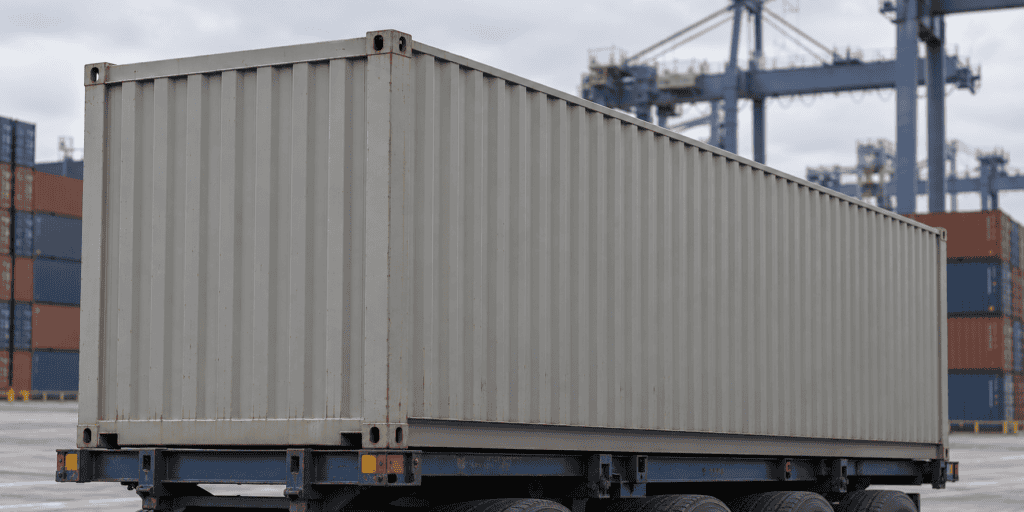
Quick Answer: The intermodal equipment provider is responsible for the annual inspection on an interchanged chassis, not the motor carrier pulling it. Under 49 CFR §390.40T(g), an IEP must periodically inspect equipment intended for interchange as required by §396.17, and §396.17(d) permits the IEP to perform that inspection itself using an inspector qualified under §396.19. The motor carrier’s obligations are different and narrower: inspect the equipment before operating it, and report any damage, defects, or deficiencies to the IEP when the equipment is returned. But a driver who accepts and operates a defective chassis is still operating a defective vehicle, which is why the pre-trip matters as much as the paperwork.
Chassis responsibility is one of the most confused areas in the FMCSRs, partly because the rule that governs it is written in two places and one of them is suspended.
This guide covers who owes what, which version of the regulation actually applies, and how the annual inspection requirement works when nobody owns the equipment they are pulling.
The Regulation You’re Probably Reading Is Suspended
Start here, because it changes what you should be citing.
49 CFR §390.40 is the section everyone quotes for intermodal equipment provider responsibilities. Check the eCFR and you will find an effective date note underneath it:
“At 82 FR 5318, Jan. 17, 2017, § 390.40 was suspended, effective Jan. 14, 2017. At 89 FR 90622, Nov. 18, 2024, the suspension was lifted and the section heading was revised. In that same document, § 390.40 was again suspended indefinitely, effective Nov. 18, 2024.”
— eCFR effective date note, 49 CFR 390.40
The operative section is §390.40T — the “T” designating a temporary section that remains in force while the permanent version is suspended.
Paragraphs (c) through (j) are word-for-word identical in both. The difference is in the registration requirement, and it matters:
| §390.40 (suspended) | §390.40T (operative) | |
|---|---|---|
| Registration form | Form MCSA-1, under §390.201 | Form MCS-150C, under §390.19T |
| Marking requirement | §390.21 | §390.21T |
| Paragraphs (c)–(j) | Identical in both versions | |
So a source telling an IEP to register using Form MCSA-1 is citing a suspended section. The operative requirement is Form MCS-150C.
What an Intermodal Equipment Provider Actually Owes
Section §390.40T lists ten obligations. An intermodal equipment provider must:
- Identify its operations to FMCSA by filing Form MCS-150C required by §390.19T.
- Mark its equipment with the USDOT number as required by §390.21T before tendering the equipment to a motor carrier.
- Systematically inspect, repair, and maintain — or cause to be systematically inspected, repaired, and maintained — in a manner consistent with §396.3(a)(1), all intermodal equipment intended for interchange.
- Provide equipment that is in safe and proper operating condition.
- Maintain a system of driver vehicle inspection reports submitted to the IEP as required by §396.11.
- Maintain a system of inspection, repair, and maintenance records as required by §396.3(b)(3).
- Periodically inspect equipment intended for interchange, as required under §396.17.
- Provide procedures and sufficient space at interchange facilities for drivers to perform a pre-trip inspection of tendered equipment.
- Repair or replace defective equipment before the driver departs, once notified by a driver of damage, defects, or deficiencies identified in a pre-trip inspection.
- Refrain from placing equipment in service if it has been found to pose an imminent hazard as defined in §386.72(b)(3).
Item 7 is the annual inspection, and item 9 is the one most often ignored in practice. The IEP has to fix it before the driver leaves — not schedule it, not note it for the next cycle.
So Who Performs the Annual Inspection on a Chassis?
The IEP, or its agent. 49 CFR §396.17 names intermodal equipment providers directly in three places:
§396.17(d) — an intermodal equipment provider may perform the required annual inspection for intermodal equipment interchanged or intended for interchange to motor carriers that are not subject to an inspection under §396.23(a)(1). That is the self-inspection provision, extended to IEPs.
§396.17(e) — in lieu of self-inspection, an IEP may have a commercial garage, fleet leasing company, truck stop, or other similar commercial business perform the inspection as its agent, provided that business employs qualified inspectors as required by §396.19.
§396.17(g) — it is the responsibility of the motor carrier or intermodal equipment provider to ensure that all parts and accessories are maintained at, or promptly repaired to, the minimum standards in Appendix A to Part 396.
And §396.17(h) applies the penalty provisions of 49 U.S.C. 521(b) to an IEP that fails to perform the annual inspection properly, exactly as it does to a motor carrier.
The qualification standard is the same one that applies to any annual inspection. There is no separate intermodal inspector credential. Whoever signs the chassis inspection has to meet §396.19, and the IEP retains the evidence. See who can perform DOT annual inspections and our guide to FMCSA §396.19.
What the Motor Carrier and Driver Owe
Narrower, but not nothing — and this is where drayage carriers get caught.
Under §390.42, a driver or motor carrier transporting intermodal equipment must report to the intermodal equipment provider, or its designated agent, any known damage, defects, or deficiencies in the intermodal equipment at the time the equipment is returned to the provider or the provider’s agent.
That is a reporting duty on return. Separately, the driver has an inspection duty before operating.
The trap is this. The IEP owes you a roadworthy chassis and an annual inspection. But if you accept a chassis with a defect and run it, you are operating a defective commercial motor vehicle — and a roadside inspector citing the defect is looking at the vehicle in front of them. The IEP’s failure does not become your defence at the scale house.
Under §390.40T(h) and (i), the IEP must give you space and procedures to inspect before departure, and must repair or replace defective equipment once you report it prior to your departure. Those provisions exist precisely so the defect gets caught at interchange rather than at a weigh station.
Use them. A pre-trip on a tendered chassis is not optional courtesy — it is the mechanism the rule is built around.
What to Check on a Tendered Chassis
The components most likely to be defective on interchanged equipment, and most likely to be cited:
- Brakes. Lining thickness, pushrod stroke, air lines and glad hands, slack adjusters. Brakes are the largest single category of out-of-service violations — in CVSA’s 2026 International Roadcheck, brake system violations accounted for 3,379 out-of-service findings, 24.3% of the vehicle total.
- Tires and wheels. Tread depth, sidewall damage, inflation, lug nuts, rim condition.
- Lighting and reflectors. The most commonly cited defect category on chassis, and the easiest to spot.
- Coupling devices and the kingpin area. Locking mechanism, upper coupler, landing gear.
- Container securement devices. The twist locks and pins that hold the container to the chassis — these are specifically covered by the maintenance requirement.
- The annual inspection documentation itself. Under §396.17(c), proof of a current inspection must be on the equipment, either the §396.21(a) report or a decal carrying the four required items.
That last one is worth checking before you pull the chassis, not after. See what goes on the truck and what stays in the file for what a compliant decal has to contain.
If the Chassis Fails at Roadside
The out-of-service process works the same way it does for any vehicle, with one addition.
Under §396.9(c)(2), nobody may operate a vehicle or intermodal equipment declared out of service until all repairs required by the out-of-service notice are completed — and “operate” includes towing, except by crane or hoist. Under §396.9(d)(1), the driver delivers a copy of the report to the motor carrier and, where applicable, the intermodal equipment provider at the next terminal, or transmits it immediately if not arriving within 24 hours.
The certification deadline is 15 days, and the record is kept 12 months. See what happens when a truck fails a DOT inspection.
There is also a mechanism for fixing the record. Section §390.44 provides procedures to correct the safety record of a motor carrier or an intermodal equipment provider. If a chassis violation is attributed to the wrong party, that is the route — alongside FMCSA’s DataQs system for challenging inspection data generally.
Does a State Inspection Program Change This?
It can. Under §396.23(b)(1), if a commercial motor vehicle is subject to a mandatory State inspection program which the Administrator has determined to be as effective as §396.17, the motor carrier or intermodal equipment provider must meet the §396.17 requirement through that State’s program.
And §396.23(a) allows a motor carrier or IEP to meet the §396.17 requirement through a State or other jurisdiction’s roadside inspection program.
Chassis registered in states with approved programs — Texas, Pennsylvania, California among others — follow the state route. Most states run no approved program, leaving the federal route open. See do state DOT inspection requirements replace the federal annual inspection.
Note also §390.46, which addresses preemption of State and local laws and regulations on the inspection of intermodal chassis. The federal roadability framework was designed to replace a patchwork of state chassis rules, and that preemption provision is why.
Where the Roadability Rule Came From
Useful background for anyone trying to understand why these obligations sit where they do.
Subpart C of Part 390 was created by a final rule published at 73 FR 76822 on December 17, 2008 — known in the industry as the roadability rule. Before it, chassis maintenance responsibility was contested: ocean carriers and leasing companies supplied the equipment, drayage carriers pulled it, and enforcement had no clean answer about who to cite.
The rule resolved that by creating the intermodal equipment provider category, requiring registration and USDOT marking, and placing the systematic maintenance and periodic inspection duties on the party that owns and tenders the equipment. IEPs were required to mark their chassis within 24 months of publication — by December 17, 2010.
The underlying statutory authority is 49 U.S.C. 31151.
What Records Does an IEP Need?
| Record | Requirement | Retention |
|---|---|---|
| Annual inspection report, per unit | §396.21(b)(1) | 14 months |
| Inspector qualification evidence | §396.19(b) | Service + 1 year |
| Brake inspector qualification | §396.25(e) | Employment in role + 1 year |
| Systematic inspection, repair, maintenance records | §390.40T(f), §396.3(b)(3) | Per §396.3(b) |
| Driver vehicle inspection reports received | §390.40T(e), §396.11 | 3 months |
The inspector qualification record is the one IEPs most often lack. A chassis pool can produce inspection reports for every unit and still have a gap, because §396.19(b) requires evidence that the person who performed those inspections was qualified. An inspection signed by someone whose qualification cannot be documented is not a compliant inspection.
See our FMCSA inspector qualifications form guide for what that record contains, and DVIR requirements under §396.11.
Chassis pools need qualified inspectors at every yard.
Under §396.17(d) an intermodal equipment provider can inspect its own equipment, and under §390.40T(i) it must repair defects before the driver departs. Both require someone qualified under §396.19 on site — and for a pool spread across multiple terminals, that means more than one person.
Qualifying one inspector creates a single point of failure while the 12-month clock runs on every unit. Training the team together also means the qualification records come out in one format, which is what makes them straightforward to produce during a compliance review.
Our DOT Annual Inspection Training Course covers 49 CFR Part 393 and Appendix A to Part 396, and each enrollment produces three records:
- Certificate of completion — documented training under §396.19(a)(3)(ii)(A)
- Inspector qualification form — the §396.19(b) record you retain
- Inspection checklist — for performing and recording annual inspections
100% online and self-paced. The qualification does not expire.
Volume discounts at 3, 6, and 11 users. Or enroll one inspector.
For the step-by-step path, see how to get certified to do DOT inspections, and for the maintenance manager’s view, DOT inspection training for fleet mechanics.
Frequently Asked Questions
Who is responsible for inspecting an intermodal chassis?
The intermodal equipment provider. Under 49 CFR §390.40T(g), an IEP must periodically inspect equipment intended for interchange as required by §396.17, and must systematically inspect, repair, and maintain all equipment intended for interchange under §390.40T(c). The motor carrier’s duties are to inspect the equipment before operating it and to report any damage, defects, or deficiencies to the IEP when the equipment is returned, under §390.42.
Does a chassis need an annual DOT inspection?
Yes. Intermodal equipment is subject to the periodic inspection requirement in 49 CFR §396.17, which the intermodal equipment provider is responsible for under §390.40T(g). Section §396.17(d) permits the IEP to perform the inspection itself, and §396.17(e) permits it to use a commercial garage as its agent, provided that business employs inspectors qualified under §396.19.
Is 49 CFR 390.40 still in effect?
No. The eCFR effective date note states that §390.40 was suspended effective January 14, 2017 at 82 FR 5318; the suspension was lifted and the heading revised at 89 FR 90622 on November 18, 2024, and in that same document §390.40 was again suspended indefinitely effective November 18, 2024. The operative section is §390.40T. Paragraphs (c) through (j) are identical in both, but the registration requirement differs: §390.40T requires Form MCS-150C under §390.19T, while the suspended §390.40 referenced Form MCSA-1 under §390.201.
What form does an intermodal equipment provider file?
Under the operative §390.40T(a), an IEP identifies its operations to FMCSA by filing Form MCS-150C as required by §390.19T. Sources citing Form MCSA-1 under §390.201 are referencing the suspended version of the section.
Can a drayage carrier be cited for a defective chassis it does not own?
Yes. A driver who accepts and operates a chassis with a defect is operating a defective commercial motor vehicle, and a roadside inspector is evaluating the vehicle in front of them. The IEP’s obligation to provide safe equipment does not eliminate the carrier’s obligation not to operate an unsafe one. Section §390.40T(h) and (i) require the IEP to provide space and procedures for a pre-trip inspection and to repair or replace defective equipment before the driver departs, which is the mechanism for catching defects at interchange. Section §390.44 provides procedures to correct the safety record of a motor carrier or an intermodal equipment provider where a violation is misattributed.
Does the IEP have to fix a defect before the driver leaves?
Yes. Under §390.40T(i), at facilities where an IEP makes equipment available for interchange, it must develop and implement procedures to repair any damage, defects, or deficiencies identified as part of a pre-trip inspection, or replace the equipment, prior to the driver’s departure. The repairs or replacement must be made after being notified by a driver.
Who can perform a chassis annual inspection?
Anyone qualified under 49 CFR §396.19. There is no separate intermodal inspector credential and no federal agency issues one. The IEP determines qualification and retains the evidence under §396.19(b) for the period the person performs inspections plus one year. Anyone performing brake work also needs separate qualification under §396.25.
What records must an intermodal equipment provider keep?
Under §390.40T, a system of driver vehicle inspection reports submitted to the IEP as required by §396.11, and a system of inspection, repair, and maintenance records as required by §396.3(b)(3). Plus the Part 396 records: annual inspection reports for 14 months under §396.21(b)(1), inspector qualification evidence for the period of service plus one year under §396.19(b), and brake inspector qualification under §396.25(e).
Does a state inspection program apply to chassis?
It can. Under §396.23(b)(1), if the equipment is subject to a mandatory State inspection program the Administrator has determined to be as effective as §396.17, the motor carrier or intermodal equipment provider must meet the requirement through that State’s program. Section §390.46 also addresses preemption of State and local laws on the inspection of intermodal chassis, which is why the federal framework largely replaced the earlier patchwork of state chassis rules.
What happens if an IEP fails to perform the annual inspection?
Section §396.17(h) provides that failure to perform properly the annual inspection subjects the motor carrier or intermodal equipment provider to the penalty provisions of 49 U.S.C. 521(b). Section §390.40T(j) separately requires an IEP to refrain from placing equipment in service on public highways if it has been found to pose an imminent hazard as defined in §386.72(b)(3).
The Bottom Line
On an interchanged chassis, the intermodal equipment provider owns the annual inspection. Section §390.40T(g) puts the §396.17 duty on the IEP, §396.17(d) lets the IEP perform it in-house, and §396.17(e) lets the IEP delegate it to a commercial garage employing §396.19-qualified inspectors.
The motor carrier’s duties are to inspect before operating and to report defects on return under §390.42. But the practical reality is harder than the paperwork suggests: a driver who runs a defective chassis is operating a defective vehicle, whatever the IEP owed. The pre-trip at interchange, and §390.40T(i)’s requirement that the IEP repair defects before departure, are the provisions that keep that from becoming your problem at a scale house.
And one citation note worth carrying: §390.40 is suspended. The operative section is §390.40T, and the registration form is MCS-150C, not MCSA-1.
Volume discounts at 3, 6, and 11 users. Or enroll a single inspector.
About the Author
Josh Lopez has spent more than 10 years in trucking and freight, working across shippers, carriers, brokerage, and reefer LTL. He founded dotinspectioncourse.com to give mechanics, owner-operators, and fleet managers accurate, regulation-first training on 49 CFR Part 396. Every regulatory citation on this site is verified against the current eCFR text before publication.