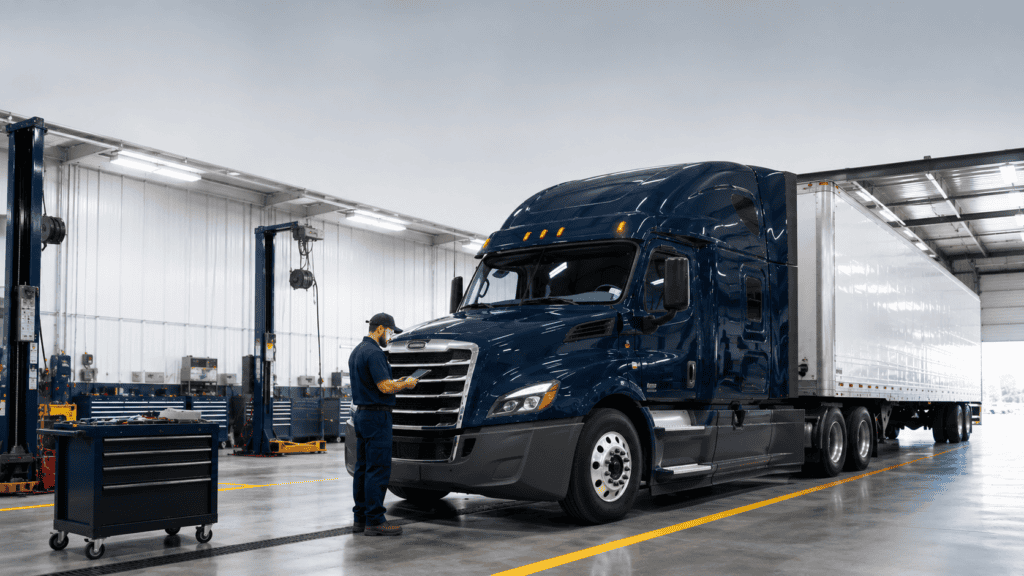
Quick answer: Commercial vehicles operating in Ohio must pass a DOT annual inspection, and Ohio is one of the most straightforward states to comply in. Ohio does not run a mandatory state inspection program for freight trucks. The only Ohio program FMCSA has approved as equivalent to the federal periodic inspection is its church bus inspection program, added to the federal list in 1998. So an Ohio freight carrier meets the annual inspection requirement directly through the federal rule, 49 CFR 396.17, using an inspector qualified under 49 CFR 396.19. That means an Ohio carrier can qualify its own in-house inspector and inspect its own equipment, with no state testing station in the way.
If you run trucks in Ohio, your path to compliance is simpler than in states like Texas or Pennsylvania, which route commercial vehicles through mandatory state inspection stations. Ohio enforces commercial vehicle safety hard at the roadside, but it does not hand freight carriers a state program they are required to use. The federal self-inspection route is the main path, and for most carriers it is the cheaper one. This guide explains how it works and who is allowed to perform the inspection.
Ohio is one of the best states in the country to bring inspections in-house, precisely because there is no mandatory state truck program standing between you and the federal route. For a carrier weighing whether to keep paying an outside shop per truck, qualifying your own inspector usually pays for itself well inside the first year.
For the step-by-step path, see how to get certified to do DOT inspections. Operating in more than one state? See our state guides for California, Texas, Pennsylvania, and Illinois, and the underlying federal requirement in our guide to 49 CFR 396.17.
About the author: Josh Lopez has spent more than 10 years in the trucking and freight industry, working across shippers, carriers, brokerage, and reefer LTL. He writes about DOT compliance, FMCSA regulations, and commercial vehicle inspection to help mechanics, owner-operators, and fleet managers understand the rules that govern their operations and stay compliant on the road.
Does Ohio require a DOT annual inspection?
Yes. Every commercial motor vehicle operating in interstate commerce must pass an annual inspection, and that applies to vehicles based in or running through Ohio. The requirement comes from 49 CFR 396.17, which requires a periodic inspection at least once every 12 months for any commercial motor vehicle meeting the threshold, generally a gross vehicle weight rating of 10,001 pounds or more, any vehicle carrying placarded hazardous materials, or vehicles designed to carry enough passengers to qualify. Ohio enforces these federal standards at the roadside through the Ohio State Highway Patrol and its commercial vehicle enforcement officers, at weigh stations and on patrol along corridors like I-70, I-71, I-75, and I-80. If you cannot produce a current annual inspection, the vehicle can be placed out of service on the spot.Does Ohio have its own truck inspection program?
Not for freight, and the precise answer here matters. Under 49 CFR 396.23, if a commercial motor vehicle is subject to a mandatory state inspection program that FMCSA has determined is as effective as the federal periodic inspection, the carrier must meet the federal requirement through that state program. In states like Texas, that closes off the federal self-inspection route entirely for state-registered trucks. Ohio is not one of those states, for freight. The only Ohio program on FMCSA’s approved list is its inspection program for church buses, added to the federal list on February 19, 1998 (63 FR 8516). Ohio does not operate a mandatory state testing-station program that general freight carriers must use for their trucks. What that means in practice: an Ohio trucking carrier is not required to route trucks through a state inspection station, because there isn’t a mandatory one for freight. The carrier satisfies the annual inspection requirement directly under the federal rule. For most carriers, that is the simpler and cheaper path, and it is also the path that puts your inspection schedule under your own control.How does an Ohio freight carrier meet the annual inspection requirement?
Through the federal route in 49 CFR 396.17. The rule gives a carrier options: perform the inspection in-house using its own qualified inspector under 396.17(d), or have a commercial garage, fleet leasing company, or truck stop perform it as the carrier’s agent under 396.17(e), provided that business maintains appropriate facilities and employs qualified inspectors. Since Ohio has no mandatory freight testing program, both of those are fully available to you, and the in-house route is the one that gives you the most control and the lowest cost per vehicle. Whichever option you choose, the inspection must be performed by a person who meets the inspector qualification standard in 49 CFR 396.19. That standard is federal and identical nationwide, so an inspector you qualify in Ohio can inspect your equipment whether you run only in Ohio or across state lines.Who can perform a DOT annual inspection in Ohio?
An inspector who meets the federal 49 CFR 396.19 qualification standard. That standard has three parts, and all three must be true. The inspector must understand the inspection criteria in Part 393 and Appendix A to Part 396 and be able to identify defective components. The inspector must be knowledgeable of and have mastered the methods, procedures, tools, and equipment used when performing an inspection. And under 49 CFR 396.19(a)(3), the inspector must be capable of performing the inspection either through a Federal- or State-sponsored training program or a qualifying state certificate, or through a combination of training and/or experience totaling at least one year. A carrier can qualify its own mechanic, or an owner-operator can qualify themselves. The carrier then keeps evidence of that qualification on file, for as long as the person performs inspections plus one year afterward. One note specific to Ohio. Section 396.19(b) contains an exception: carriers do not have to maintain inspector qualification documentation for inspections performed as part of a State periodic inspection program. Because Ohio freight carriers are not using such a program, that exception does not apply to you. You keep the qualification evidence. It is a small burden, and it is the trade for not having to route every truck through a station. For the full breakdown, see who can perform DOT annual inspections and our guide to FMCSA 396.19.Brakes require a second, separate qualification
Every DOT annual inspection includes the brake system, and brakes carry their own qualification requirement under 49 CFR 396.25. It is not part of 396.19. It is a separate rule with separate evidence and its own retention requirement, and it applies to anyone who inspects, maintains, services, or repairs brakes on a commercial vehicle. If you are an Ohio carrier bringing inspections in-house, this is the piece most operations miss. Your inspector needs documented qualification under both 396.19 and 396.25, and the brake evidence is kept at your principal place of business. A CDL air brake endorsement does not satisfy 396.25. FMCSA has stated that directly. See does a CDL air brake endorsement make you a qualified brake inspector and our DOT air brake certification requirements guide. Brakes are worth the attention. In the 2025 CVSA International Roadcheck, brake system violations accounted for 24.4% of all vehicle out-of-service findings, and brake-related issues combined made up roughly 41% of them, the largest category by a wide margin.What does the annual inspection cover?
It is a measured, pass-or-fail check against the federal minimum standards in Appendix A to Part 396: brakes, steering, suspension, frame, tires and wheels, lighting, coupling devices, fuel system, exhaust, and the rest. In a combination vehicle, each unit is inspected separately. A tractor and its trailer are inspected individually, not as one rig. Because the standard is federal, the inspection is the same in Ohio as anywhere else. And a roadside enforcement inspection by the Ohio State Highway Patrol is not the same thing as your annual periodic inspection. The annual inspection is a separate, scheduled inspection you must have performed and documented every 12 months, no matter how clean your roadside record looks.How long must inspection records be kept in Ohio?
Under 49 CFR 396.21, the periodic inspection report must be retained for 14 months from the date of the inspection. A copy must be kept where the vehicle is housed or maintained, and proof of the current inspection must be on the vehicle. Because you are self-inspecting under the federal route, you also keep evidence of your inspector’s 396.19 qualification on file, plus separate 396.25 evidence for anyone performing brake work. Note that the retention periods differ: inspection reports run 14 months, while inspector qualification evidence runs for the duration of the inspector’s service plus one year. Fleets confuse these constantly and discard qualification records too early.How do I qualify to perform my own DOT inspections in Ohio?
You qualify under the federal standard, 49 CFR 396.19. There is no Ohio state license for freight inspectors and no government-issued federal certificate. The carrier determines that the inspector meets the qualification requirements and keeps the evidence on file. Most working mechanics qualify through 49 CFR 396.19(a)(3)(ii), the training and experience route. If you already have a year or more of commercial vehicle maintenance behind you, the experience component is there. What is usually missing is documented training in the federal inspection standards rather than knowledge picked up on the job, and that gap is exactly what an auditor finds.No state station. No appointment. Just a qualified mechanic.
Ohio’s only FMCSA-approved program covers church buses. For freight, the federal route is the route — which means the cheapest path to compliance is qualifying someone you already employ, and the qualification does not expire.
Our DOT Annual Inspection Training Course covers 49 CFR Part 393 and Appendix A to Part 396, the criteria §396.19(a)(1) requires an inspector to understand, including the brake systems that drive the largest share of out-of-service violations. Every enrollment includes three records for your file:
- Certificate of completion — documented training under §396.19(a)(3)(ii)(A)
- Inspector qualification form — the §396.19(b) record your carrier retains
- Inspection checklist — for performing and recording annual inspections
Several mechanics or multiple terminals? Group registration with volume discounts.
Ohio DOT annual inspection frequently asked questions
Does Ohio require a DOT annual inspection? Yes. Commercial motor vehicles operating in or through Ohio must pass an annual inspection under 49 CFR 396.17, and the Ohio State Highway Patrol enforces it at the roadside. Does Ohio have a state truck inspection program? Not for freight. The only Ohio program on FMCSA’s approved list is its inspection program for church buses, added to the federal list in 1998. Freight carriers meet the annual requirement through the federal route rather than a mandatory state testing station. Can I self-inspect my trucks in Ohio? Yes. Because Ohio has no mandatory FMCSA-approved inspection program for freight vehicles, 49 CFR 396.17(d) applies and a motor carrier may perform the required annual inspection itself, using an inspector qualified under 49 CFR 396.19. Who can perform a DOT annual inspection in Ohio? A person qualified under 49 CFR 396.19: your own qualified mechanic, a qualified owner-operator, or a commercial garage, fleet leasing company, or truck stop acting as the carrier’s agent under 396.17(e). Do I need a separate qualification to inspect brakes in Ohio? Yes. Under 49 CFR 396.25, anyone who inspects, maintains, services, or repairs brakes on a commercial vehicle needs documented brake inspector qualification in addition to 396.19, and the carrier keeps that evidence at its principal place of business. A CDL air brake endorsement does not satisfy it. How long must I keep Ohio inspection records? Periodic inspection reports must be kept for 14 months under 49 CFR 396.21, with proof of the current inspection on the vehicle. Inspector qualification evidence is kept for the duration of the inspector’s service plus one year. The two periods are different and are commonly confused. Does your course qualify me to inspect in Ohio? The course covers the federal inspection standards in Part 393 and Appendix A and issues a certificate documenting the training component of your qualification under 49 CFR 396.19(a)(3)(ii). Combined with your commercial vehicle maintenance experience, that satisfies the federal qualification requirement, which is exactly how Ohio freight carriers comply.About the author: Josh Lopez has spent more than 10 years in the trucking and freight industry, working across shippers, carriers, brokerage, and reefer LTL. He writes about DOT compliance, FMCSA regulations, and commercial vehicle inspection to help mechanics, owner-operators, and fleet managers understand the rules that govern their operations and stay compliant on the road.