Quick Answer: 49 CFR Part 393 is the federal equipment standard — “Parts and Accessories Necessary for Safe Operation.” It sets the condition every component on a commercial motor vehicle must meet at all times, organized into ten subparts from §393.1 through §393.209. Part 396 is a separate thing: it governs inspection, repair, and maintenance, and §396.19(a)(1) requires an annual inspector to understand the criteria in both Part 393 and Appendix A to Part 396. Part 393 tells you what “good” looks like. Part 396 tells you how often to check and who may check it.
Part 393 is cited constantly and explained almost never. It is the reason a 2/32-inch tire fails and a 4/32-inch steering tire fails, the reason your brake lining has a minimum thickness, and the reason the cargo on a flatbed needs a specific number of tiedowns.
This guide covers the full structure, the specific numbers that matter, and the one citation error that appears across most published guidance on the subject.
What Is 49 CFR Part 393?
Part 393 is titled Parts and Accessories Necessary for Safe Operation. It establishes the minimum condition and performance requirements for the equipment on a commercial motor vehicle.
The scope provision, §393.1, states the principle that makes this part different from Part 396: every employer and employee must comply with the rules in this part, and no motor vehicle may be operated unless it is equipped in accordance with the requirements and specifications of this part.
That is a continuous obligation. A truck that met Part 393 at its annual inspection but has a burned-out lamp this morning does not meet Part 393 this morning. The standard applies every time the vehicle moves — not once a year.
Section §393.3 adds that nothing in the part prohibits additional equipment, provided it does not decrease the safety of operation of the vehicle.
Part 393 vs Part 396: The Distinction That Matters
These are routinely conflated, and keeping them separate is the foundation of understanding either one.
| Part 393 | Part 396 | |
|---|---|---|
| Title | Parts and Accessories Necessary for Safe Operation | Inspection, Repair, and Maintenance |
| Answers | What condition must the equipment be in? | How often is it checked, by whom, and what gets recorded? |
| When it applies | Continuously — every time the vehicle operates | At the periodic inspection, daily DVIR, and on repair |
| Key sections | §393.47 brakes, §393.75 tires, §393.11 lamps, §393.100–136 cargo | §396.17 annual, §396.19 inspector, §396.11 DVIR, §396.25 brakes |
The link between them is §396.19(a)(1), which requires the motor carrier to ensure that an individual performing an annual inspection understands the inspection criteria set forth in Part 393 and Appendix A to Part 396 and can identify defective components.
Both, not either. Appendix A is the inspection checklist; Part 393 is the underlying equipment standard it refers back to. An inspector who knows one and not the other cannot do the job.
The Ten Subparts of Part 393
| Subpart | Covers | Sections |
|---|---|---|
| A | General — scope, additional equipment, definitions | §§393.1–393.7 |
| B | Lamps, reflective devices, and electrical wiring | §§393.9–393.33 |
| C | Brakes | §§393.40–393.55 |
| D | Glazing and window construction | §§393.60–393.63 |
| E | Fuel systems | §§393.65–393.69 |
| F | Coupling devices and towing methods | §§393.70–393.71 |
| G | Miscellaneous parts and accessories — includes tires at §393.75 | §§393.75–393.94 |
| H | Emergency equipment | §393.95 |
| I | Protection against shifting and falling cargo | §§393.100–393.136 |
| J | Frames, cab and body components, wheels, steering, suspension | §§393.201–393.209 |
Two things stand out in that layout. Tires are in Subpart G, grouped under “miscellaneous,” which surprises people given how often tire violations are cited. And Subpart I is by far the largest, running 37 sections — more than the rest of the part combined.
Subpart C: The Brake Numbers
Brakes are the single largest source of out-of-service violations, and §393.47 is where the thresholds live.
Lining and pad thickness — §393.47(d)
| Position and type | Minimum |
|---|---|
| Steering axle, air drum — continuous strip of lining | 4.8 mm (3/16 inch) at the shoe center |
| Steering axle, air drum — shoe with two pads | 6.4 mm (1/4 inch) at the shoe center |
| Steering axle, air disc | 3.2 mm (1/8 inch) |
| Non-steering axle, air drum | 6.4 mm (1/4 inch) at the shoe center |
| Non-steering axle, air disc | 3.2 mm (1/8 inch) |
| Hydraulic or electric, disc or drum | 1.6 mm (1/16 inch) |
Linings worn to a wear indicator, where the shoe is so marked, also fail regardless of measurement.
One nuance that catches experienced technicians. Appendix A to Part 396 and §393.47 do not state the steering-axle drum requirement identically — Appendix A rejects steering-axle lining under 1/4 inch at the shoe center, while §393.47(d)(1) distinguishes by shoe type. When performing a periodic inspection, Appendix A is the governing minimum inspection standard. Knowing both exist, and which applies to the inspection you are conducting, is what makes an inspection record defensible.
Drums and rotors — §393.47(g)
There is no federal minimum thickness figure. The section requires only that drum or rotor thickness not fall below the limits established by the manufacturer — typically cast or stamped into the component. Any source quoting a single federal number for drums or rotors is citing something that does not exist.
Pushrod stroke — §393.47(e)
Readjustment limits are set by chamber type in the tables at §393.47(e). For actuator types not listed, stroke must not exceed 80 percent of the rated stroke marked by the manufacturer, or the manufacturer’s marked readjustment limit. Appendix A specifies the measurement conditions: engine off, reservoir pressure 80 to 90 psi, brakes fully applied.
For wedge brakes, §393.47(f) limits movement of the scribe mark on the lining to 1.6 mm (1/16 inch).
Other sections in Subpart C worth knowing: §393.40 required brake systems, §393.48 brakes to be operative, §393.52 brake performance, §393.53 automatic brake adjusters and adjustment indicators, and §393.55 antilock brake systems.
For the qualification required to work on brakes, see 396.19 vs 396.25 and our DOT air brake certification requirements guide.
Subpart G: Tires — §393.75
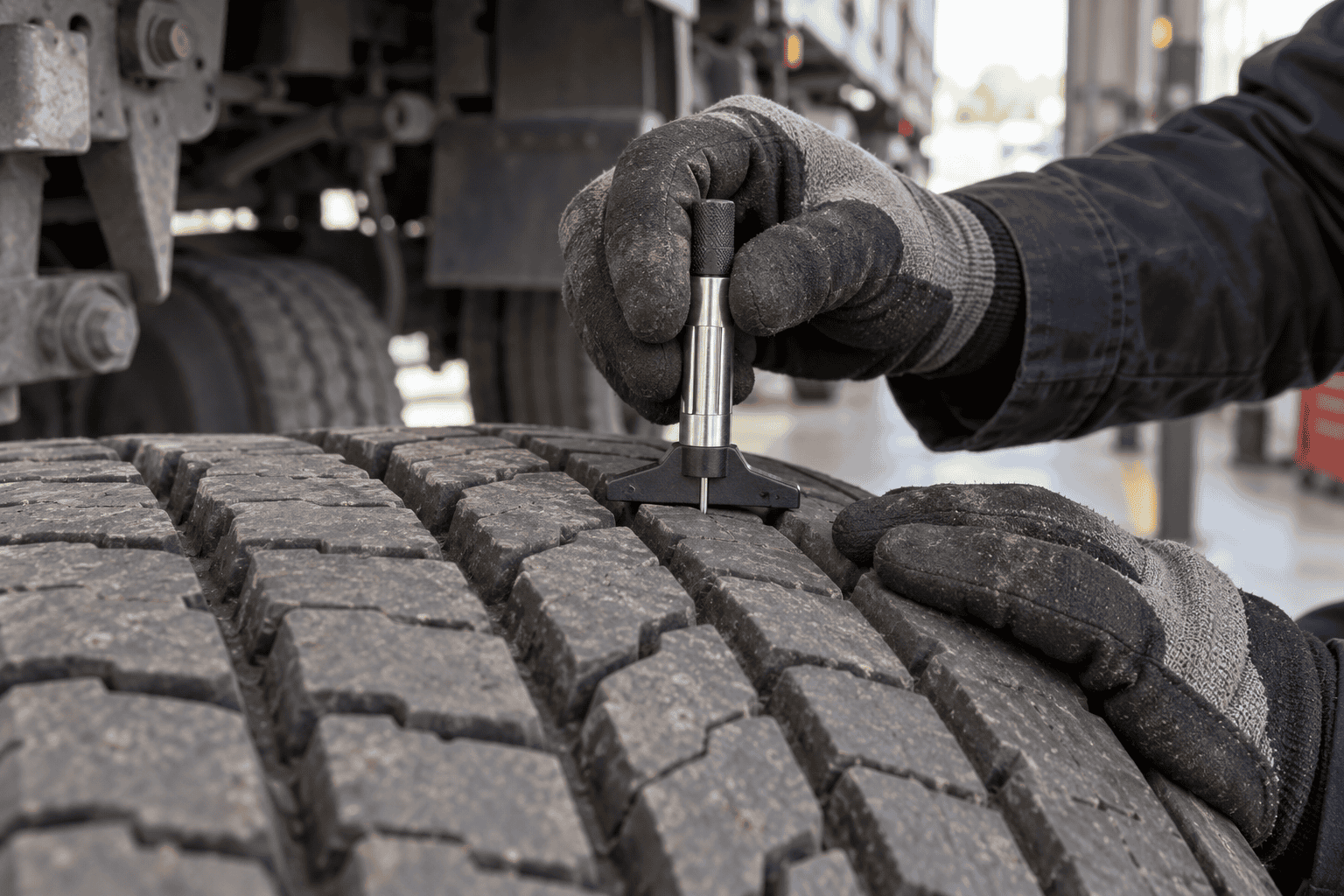
Tires sit in the miscellaneous subpart, and the tread depth numbers are among the most-cited figures in the FMCSRs.
| Position | Minimum tread groove depth |
|---|---|
| Steering axle — §393.75(c) | 4/32 inch |
| All other axles — §393.75(d) | 2/32 inch |
Section §393.75(a) lists the conditions under which no commercial motor vehicle may be operated on a tire, regardless of tread depth: body ply or belt material exposed through the tread or sidewall, tread or sidewall separation, a flat tire or an audible leak, or a cut exposing ply or belt material.
Regrooved, recapped, or retreaded tires are prohibited on the steering axle of a bus, and §393.75 also addresses load restrictions and tire inflation.
Subpart I: Cargo Securement — The Largest Subpart
Thirty-seven sections, §393.100 through §393.136, and the structure is worth understanding because the general rules and the commodity-specific rules work together.
A note on terminology: the industry calls this load securement, the regulation calls it protection against shifting and falling cargo, and most training material calls it cargo securement. All three refer to Subpart I of Part 393. There is no separate load securement regulation.
Two numbers define the whole subpart:
- The performance criteria — §393.102(a). A securement system must withstand 0.8 g deceleration in the forward direction, 0.5 g acceleration rearward, and 0.5 g acceleration laterally. Those are the forces of hard braking, acceleration, and a sharp turn.
- The 50 percent rule — §393.106(d). The aggregate working load limit of the tiedowns securing an article must be at least one-half the weight of that article. A 10,000-pound load needs tiedowns totalling at least 5,000 pounds of working load limit.
And the two requirements run simultaneously. You satisfy the minimum tiedown count under §393.110 and the aggregate working load limit under §393.106(d) — whichever demands more tiedowns is the one that governs.
The general rules — §393.100 to §393.114
- §393.100 — which commercial motor vehicles are subject to cargo securement
- §393.102 — minimum performance criteria for securement devices
- §393.104 — standards for securement devices and systems
- §393.106 — general requirements for securing articles of cargo
- §393.108 — how to determine the working load limit of a tiedown
- §393.110 — how many tiedowns are required
- §393.112 — tiedowns must be adjustable
- §393.114 — requirements for front end structures used as part of a securement system
The commodity-specific rules — §393.116 to §393.136
This is the part most guidance skips entirely. Specific securement requirements exist by commodity type, beginning with logs at §393.116 and continuing through dressed lumber, metal coils, paper rolls, concrete pipe, intermodal containers, automobiles and light trucks, heavy vehicles and equipment, flattened or crushed vehicles, roll-on/roll-off containers, and large boulders.
If you haul one of those commodities, the general rules are the floor and the commodity rule is the requirement. A flatbed carrier moving metal coils is governed by the coil-specific section, not by the general tiedown count — and the coil rules differ depending on whether the eye is vertical, crosswise, or lengthwise.
Cargo securement was the vehicle focus area for CVSA’s 2026 International Roadcheck, producing 1,724 out-of-service violations — 12.4% of the vehicle total, the fourth-largest category.
Subpart I is deep enough to need its own treatment. For the full tiedown count tables, working load limit arithmetic, the commodity-specific rules, and the en-route re-inspection requirement, see our complete guide to DOT cargo securement rules.
The Rest of the Part, Briefly
Subpart B — lamps and reflective devices, §§393.9 to §393.33. Section §393.9 requires all lamps to be operable at all times and prohibits obstruction of lamps and reflectors. Section §393.11 sets out the required lamps and reflective devices by vehicle type in table form, covering head lamps, tail lamps, stop lamps, turn signals, clearance lamps, identification lamps, side marker lamps, and reflex reflectors.
Subpart D — glazing, §§393.60 to §393.63. Glazing in specified openings must meet FMVSS No. 205, and §393.60 addresses windshield condition — including limits on damage in the area swept by the wipers.
Subpart E — fuel systems, §§393.65 to §393.69. Location, mounting, and construction of fuel tanks and lines, including the requirement that no fuel system may leak.
Subpart F — coupling devices, §§393.70 to §393.71. Fifth wheels, kingpins, safety chains, and towing methods for driveaway-towaway operations.
Subpart H — emergency equipment, §393.95. Every power unit must carry a fire extinguisher and warning devices for stopped vehicles — either three bidirectional emergency reflective triangles meeting FMVSS No. 125, or at least six fusees plus any additional fusees required by §392.22. The spare fuse requirement formerly at §393.95(b) was removed effective April 20, 2026, and paragraphs (b) through (e) are now reserved.
Subpart J — frames, cab, wheels, steering, suspension, §§393.201 to §393.209. Frame condition at §393.201, cab and body components at §393.203, wheels and rims at §393.205, suspension systems at §393.207, and steering wheel systems at §393.209.
About “Appendix G”
If you learned this material more than a few years ago, you learned the inspection criteria as Appendix G to Subchapter B. A great deal of published guidance still says Appendix G — including training materials, shop checklists, and competitor course pages.
Appendix G was consolidated into Appendix A to Part 396. The substance did not disappear; the minimum periodic inspection standards live in Appendix A now, and that is the appendix the current regulations point to. Section §396.19(a)(1) requires an annual inspector to understand the criteria in Part 393 and Appendix A to Part 396.
Two practical consequences. If a provider or checklist still references Appendix G, the underlying content is likely still correct but the citation is outdated. And if you are documenting inspector qualification or writing a maintenance program today, cite Appendix A — that is the appendix an auditor will be working from.
Three Different Standards, Three Different Numbers
This causes more confusion than any other aspect of vehicle compliance, and Part 393 is only one of the three.
| Standard | What it governs | Who applies it |
|---|---|---|
| 49 CFR Part 393 | Minimum condition for lawful operation | Applies continuously, every time the vehicle moves |
| Appendix A to Part 396 | Minimum periodic inspection standard | Your §396.19-qualified inspector, annually |
| CVSA out-of-service criteria | Threshold for parking the vehicle at roadside | A certified enforcement officer |
They are not the same numbers, and a component can be legal under one and fail another. We separate all three in legal, out-of-service, or failed inspection.
Who Has to Know Part 393?
Under 49 CFR §396.19(a)(1), anyone performing the annual periodic inspection. The motor carrier must ensure that individual understands the inspection criteria in Part 393 and Appendix A to Part 396 and can identify defective components — and the carrier retains evidence of that qualification under §396.19(b).
The annual inspection itself is required by 49 CFR §396.17, at least once every 12 months. There is no federal DOT inspector certification and no agency issues one. The carrier determines qualification and keeps the record. The §396.19(a)(3) standard has two routes: a Federal- or State-sponsored training program or qualifying state certificate, or a combination of training and/or experience totaling at least one year.
Most working mechanics already satisfy the experience component. What is usually missing is documented training in the federal standards — and Part 393 is a substantial share of what that training has to cover.
See who can perform DOT annual inspections, our guide to FMCSA §396.19, and can I do my own DOT annual inspection.
Part 393 is half of what §396.19 requires an inspector to know.
Section §396.19(a)(1) requires an annual inspector to understand the criteria in Part 393 and Appendix A to Part 396. Not one or the other — both. That is the curriculum, and it is what an auditor expects the training record to cover.
Our DOT Annual Inspection Training Course covers both, component by component, and produces three records for your file:
- Certificate of completion — documented training under §396.19(a)(3)(ii)(A)
- Inspector qualification form — the §396.19(b) record your carrier retains
- Inspection checklist — for performing and recording annual inspections
100% online and self-paced. The qualification does not expire.
Qualifying a shop? Group registration with volume discounts at 3, 6, and 11 users.
For the step-by-step path, see how to get certified to do DOT inspections, and for the maintenance manager’s view, DOT inspection training for fleet mechanics.
Why Part 393 Shows Up in Enforcement
Because the components it governs are the ones that park trucks.
In CVSA’s 2026 International Roadcheck, inspectors conducted 54,575 inspections and placed 10,350 vehicles out of service — a rate of 19%. Brake systems accounted for 3,379 out-of-service violations, 24.3% of the vehicle total and the largest single category. Cargo securement, the 2026 focus area, produced 1,724 violations at 12.4%.
Brakes are Subpart C. Cargo securement is Subpart I. Tires are Subpart G. Lighting is Subpart B. Every leading out-of-service category is a Part 393 subpart — which is the practical reason an inspector has to know this part rather than just the checklist.
See why trucks fail DOT inspections, what happens when a truck fails a DOT inspection, and DVIR requirements under §396.11.
Frequently Asked Questions
What is 49 CFR Part 393?
Part 393 is the federal equipment standard for commercial motor vehicles, titled “Parts and Accessories Necessary for Safe Operation.” It sets the minimum condition and performance requirements for brakes, lamps, tires, glazing, fuel systems, coupling devices, emergency equipment, cargo securement, frames, wheels, steering, and suspension. Under §393.1, no motor vehicle may be operated unless it is equipped in accordance with the requirements of the part.
What is the difference between Part 393 and Part 396?
Part 393 governs what condition the equipment must be in, and applies continuously every time the vehicle operates. Part 396 governs inspection, repair, and maintenance — how often the vehicle is inspected, who may inspect it, and what records are kept. They connect through §396.19(a)(1), which requires an annual inspector to understand the criteria in both Part 393 and Appendix A to Part 396.
How many subparts does Part 393 have?
Ten, labeled A through J. Subpart A general (§§393.1–393.7), B lamps and electrical (§§393.9–393.33), C brakes (§§393.40–393.55), D glazing (§§393.60–393.63), E fuel systems (§§393.65–393.69), F coupling devices (§§393.70–393.71), G miscellaneous parts including tires (§§393.75–393.94), H emergency equipment (§393.95), I protection against shifting and falling cargo (§§393.100–393.136), and J frames, cab, wheels, steering, and suspension (§§393.201–393.209).
What is the minimum tire tread depth under Part 393?
Under §393.75(c), no steering axle tire may have a tread groove pattern depth less than 4/32 of an inch. Under §393.75(d), tires on all other axles must have at least 2/32 of an inch. Section §393.75(a) separately prohibits operating on a tire with body ply or belt material exposed, tread or sidewall separation, a flat tire or audible leak, or a cut exposing ply or belt material, regardless of tread depth.
What is the minimum brake lining thickness under Part 393?
Under §393.47(d), air drum brakes on a steering axle require 4.8 mm (3/16 inch) at the shoe center for a continuous strip of lining, or 6.4 mm (1/4 inch) for a shoe with two pads. Non-steering air drum brakes require 6.4 mm (1/4 inch). Air disc brakes require 3.2 mm (1/8 inch), and hydraulic or electric brakes 1.6 mm (1/16 inch). Linings worn to a wear indicator also fail. Note that Appendix A to Part 396 states the steering-axle drum requirement as 1/4 inch without distinguishing shoe type, and Appendix A governs the periodic inspection.
Is Appendix G still part of the regulations?
No. Appendix G to Subchapter B was consolidated into Appendix A to Part 396, which now contains the minimum periodic inspection standards. Section §396.19(a)(1) requires annual inspectors to understand the criteria in Part 393 and Appendix A to Part 396. Older training materials and checklists still reference Appendix G, and the underlying content is generally still accurate, but current documentation should cite Appendix A.
Where are the cargo securement rules in Part 393?
Subpart I, sections §393.100 through §393.136 — the largest subpart in Part 393. Sections §393.100 to §393.114 set the general rules covering performance criteria, securement devices, working load limits, the minimum number of tiedowns, and front end structures. Sections §393.116 to §393.136 set commodity-specific requirements beginning with logs and covering dressed lumber, metal coils, paper rolls, concrete pipe, intermodal containers, automobiles and light trucks, heavy equipment, flattened vehicles, roll-on/roll-off containers, and large boulders.
Where are the load securement regulations?
Load securement is governed by 49 CFR Part 393, Subpart I, titled “Protection Against Shifting and Falling Cargo,” sections §393.100 through §393.136. The industry term load securement, the regulatory term protection against shifting and falling cargo, and the common term cargo securement all refer to the same subpart. There is no separate load securement regulation. The two defining requirements are the performance criteria in §393.102(a) — 0.8 g forward, 0.5 g rearward, 0.5 g lateral — and the aggregate working load limit in §393.106(d), which must be at least half the weight of the article secured.
Does Part 393 specify a minimum brake drum thickness?
No. Section §393.47(g) requires only that drum or rotor thickness not be less than the limits established by the drum or rotor manufacturer, typically cast or stamped into the component or published in the manufacturer’s service literature. There is no single federal thickness figure, and any source quoting one is citing something that does not exist.
Who needs to know Part 393?
Anyone performing a DOT annual inspection. Section §396.19(a)(1) requires the motor carrier to ensure the individual understands the inspection criteria in Part 393 and Appendix A to Part 396 and can identify defective components, and the carrier retains evidence of that qualification under §396.19(b). Drivers also need working knowledge, since the pre-trip inspection and driver vehicle inspection report under §396.11 cover Part 393 components.
What emergency equipment does Part 393 require?
Under §393.95, every power unit must be equipped with a fire extinguisher and warning devices for stopped vehicles — either three bidirectional emergency reflective triangles meeting FMVSS No. 125, or at least six fusees plus any additional fusees required by §392.22. Spare fuses are no longer required: FMCSA removed and reserved §393.95(b) effective April 20, 2026. Subpart H consists of this single section.
Does Part 393 apply all the time or only at inspection?
All the time. Section §393.1 provides that no motor vehicle may be operated unless it is equipped in accordance with the requirements and specifications of the part. A vehicle that passed its annual inspection but develops a defect the next week does not meet Part 393 while that defect exists. The periodic inspection under §396.17 is a scheduled verification, not the moment the standard begins to apply.
The Bottom Line
Part 393 is the equipment standard: ten subparts, §393.1 through §393.209, setting the condition every component on a commercial motor vehicle has to meet whenever it operates. Part 396 is the inspection and maintenance framework that verifies it.
Section §396.19(a)(1) requires an annual inspector to understand both — Part 393 and Appendix A to Part 396. Not the checklist alone, and not the equipment standard alone.
And the appendix is A, not G. If your training materials or your qualification file still say Appendix G, the content may be fine but the citation is a decade out of date.
Qualifying more than one mechanic? Group registration with volume discounts is available for shops and fleets.
About the Author
Josh Lopez has spent more than 10 years in trucking and freight, working across shippers, carriers, brokerage, and reefer LTL. He founded dotinspectioncourse.com to give mechanics, owner-operators, and fleet managers accurate, regulation-first training on 49 CFR Part 396. Every regulatory citation on this site is verified against the current eCFR text before publication.