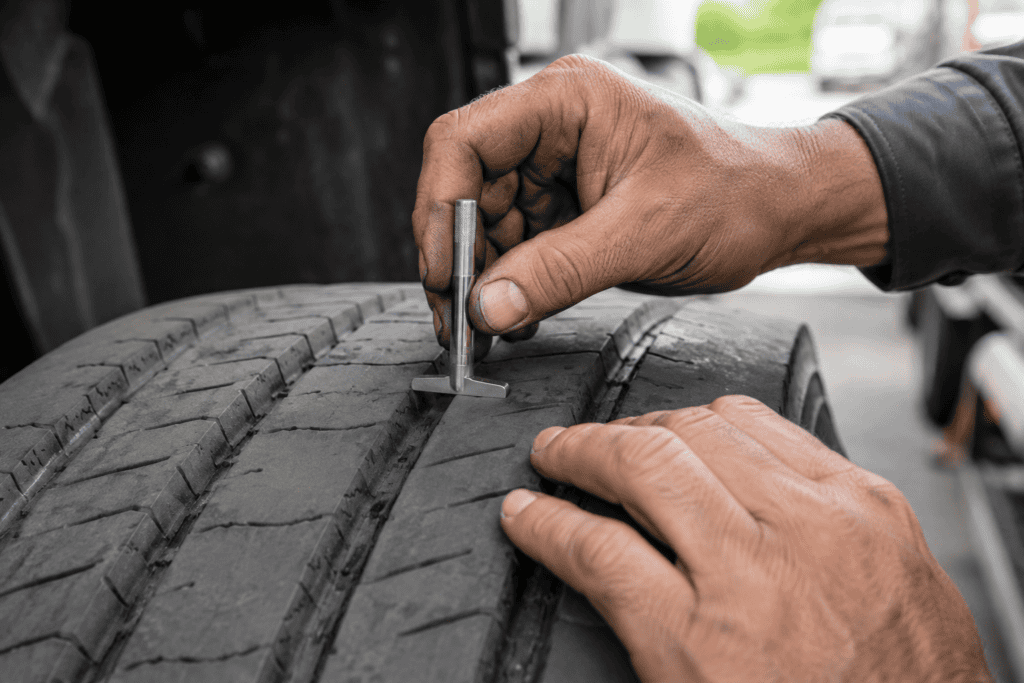
Quick Answer: There are three different standards a commercial vehicle component can be measured against, and they are not the same numbers. 49 CFR Part 393 sets the operating minimum — below it, the vehicle is illegal to operate. The CVSA North American Standard Out-of-Service Criteria set a separate, generally lower threshold at which a vehicle is physically removed from service at roadside. And Appendix A to Part 396 sets the criteria that fail a vehicle during the annual periodic inspection. A steer tire at 3/32 of an inch is a federal violation under §393.75(b) but is not an out-of-service condition — the driver gets cited and keeps driving. Knowing which standard you are applying, and being able to explain the difference to a customer, is what separates an inspector from someone reading a gauge.
This article came out of a question from a student who moved into fleet maintenance from the automotive side and noticed the standards did not line up with what he had been taught. He was right that something was off. What was off is that “the minimum” is three different numbers depending on who is asking.
Why Are There Three Different Standards?
They exist for three different purposes, and they are issued by two different bodies.
- 49 CFR Part 393 — federal regulations setting the minimum condition for lawful operation. Written by FMCSA. Below these, operating the vehicle is a violation, and the violation is recorded against the carrier.
- CVSA North American Standard Out-of-Service Criteria — the thresholds at which an inspector physically parks the vehicle. Published by the Commercial Vehicle Safety Alliance, updated annually, applied by enforcement across the U.S., Canada, and Mexico.
- Appendix A to Part 396 — the minimum periodic inspection standards. These are what a qualified inspector applies during the annual inspection under §396.17. A vehicle that fails these does not pass its annual.
A component can be compliant under one and not another. That is not a flaw in the system — the question “is this legal to operate” is different from “is this dangerous enough to strand this truck at the scale house right now,” and both are different from “does this pass its annual inspection.”
And none of the three answers a fourth question: what should you actually tell the customer to replace?
What Does 49 CFR §393.75 Actually Require for Tires?
Two numbers, from §393.75:
- §393.75(b) — any tire on the front wheels of a bus, truck, or truck tractor shall have a tread groove pattern depth of at least 4/32 of an inch when measured at any point on a major tread groove.
- §393.75(c) — except as provided in (b), tires shall have a tread groove pattern depth of at least 2/32 of an inch when measured in a major tread groove.
Both paragraphs end with the same sentence, and it is the part most people skip: “The measurements shall not be made where tie bars, humps, or fillets are located.”
Note also what “at any point” means in paragraph (b). A single reading below 4/32 anywhere along a major groove puts a steer tire in violation. It is not an average across the tire.
Should You Measure at the Wear Bar?
No — and this is a common carryover from automotive practice.
Tread wear indicators, commonly called wear bars, are raised bars molded into the bottom of the major grooves at 2/32 of an inch. When the surrounding tread wears flush with them, the tire has reached 2/32. In passenger car service, that is the replacement signal, and measuring to the wear bar is a perfectly sensible shop practice.
For a commercial vehicle inspection, it produces the wrong answer for two reasons.
First, the regulation excludes it. A wear bar is a raised feature in the groove. Measuring on top of it reads shallower than the actual groove depth, which is exactly what §393.75(b) and (c) prohibit when they exclude tie bars, humps, and fillets. Industry guidance is consistent on this point — tread depth measurements cannot be taken at the wear indicators or the stone ejectors in the grooves.
Second, on steer tires the wear bar is below the legal minimum. Wear bars sit at 2/32. The federal minimum for a steer tire is 4/32. A steer tire worn flush with its wear bars is already in violation of §393.75(b) — by a factor of two. Waiting for the wear bar on a steer position means the tire has been illegal for thousands of miles.
The wear bar is a tire manufacturer’s end-of-life indicator built to a passenger-vehicle standard. It is a useful visual cue. It is not the federal commercial inspection standard, and on the steering axle it is dangerously permissive.
Can a Tire Be Illegal but Not Out of Service?
Yes, and this is the single most useful thing an inspector can understand about the two standards.
The CVSA out-of-service threshold for a steer tire is less than 2/32 of an inch measured in two adjacent major grooves. For all other wheel positions it is less than 1/32 of an inch, measured in any two adjacent grooves at three separate locations spaced at least eight inches apart around the circumference.
Put those next to the federal minimums and the gap is obvious:
| Position | §393.75 operating minimum | CVSA out-of-service |
|---|---|---|
| Steer | 4/32″, any point, any major groove | Below 2/32″, two adjacent grooves |
| Drive / trailer | 2/32″, major groove | Below 1/32″, two adjacent grooves at three locations |
A steer tire at 3/32 is a citation and eight CSA severity points, but the truck is not parked. The driver is issued a violation and continues the trip on a tire that federal regulation says should not be in service.
That gap is where the professional judgment lives. An inspector who only knows the out-of-service number will pass tires that are generating violations. An inspector who only knows the federal minimum will not understand why the truck they just flagged was allowed to leave the scale.
Note also that the measurement methods differ. Section §393.75 fails a tire on a single reading at any point in a major groove. The CVSA criteria require readings in two adjacent grooves, and for non-steer positions at three separate locations around the circumference. Same component, different procedures.
Where Do Fleets Actually Replace Tires?
Well above both numbers, and for reasons that have nothing to do with citations.
Common fleet practice is to pull steer tires around 5/32 and drive and trailer tires around 3/32. Some operations set 4/32 across all positions for simplicity. These are maintenance policies, not regulations — no federal rule requires them.
The reasoning is water evacuation. Tread grooves exist to channel water out from under the contact patch. As groove depth decreases, the volume of water the tread can move per revolution drops, and the speed at which the tire begins to hydroplane falls with it. A tire at 4/32 has roughly twice the water-clearing capacity of a tire at 2/32. Wet stopping distance and cornering grip degrade well before the legal threshold.
Add the practical arithmetic: a tire pulled at 5/32 is a retread candidate with usable casing life. A tire run to 2/32 and blown out on the interstate is a road service call, a damaged fender, possible cargo delay, and a violation.
Both facts are true at once. A steer tire at 4/32 passes inspection, and a steer tire at 4/32 should probably be scheduled for replacement. Saying so is not contradicting the regulation. It is doing the job properly.
Knowing which standard applies is the job.
Our DOT Annual Inspection Training Course is built around 49 CFR Part 393 and Appendix A to Part 396 — the criteria §396.19(a)(1) requires an inspector to understand — with the actual measurement thresholds and where they are taken. Every enrollment includes:
- Certificate of completion — documented training under §396.19(a)(3)(ii)(A)
- Inspector qualification form — the §396.19(b) record
- Inspection checklist — for performing and recording annual inspections
Does the Same Gap Exist for Brake Linings?
Yes, and it is subtler because the two federal texts themselves are not identical.
Section §393.47(d) sets the operating minimums:
- Steering axle, §393.47(d)(1): not less than 4.8 mm (3/16 inch) at the shoe center for a shoe with a continuous strip of lining; not less than 6.4 mm (1/4 inch) at the shoe center for a shoe with two pads; or worn to the wear indicator if so marked, for air drum brakes. Not less than 3.2 mm (1/8 inch) for air disc brakes, or 1.6 mm (1/16 inch) or less for hydraulic disc, drum, and electric brakes.
- Non-steering axle, §393.47(d)(2): air braked vehicles shall not operate with lining or pad thickness less than 6.4 mm (1/4 inch) measured at the shoe center for drum brakes, or worn to the wear indicator if so marked; or less than 3.2 mm (1/8 inch) for disc brakes. Hydraulic or electric braked vehicles, less than 1.6 mm (1/16 inch) at the shoe center.
Appendix A to Part 396 states the steering-axle drum requirement differently. It rejects steering-axle lining with a thickness less than 1/4 inch at the shoe center for drum brakes, without the continuous-strip and two-pad distinction that §393.47(d)(1) draws. When you are performing a periodic inspection, Appendix A is the governing minimum inspection standard.
Two texts, same component, slightly different thresholds, and which applies depends on what you are doing. That is exactly the situation this article exists to explain.
On the measurement point itself: the specification is friction material thickness at the shoe center. It is not a measurement to metal-to-metal contact, and it is not a measurement including the backing plate. The minimums above all sit meaningfully above zero remaining lining — the regulation does not contemplate running a pad to the rivets or to the bonding line.
What About Brake Drums and Rotors?
Here there is no federal number at all, which surprises people who expect one.
Section §393.47(g) requires only that the thickness of the drums or rotors not be less than the limits established by the drum or rotor manufacturer. That is the entire federal requirement on thickness. The standard is whatever that specific component’s manufacturer specifies, typically cast or stamped into the part or published in service literature.
Any source quoting a single federal thickness figure for drums or rotors is citing something that does not exist.
Structural condition is handled separately. Appendix A requires rejection of a drum or rotor with any external crack or cracks that open upon brake application, and cautions explicitly against confusing short hairline heat check cracks with flexural cracks. It also requires rejection where any portion of the drum or rotor is missing or in danger of falling away. Our air brake certification guide covers the brake standards in full.
And the 20 Percent Rule
The CVSA out-of-service criteria place a vehicle out of service when 20 percent or more of its service brakes have a defect, counted across every wheel position. On a five-axle tractor-trailer with ten brakes, two defective brakes crosses the threshold.
This is the clearest illustration of why individual component thresholds are not the whole picture. Each of those two brakes might be a minor, non-out-of-service defect on its own. Together they park the truck. During Brake Safety Week 2025 the 20 percent rule was the single most-cited out-of-service reason, accounting for 1,199 violations.
An inspector working component by component without tallying the total will miss it every time.
Why Doesn’t the FMCSR Follow OEM Maintenance Schedules?
Because they answer different questions, and this is the point that most often frustrates technicians coming from the automotive side.
Section §396.3(a) requires every motor carrier to systematically inspect, repair, and maintain — or cause to be systematically inspected, repaired, and maintained — all motor vehicles subject to its control. It does not prescribe intervals, mileages, or service items. “Systematic” means you have a program and follow it, not that you follow a particular one.
An OEM maintenance schedule is a manufacturer’s engineering recommendation for component longevity and warranty. A federal inspection standard is a minimum safety condition for lawful operation. A vehicle can be badly overdue on OEM service and fully compliant with Part 396. It can also be fresh out of a dealer service interval and fail an annual inspection on a cracked drum.
Neither document is wrong. They are simply not measuring the same thing, and a fleet program that uses only one of them has a gap.
What This Means When You Are the One Signing
Under §396.21(a), the qualified inspector’s report must identify the components inspected and describe the results, including identification of those components not meeting the minimum standards in Appendix A. That is a regulatory pass/fail determination and it should be made against Appendix A, not against a shop’s replacement policy or a manufacturer’s schedule.
But the inspection report is not the only thing a customer needs from you. A tire at 4/32 on the steer axle passes. It also has a season left, at best. Recording the pass and separately advising replacement is not inconsistent — it is the difference between an inspection and a service recommendation, and a professional delivers both.
The practical framework:
- Appendix A decides whether the vehicle passes its annual inspection. This is what goes on the report.
- Part 393 decides whether the vehicle is legal to operate today. This is what generates roadside violations and CSA points.
- CVSA out-of-service criteria decide whether the vehicle gets parked at the scale.
- Your judgment and the fleet’s maintenance policy decide what you recommend replacing, and that number should be higher than all three.
Confusing item 4 with items 1 through 3 is how inspectors fail vehicles that legally pass. Confusing items 1 through 3 with item 4 is how customers end up with a legal truck that strands them on a Tuesday.
Get Qualified to Make the Call
Every threshold in this article is part of what §396.19(a)(1) requires an annual inspector to understand — the criteria in Part 393 and Appendix A to Part 396, and the ability to identify defective components.
Our DOT Annual Inspection Training Course covers brakes, steering, suspension, lighting, tires, coupling devices, frame, fuel systems, and every other Appendix A component category, along with the inspection report requirements under §396.21. Every enrollment includes three deliverables:
- Certificate of completion — documenting the training component of qualification under §396.19(a)(3)(ii)(A)
- Inspector qualification form — the §396.19(b) record your carrier retains on file
- Inspection checklist — the working document for performing and recording annual inspections
Fully online and self-paced, with lifetime access. For how qualification actually works, see how to get certified to do DOT inspections and who can perform DOT annual inspections.
Training a team? Group registration with volume discounts is available for shops and fleets.
Frequently Asked Questions
What is the DOT minimum tire tread depth for a commercial truck?
Under 49 CFR §393.75(b), any tire on the front wheels of a bus, truck, or truck tractor must have a tread groove pattern depth of at least 4/32 of an inch measured at any point on a major tread groove. Under §393.75(c), all other tires must have at least 2/32 of an inch measured in a major tread groove. Both paragraphs specify that measurements shall not be made where tie bars, humps, or fillets are located.
Can you measure tire tread depth at the wear bar?
No. Wear bars are raised features molded into the groove at 2/32 of an inch, and measuring on them reads shallower than the actual groove depth, which §393.75 excludes. More importantly, the federal minimum for a steer tire is 4/32 — so a steer tire worn flush with its wear bars is already in violation. The wear bar is a tire manufacturer’s end-of-life indicator, not the federal commercial inspection standard.
Can a tire be illegal but not out of service?
Yes. The CVSA out-of-service threshold for a steer tire is below 2/32 of an inch measured in two adjacent major grooves, while the federal operating minimum under §393.75(b) is 4/32. A steer tire at 3/32 is a federal violation that generates a citation and CSA points, but it is not an out-of-service condition, so the vehicle is not parked.
What is the difference between DOT minimums and CVSA out-of-service criteria?
Part 393 regulations set the minimum condition for lawful operation and are issued by FMCSA. The CVSA North American Standard Out-of-Service Criteria set the thresholds at which an inspector physically removes a vehicle from service at roadside, and are published by the Commercial Vehicle Safety Alliance and updated annually. They are separate standards with different numbers and, for tires, different measurement methods.
At what tread depth do fleets actually replace tires?
Common fleet practice is to pull steer tires around 5/32 of an inch and drive and trailer tires around 3/32, though policies vary and some fleets use 4/32 across all positions. These are maintenance decisions, not regulatory requirements. The reasoning is water evacuation and wet braking performance, which degrade well before the legal minimum is reached, along with preserving casing value for retreading.
What is the minimum brake lining thickness?
Under §393.47(d)(1) for steering axles: not less than 3/16 inch at the shoe center for a shoe with a continuous strip of lining, or 1/4 inch for a shoe with two pads, for air drum brakes; 1/8 inch for air disc; 1/16 inch or less for hydraulic disc, drum, and electric. Under §393.47(d)(2) for non-steering axles: 1/4 inch for air drum, 1/8 inch for disc, 1/16 inch for hydraulic or electric. Appendix A to Part 396 states the steering-axle drum requirement as less than 1/4 inch at the shoe center, and Appendix A governs during a periodic inspection.
Is brake lining measured to the backing plate or to the friction material?
The specification is friction material thickness measured at the shoe center. It is not a measurement to metal-to-metal contact and does not include the backing plate. The federal minimums all sit meaningfully above zero remaining lining, so the regulation does not contemplate running a pad down to the rivets or the bonding line.
What is the federal minimum thickness for a brake drum or rotor?
There is none. Section §393.47(g) requires only that thickness not be less than the limits established by the drum or rotor manufacturer. Verifying compliance requires knowing that specific manufacturer’s specification, which is typically cast or stamped into the component or published in service literature.
Why don’t FMCSA regulations match OEM maintenance schedules?
Because they answer different questions. Section §396.3(a) requires carriers to systematically inspect, repair, and maintain their vehicles but prescribes no intervals or service items. An OEM schedule is an engineering recommendation for component longevity and warranty. A vehicle can be overdue on OEM service and fully compliant with Part 396, or freshly serviced and still fail an annual inspection.
Which standard do I apply when performing an annual DOT inspection?
Appendix A to Part 396, the minimum periodic inspection standards. Under §396.21(a) the report must identify the components inspected and describe the results, including identification of those components not meeting the Appendix A minimums. That is a regulatory pass or fail determination, separate from any service recommendation you make to the customer.
About the Author
Josh Lopez has spent more than 10 years in trucking and freight, working across shippers, carriers, brokerage, and reefer LTL. He founded dotinspectioncourse.com to give mechanics, owner-operators, and fleet managers accurate, regulation-first training on 49 CFR Part 396. Every regulatory citation on this site is verified against the current eCFR text before publication.