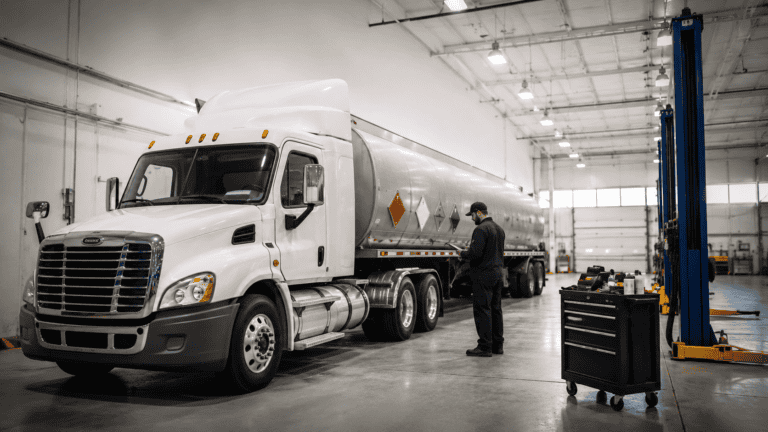
Quick answer: Yes. Any commercial vehicle that transports hazardous materials in a type or quantity requiring placards must pass a DOT annual inspection under 49 CFR 396.17, and this applies regardless of the vehicle’s weight. A small truck that would otherwise be under the 10,001 pound threshold still needs the annual inspection if it carries placarded hazmat. On top of that, the people who handle that hazmat must be trained under 49 CFR 172.704. Hazmat carriers carry two separate compliance obligations: the vehicle gets inspected, and the employee gets trained.
If you haul hazardous materials, you are holding two compliance cards at once, and a lot of operators only know about one of them. The truck has to pass an annual safety inspection. The employee handling the hazmat has to be trained. They come from two different parts of the federal rules, they run on different clocks, and an auditor will check both. This guide explains exactly what a hazmat carrier owes on each side, and the one fact that catches the most people off guard.
About the author: Josh Lopez has spent more than 10 years in the trucking and freight industry, working across shippers, carriers, brokerage, and reefer LTL. He writes about DOT compliance, FMCSA regulations, and commercial vehicle inspection to help mechanics, owner-operators, and fleet managers understand the rules that govern their operations and stay compliant on the road.
Do placarded hazmat vehicles need a DOT annual inspection?
Yes. A vehicle transporting hazardous materials in a type or quantity that requires placarding is a commercial motor vehicle subject to the annual periodic inspection under 49 CFR 396.17. The placard requirement alone brings the vehicle into scope. It does not matter how much the vehicle weighs. This is the part that surprises people. Most operators know the annual inspection applies to trucks rated at 10,001 pounds or more. They assume a lighter vehicle is exempt. But the rule has three separate triggers, and placarded hazmat is its own trigger, independent of weight. So a delivery van well under 10,001 pounds that carries placarded hazardous materials still needs a full annual inspection. The hazmat puts it in scope on its own.What triggers the DOT annual inspection requirement?
Under 49 CFR 396.17, a commercial motor vehicle must pass a periodic inspection at least once every 12 months if it meets any one of these triggers:- Weight: a gross vehicle weight rating, gross combination weight rating, or actual weight of 10,001 pounds or more.
- Hazmat: transporting hazardous materials in a type or quantity that requires placarding under 49 CFR Part 172, at any weight.
- Passengers: designed to carry more than 8 passengers including the driver for compensation, or more than 15 including the driver whether or not for compensation.
Does a hazmat truck get inspected differently from a regular truck?
No. The annual inspection itself covers the same components for every commercial motor vehicle. It is a measured, pass-or-fail check against the minimum standards in Appendix A to Part 396, brakes, steering, suspension, frame, tires and wheels, lighting, coupling devices, fuel system, exhaust, and the rest. The hazmat status changes whether the inspection is required, not what the inspection examines. In a combination vehicle, each unit is inspected separately. A tractor pulling a placarded tank trailer needs both the tractor and the trailer inspected individually. One inspection does not cover the whole rig.Who can perform the annual inspection on a hazmat vehicle?
The inspection must be performed by a qualified inspector who meets 49 CFR 396.19. That qualification standard is the same for hazmat vehicles as for any other commercial vehicle. The carrier can use its own qualified in-house inspector, a commercial garage or truck stop acting as its agent that employs qualified inspectors, or a qualifying state inspection program. For a hazmat fleet, qualifying an in-house inspector under 396.19 is often the smart move. You stop paying an outside shop per truck, you control your own inspection paperwork, and you can keep your placarded units in service without scheduling around a vendor. The annual inspection is the rule that creates the need; inspector qualification under 396.19 is how you meet it on your own equipment. We cover the requirement itself in detail in our guide to 49 CFR 396.17 and the inspector qualification standard in our guide to FMCSA 396.19.What about hazmat employee training? Is that the same thing?
No, and this is the second compliance card hazmat carriers hold. The annual inspection is about the vehicle. Hazmat employee training is about the person. They are completely separate obligations under different parts of the federal rules, and you owe both. Under 49 CFR 172.704, every hazmat employee must be trained. A hazmat employee is anyone whose job affects the safe transportation of hazardous materials, which includes drivers who transport placarded loads, and the people who load, unload, handle, or prepare hazmat for shipment. The training has required components: general awareness, function-specific training matched to the person’s actual duties, safety training, and security awareness training. Our DOT Hazmat Training course covers all of these required components for highway carriers, with the employer documentation and training record built in. So a hazmat carrier running placarded trucks has to keep the vehicles inspected under 396.17 and the employees trained under 172.704. An auditor will ask for both. Passing your annual inspections does nothing for your training obligation, and trained employees do nothing for your inspection obligation. Two cards, both required.How often is hazmat employee training required?
Hazmat training runs on two clocks under 49 CFR 172.704. A new hazmat employee, or one who changes job functions, must complete training within 90 days. Until that training is done, they may perform hazmat functions only under the direct supervision of a properly trained employee. After the initial training, recurrent training is required at least once every three years. There is also a recordkeeping rule that catches employers off guard. The training record must be kept for as long as the person is employed as a hazmat employee, plus 90 days after they leave. The employer is responsible for the record and must produce it on demand for an authorized official.Does a hazmat CDL endorsement count as hazmat employee training?
No. This is the single biggest misconception in hazmat compliance. A hazmat CDL endorsement is a driver licensing credential earned by passing a state knowledge test. Hazmat employee training under 172.704 is a separate employer obligation covering the required training components for the employee’s function. Holding the endorsement does not satisfy the 172.704 training requirement, and the employer still has to provide and document that training. If you run hazmat and your only “training” on file is that your drivers have the endorsement, you have a documentation gap. The endorsement is on the driver’s license. The 172.704 training is on the employer.What happens if a hazmat carrier misses either requirement?
Missing the annual inspection subjects the carrier to the federal penalty provisions of 49 U.S.C. and can put the vehicle out of service at the roadside, which strands the load. Missing or failing to document hazmat training exposes the employer to significant civil penalties, hazmat violations carry some of the steepest fines in the federal system. Both feed into your safety profile and your audit risk. The practical reality for hazmat carriers is that you are a bigger audit target than a general freight carrier, because you carry two obligations instead of one and the cargo is higher risk. Treating both the inspection and the training as real, documented, on-demand requirements is what keeps placarded equipment moving and keeps an audit from turning into penalties.What hazmat carriers should do
If you run placarded hazmat, build your compliance around both cards. On the vehicle side, make sure every placarded unit passes its annual inspection under 396.17 and that the inspector is qualified under 396.19, ideally an inspector you control in-house. On the employee side, make sure every hazmat employee is trained under 172.704 within the 90-day window, retrained on the three-year cycle, and that the records are on file. The inspection side is the one you can bring in-house today and stop outsourcing. Our DOT Annual Inspection Training course qualifies mechanics and owner-operators as annual inspectors under 396.19, so you can legally perform 396.17 inspections on your own equipment, including your placarded hazmat units. For a hazmat fleet running multiple trucks and trailers, qualifying your own inspector usually pays for itself well inside the first year. For the employee training side, our DOT Hazmat Training course covers the 172.704 requirements for highway carriers: general awareness, function-specific, safety, and security awareness training, delivered online and self-paced, with the certificate and the employer training record done for you. Between the two courses, you can cover both compliance cards, the inspection on your vehicles and the training on your people, in-house.Hazmat inspection and training frequently asked questions
Do hazmat vehicles need a DOT annual inspection? Yes. Any vehicle carrying hazardous materials in a quantity requiring placards must pass an annual inspection under 49 CFR 396.17, regardless of the vehicle’s weight. Does the annual inspection apply to a hazmat vehicle under 10,001 pounds? Yes. Placarded hazmat is its own trigger for the annual inspection, independent of the weight threshold. A lighter vehicle carrying placarded hazmat still needs the inspection. Is hazmat employee training the same as the annual inspection? No. The annual inspection (396.17) covers the vehicle. Hazmat employee training (172.704) covers the person. They are separate obligations and a hazmat carrier owes both. Does a hazmat CDL endorsement satisfy 172.704 training? No. The endorsement is a driver licensing credential. The 172.704 training is a separate employer obligation that must be provided and documented regardless of the endorsement. Our DOT Hazmat Training course provides and documents that training for highway carriers. How often is hazmat employee training required? New hazmat employees must be trained within 90 days, and all hazmat employees must be retrained at least once every three years under 49 CFR 172.704. Who can perform the annual inspection on a hazmat truck? A qualified inspector meeting 49 CFR 396.19, whether an in-house inspector, a commercial shop acting as the carrier’s agent, or a qualifying state program.About the author: Josh Lopez has spent more than 10 years in the trucking and freight industry, working across shippers, carriers, brokerage, and reefer LTL. He writes about DOT compliance, FMCSA regulations, and commercial vehicle inspection to help mechanics, owner-operators, and fleet managers understand the rules that govern their operations and stay compliant on the road.