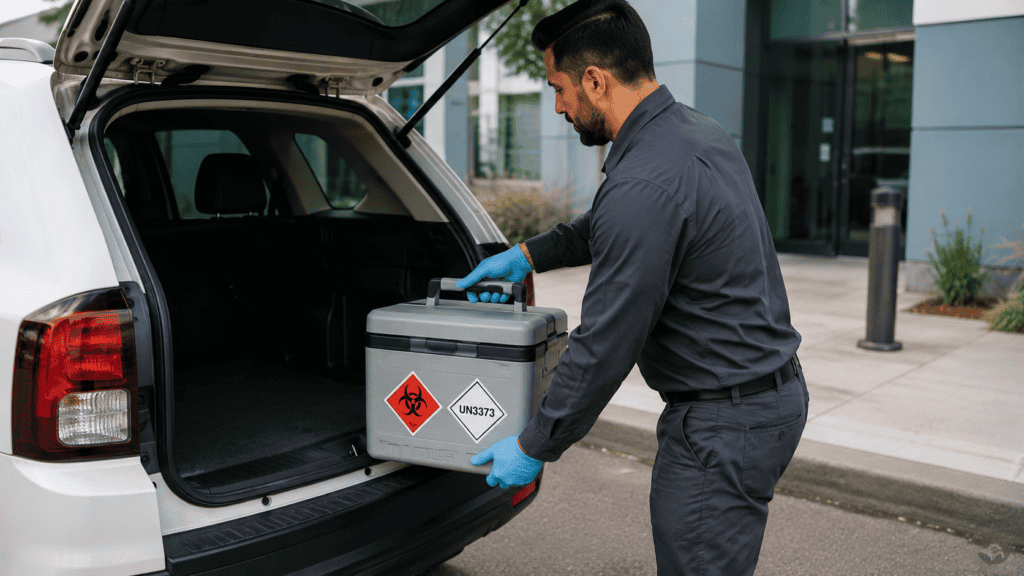
Quick Answer: Yes, in most cases medical couriers need DOT hazmat training. If you transport diagnostic specimens or lab samples classified as Category B infectious substances (UN3373), or you use dry ice to keep them cold, you are handling materials regulated under the U.S. Hazardous Materials Regulations, and 49 CFR 172.704 requires training. That training covers general awareness, function-specific handling, safety, and security awareness. One important note: DOT hazmat training is separate from OSHA Bloodborne Pathogens training, which many medical couriers also need. This guide explains exactly when the DOT requirement applies and what it covers.
Medical couriers are one of the most overlooked groups when it comes to hazmat rules. If you drive lab specimens, blood samples, or diagnostic materials between clinics, hospitals, and labs, you may be a “hazmat employee” under federal law without realizing it. Here’s a clear breakdown of when DOT hazmat training is required, what it covers, and how it differs from the other training couriers often need.
Do Medical Couriers Need DOT Hazmat Training?
In most cases, yes. Here’s why: the materials medical couriers routinely carry, diagnostic specimens and lab samples, are frequently classified as Category B infectious substances under the Hazardous Materials Regulations, assigned the identifier UN3373. These are regulated hazardous materials.
Under 49 CFR 172.704, any person who directly affects the safe transportation of hazardous materials must be trained. A courier who packages, handles, loads, or transports UN3373 specimens directly affects transportation safety, which makes them a hazmat employee subject to the training requirement.
On top of the specimens themselves, many couriers use dry ice to keep samples frozen or cold. Dry ice is its own hazardous material (Class 9), so using it to transport specimens is a second, independent trigger for hazmat training even beyond the specimens.
What Is a Category B Infectious Substance (UN3373)?
A Category B infectious substance is an infectious substance that does not meet the stricter criteria for Category A. In plain terms, it’s the routine stuff medical couriers carry every day: blood samples, most lab specimens, diagnostic samples, and similar human or animal materials being transported for diagnosis or investigation.
These are assigned to UN3373 and marked “Biological Substance, Category B.” The vast majority of medical courier work involves Category B materials, not Category A.
Category A is different and more serious. Category A covers substances capable of causing permanent disability or life-threatening disease in otherwise healthy people, think Ebola-level pathogens, and those are assigned to UN2814 or UN2900 with far more stringent handling requirements. Most couriers never touch Category A, but it’s worth knowing the line exists, because the classification determines everything about how the material is handled and what training applies.
What Does DOT Hazmat Training Cover for Couriers?
Under 49 CFR 172.704, hazmat training for someone transporting Category B substances must include these components:
General awareness/familiarization. Understanding the Hazardous Materials Regulations framework and being able to recognize and identify hazardous materials, including how to read the labels and markings.
Function-specific training. The specific procedures for the job the courier actually does, for couriers, this centers on handling Division 6.2 infectious substances: proper packaging, the UN3373 marking, and dry ice handling if used.
Safety training. How to protect yourself, emergency response if there’s a spill or leak, and accident-avoidance procedures.
Security awareness training. Recognizing and responding to potential security threats involving the materials being transported.
These are the same four core components required of any hazmat employee, applied to the specific reality of moving specimens and dry ice.
The Triple Packaging Requirement
One of the most important function-specific pieces couriers must understand is the packaging. Under 49 CFR 173.199, Category B substances must use a triple packaging system:
A leak-proof primary receptacle (the vial or container holding the specimen), a leak-proof secondary packaging with absorbent material, and a rigid outer packaging marked with the UN3373 diamond and “Biological Substance, Category B.” If dry ice is used, additional requirements apply so the carbon dioxide gas can vent safely.
Understanding this system is part of the function-specific training, and getting it wrong is one of the most common ways couriers and the labs that use them fall out of compliance.
DOT Hazmat vs. OSHA Bloodborne Pathogens: They’re Not the Same
This is the point that trips up couriers and even the companies that hire them, so let’s be clear about it.
DOT hazmat training (49 CFR 172.704) is about transportation safety, protecting the public and emergency responders if there’s a crash or spill while the material is being moved. That’s the training we’ve been describing, and it’s what applies because you’re transporting a regulated material.
OSHA Bloodborne Pathogens training is a separate requirement, under OSHA (29 CFR 1910.1030), about protecting the worker from exposure to bloodborne pathogens they may handle. Many medical couriers need this too, because they handle specimens that may contain infectious material.
These are two different rules from two different agencies covering two different risks. A courier who handles blood specimens and drives them to a lab may need both. Completing one does not satisfy the other. Any provider who tells you a single course covers “everything” is glossing over this distinction, and it’s exactly the kind of thing an auditor or a well-run lab will check.
Who Is Responsible for the Training?
The hazmat employer. Under 172.704, it’s the employer’s responsibility to ensure each hazmat employee is trained, tested, and has a current training record. For a courier company, that means the company must ensure its drivers are trained. For an independent courier contracting with labs, you may effectively be responsible for your own compliance, and the labs you serve will often ask for proof before they hand you their specimens.
Recurrent training is required at least every three years, and the training record must be kept for as long as the person is employed as a hazmat employee, plus 90 days.
How Often Do Medical Couriers Need to Retrain?
The same recurrent cycle applies as any other hazmat employee: at least once every three years under 172.704. New couriers must be trained within 90 days of starting, and may work under the supervision of a trained employee until then. If the regulations change significantly, retraining on the new rules is required within 90 days. We cover the full schedule in our guide on how often hazmat training is required.
Get DOT Hazmat Trained as a Medical Courier
If you transport Category B specimens or use dry ice, the DOT hazmat training requirement under 172.704 applies to you, and being able to show a training certificate is increasingly what labs and courier companies ask for before they’ll work with you.
Our DOT Hazmat Training covers the 172.704 requirements, general awareness, function-specific handling, safety, and security awareness, and issues a certificate of completion documenting your training for your records. It’s 100% online and self-paced, so you can complete it around your route. You can view the course and enroll here.
One honest note, because it matters for your compliance: our course covers the DOT hazmat side (49 CFR 172.704). If your role also requires OSHA Bloodborne Pathogens training, that’s a separate certification you’ll need to obtain in addition. We’d rather tell you that up front than have you think one course covers a requirement it doesn’t.
Frequently Asked Questions
Do medical couriers need DOT hazmat training?
In most cases, yes. If you transport diagnostic specimens or lab samples classified as Category B infectious substances (UN3373), or use dry ice to keep them cold, you’re handling regulated hazardous materials, and 49 CFR 172.704 requires training.
What is UN3373?
UN3373 is the identifier for Category B infectious substances, the routine diagnostic specimens, blood samples, and lab materials most medical couriers carry. Packages are marked “Biological Substance, Category B” with the UN3373 diamond.
Is dry ice regulated for medical couriers?
Yes. Dry ice is a Class 9 hazardous material. If you use it to keep specimens cold during transport, that independently triggers hazmat handling and training requirements, on top of the specimens themselves.
Is DOT hazmat training the same as Bloodborne Pathogens training?
No. DOT hazmat training (49 CFR 172.704) covers transportation safety. OSHA Bloodborne Pathogens training (29 CFR 1910.1030) covers protecting the worker from exposure. They’re separate requirements from separate agencies, and many couriers need both. One does not satisfy the other.
How often do medical couriers need hazmat training?
Recurrent training is required at least every three years under 172.704. New couriers must be trained within 90 days of starting and may work under supervision until then.
Who is responsible for a courier’s hazmat training?
The hazmat employer must ensure each employee is trained, tested, and has a current record. Independent couriers may be responsible for their own compliance, and the labs they serve often require proof of training before handing over specimens.
The Bottom Line
If you’re a medical courier moving Category B specimens or using dry ice, DOT hazmat training under 49 CFR 172.704 almost certainly applies to you, even if nobody has told you so. It covers how to recognize, handle, package, and safely transport the materials, and it’s increasingly required before labs and courier companies will work with you. Just remember it’s the DOT piece, and OSHA Bloodborne Pathogens training is a separate requirement you may also need.
Get the DOT hazmat side handled, keep your training record current on the three-year cycle, and you’re compliant on the transportation side of the job.
Josh Lopez has spent more than 10 years in the trucking and freight industry, working across shippers, carriers, brokerage, and reefer LTL. He writes about DOT compliance, FMCSA and PHMSA regulations, and safe transport of regulated materials to help drivers, couriers, and carriers stay compliant on the road.